Habitat
 Depth
 Group
 Role
 Average size
 Precautions
WHAT DOES IT LOOK LIKE?
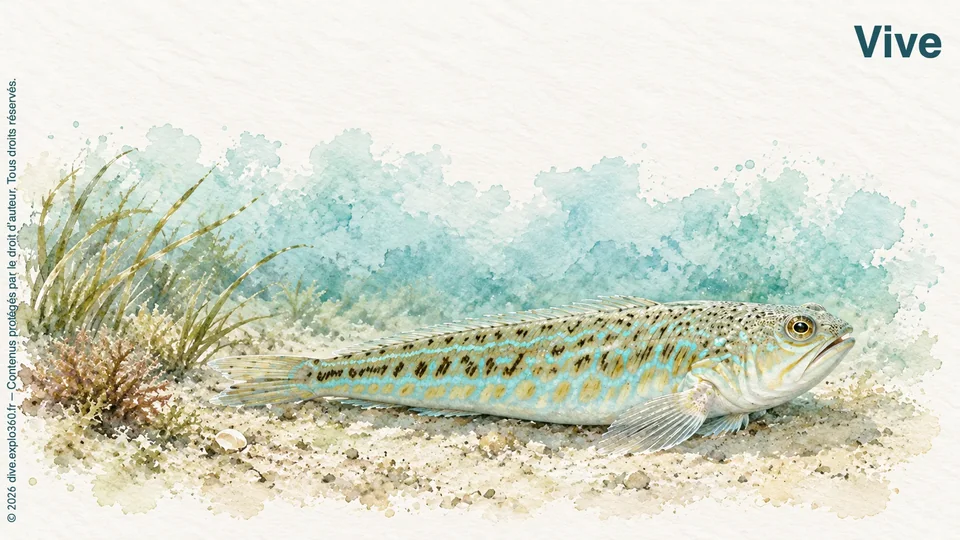
A small black first dorsal fin along the back adds detail to the greater weever (Trachinus draco). A long second fin extends behind this spiny triangle.
The elongated body has a beige-brown back and paler sides streaked diagonally with blue and yellow. Close-set eyes on top of the head and an upturned mouth shape the front profile.
WHERE DOES IT LIVE?
It lives on sandy or muddy seabeds, where it spends much of its time buried, leaving only its eyes and mouth showing.
WHAT DOES IT EAT?
The greater weever is often seen motionless and almost buried, yet feeding is not confined to this posture. It also swims freely at night in search of animals. Crustaceans and small fishes dominate, with molluscs and worms as additional foods. Analyses from the Gulf of Tunis show a change with growth: smaller fish chiefly eat crustaceans, larger ones more fishes. The buried fish and the nocturnal swimmer are two aspects of the same predator.
GO FURTHER WITH AMIGANSEAU
Unlock the full profile
Deepen your knowledge with the exclusive chapters and interactive resources included in an AMIGANSEAU licence.
Subscribing to Dive.Explo360 means supporting a different way to discover marine life.
Our independent platform is entirely self-funded and relies solely on subscriptions. Every licence helps us continue our work, create new content, and share what we know about the marine world with as many people as possible.
Starting at €80 per year, your support makes all the difference.
 Understand the species