


 Habitat
 Depth
 Group
 Role
 Average size
WHAT DOES IT LOOK LIKE?
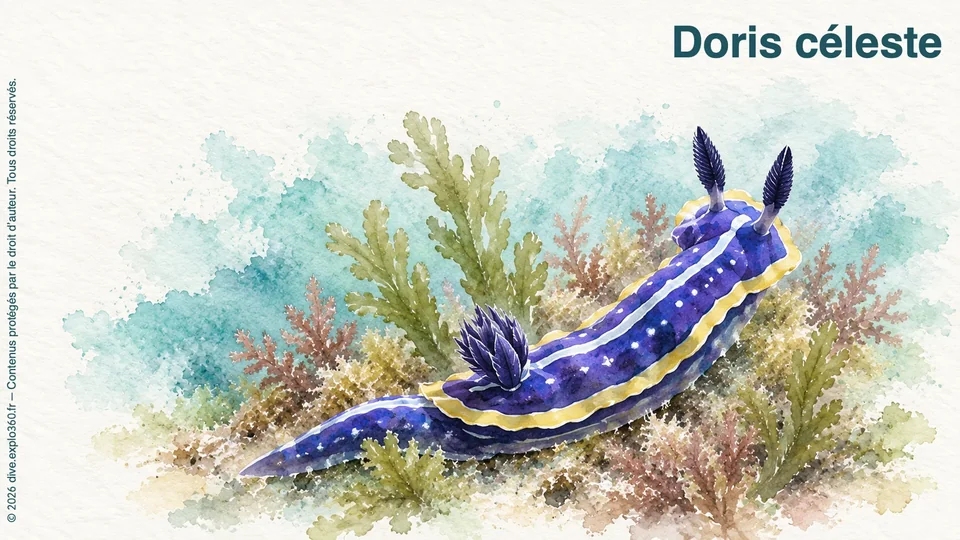
Between the two head projections and the feathery rear tuft, a thin white line divides the back of the celestial doris (Felimare orsinii). The body is intensely blue, edged with a white or yellow line.
The rhinophores, the upright head projections, have rings and remain entirely blue, as do the gills, the plumes gathered at the rear. Other sea slugs have comparable blue colouring: the blue ringed appendages add to the details of the back.
WHERE DOES IT LIVE?
It is mainly found on rocky seabeds, drop-offs and areas rich in attached life. It is closely associated with sponges, over which it moves and on which it depends for food. It generally lives between a few metres and around fifty metres deep.
WHAT DOES IT EAT?
The celestial sea slug feeds on sponges attached to rocks. It moves slowly over their surface and removes small pieces of tissue using its radula, a ribbon bearing tiny teeth inside its mouth. Its feeding movements are subtle: the head stays in contact with the sponge as it removes the tissue it eats.
GO FURTHER WITH AMIGANSEAU
Unlock the full profile
Deepen your knowledge with the exclusive chapters and interactive resources included in an AMIGANSEAU licence.
- HOW DOES IT REPRODUCE?
- OUR OBSERVATIONS
- ARTICLE
Also included in the full profile
- Advanced navigation between description, ecological context, observations and behaviour
- Interactive food chain to explore the species’ feeding relationships
- Infographic and illustrated summary profile

 Understand the species