


 Habitat
 Depth
 Group
 Role
 Average size
WHAT DOES IT LOOK LIKE?
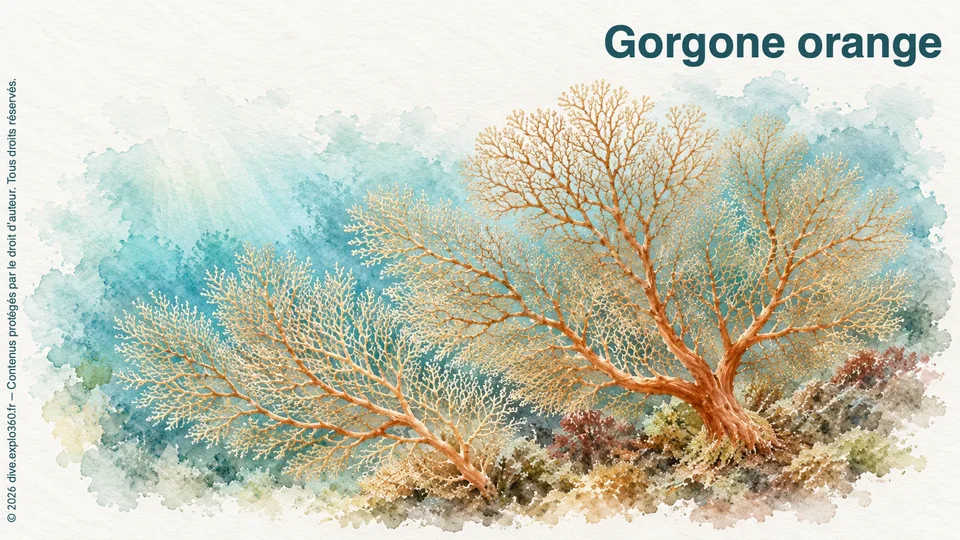
The tapering twigs of the orange gorgonian (Leptogorgia sarmentosa) extend from a few main branches. Fine and flexible, they give the fan a slightly bushy appearance.
Colonies are often orange, but colour may be yellow, pink or red. The polyps, the small animals carried by the twigs, add subtle relief to this delicate framework.
WHERE DOES IT LIVE?
It is mainly encountered in the Mediterranean on soft or detrital seabeds, but also near rocky areas. It attaches to hard objects such as pebbles or shell debris buried in the sediment, generally at intermediate to considerable depths.
WHAT DOES IT EAT?
The orange gorgonian’s slender branches carry very small polyps. With their tentacles extended, they intercept organic material carried by the water, including planktonic organisms. Food arrives with the flow as scattered particles. Inside the colony, channels linking the polyps allow nutrients to circulate, so food caught at one point can contribute beyond that individual. The tiny crowns extending around the branches reveal the feeding surface.
GO FURTHER WITH AMIGANSEAU
Unlock the full profile
Deepen your knowledge with the exclusive chapters and interactive resources included in an AMIGANSEAU licence.
- HOW DOES IT REPRODUCE?
- OUR OBSERVATIONS
- ARTICLE
Also included in the full profile
- Advanced navigation between description, ecological context, observations and behaviour
- Interactive food chain to explore the species’ feeding relationships
- Infographic and illustrated summary profile
 Understand the species