


 Habitat
 Depth
 Group
 Role
 Average size
WHAT DOES IT LOOK LIKE?
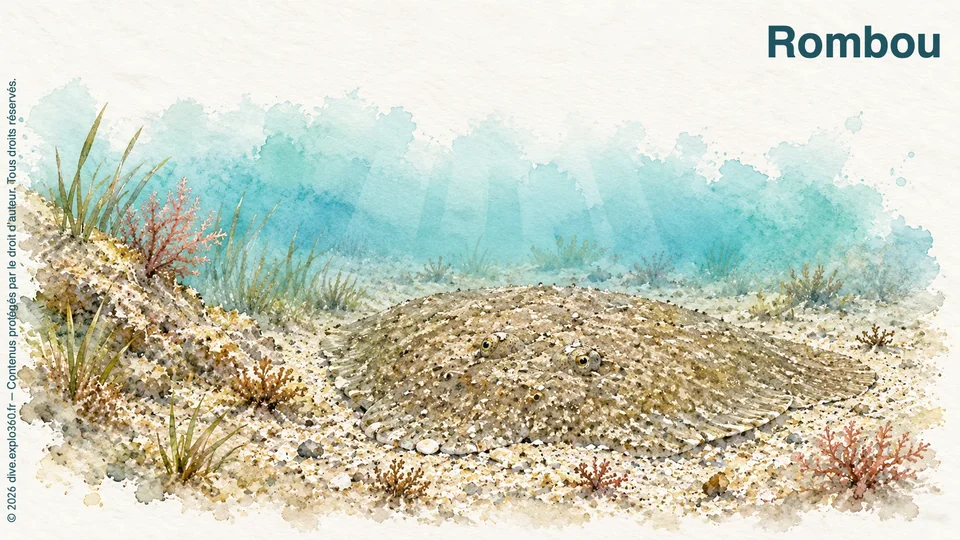
Widely spaced eyes distinguish the wide-eyed flounder (Bothus podas), especially in males. Both projecting eyes sit on the left side, one far forward near the mouth, above a broad and strongly flattened body.
Males have a fairly straight front profile, while females show a rounder outline. Long fins edge the body; the spotted upper side varies from beige to brown, while the lower side remains white.
WHERE DOES IT LIVE?
It mainly lives on soft seabeds such as sand or detrital areas, from shallow water down to several tens of metres. It spends most of its time motionless on the bottom, sometimes partly buried.
WHAT DOES IT EAT?
The wide-eyed flounder obtains much of its food from small mobile benthic crustaceans. Amphipods, isopods and cumaceans are important in Mediterranean digestive analyses. Worms, molluscs and small fish broaden the menu. Resources change among sites and seasons, and the fish uses prey available in its foraging area. Studies describe it as an active opportunistic predator. Although it is often seen on sand, it does not always lie still waiting for prey. Much of its recorded diet consists of small, mobile animals.
GO FURTHER WITH AMIGANSEAU
Unlock the full profile
Deepen your knowledge with the exclusive chapters and interactive resources included in an AMIGANSEAU licence.
Subscribing to Dive.Explo360 means supporting a different way to discover marine life.
Our independent platform is entirely self-funded and relies solely on subscriptions. Every licence helps us continue our work, create new content, and share what we know about the marine world with as many people as possible.
Starting at €80 per year, your support makes all the difference.
 Understand the species