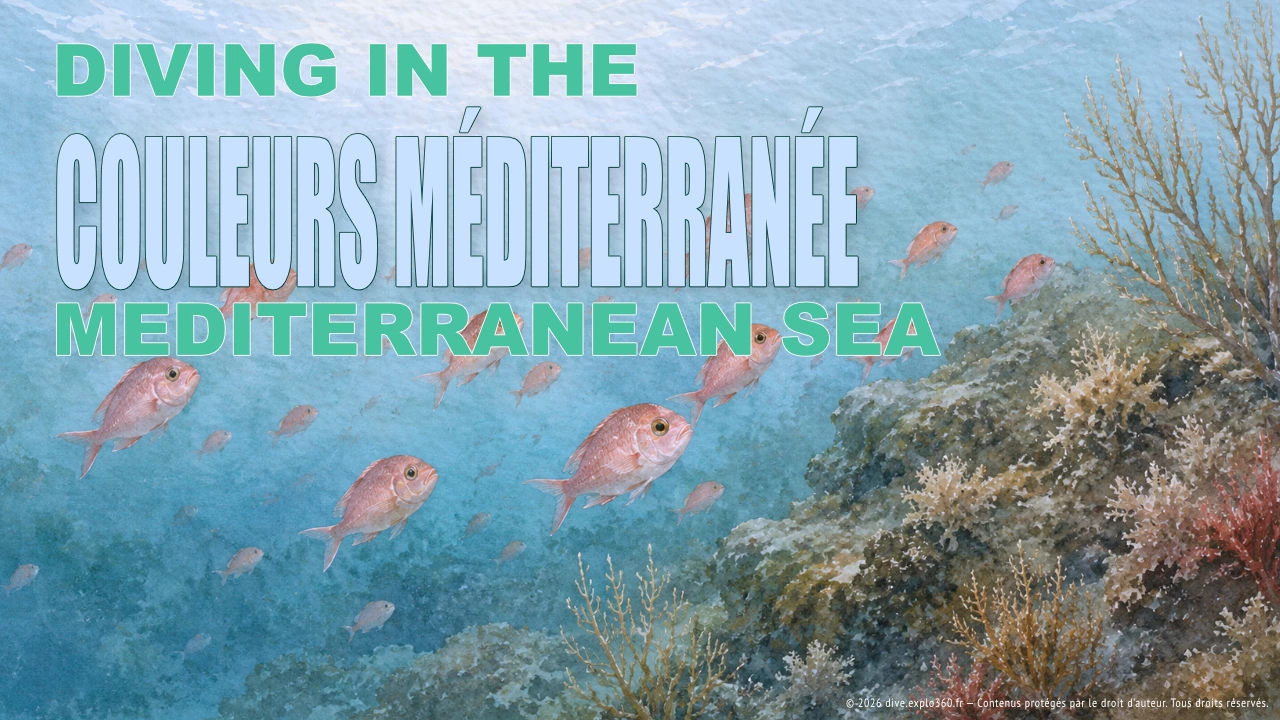

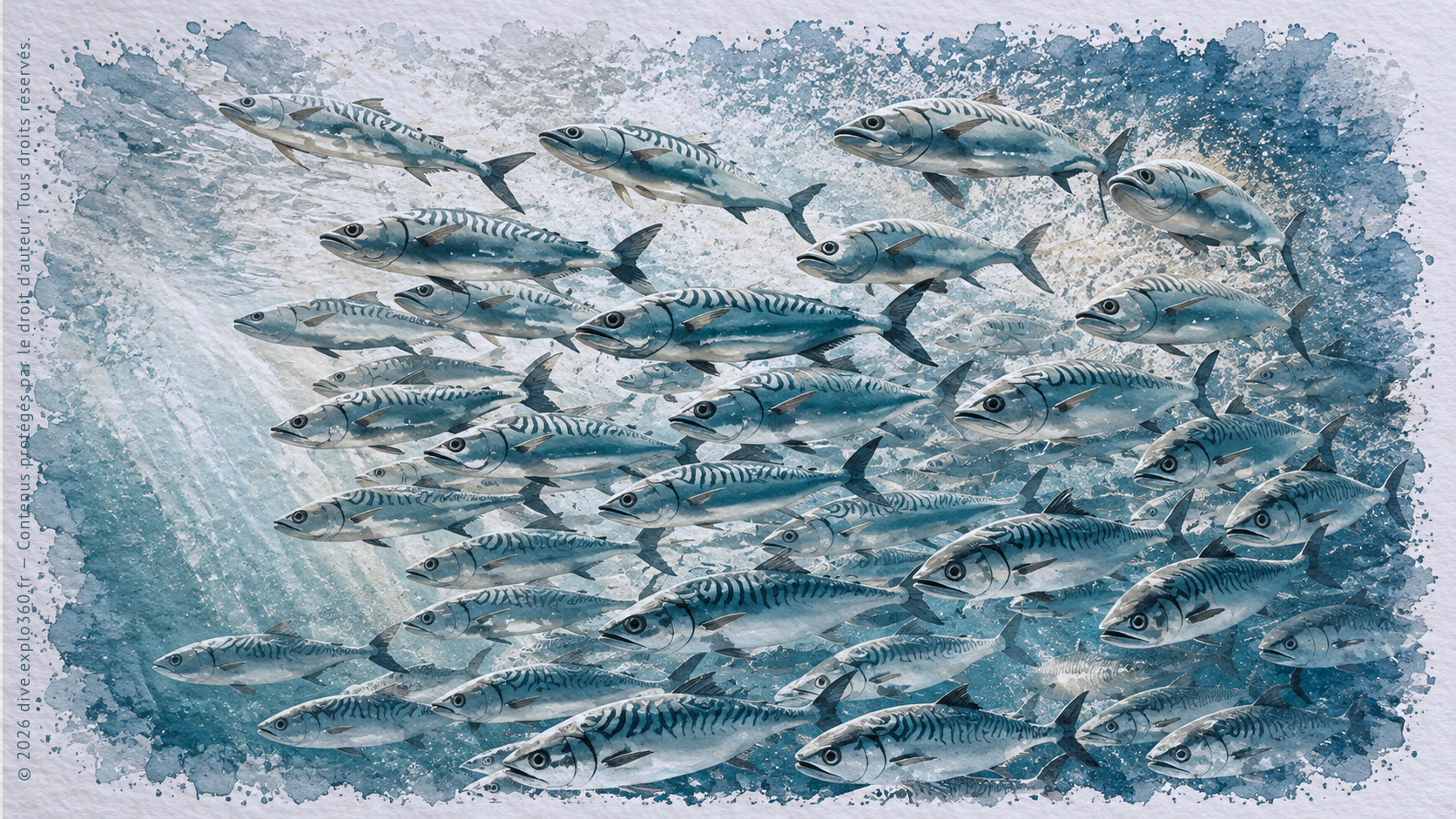
School of fish
Moving in a school can contribute to protection against predators, searching for food and reproduction. © dive.explo360.fr — All rights reserved. Reproduction prohibited without permission.
Grouping together is an advantageous strategy for many species.
1

Protection

When facing a predator, belonging to a large group can reduce an individual’s risk of being caught. The predator must choose a target among many fish moving simultaneously.

The school’s rapid changes of direction can also make it harder to track one individual: this is the confusion effect.

2

Searching for food

A group has many individuals capable of detecting a food resource.

When a food source is discovered, the behaviour of the first fish can provide information to other group members.

3

Reproduction

Grouping increases opportunities to meet mates. In some species, large gatherings appear particularly during breeding periods.
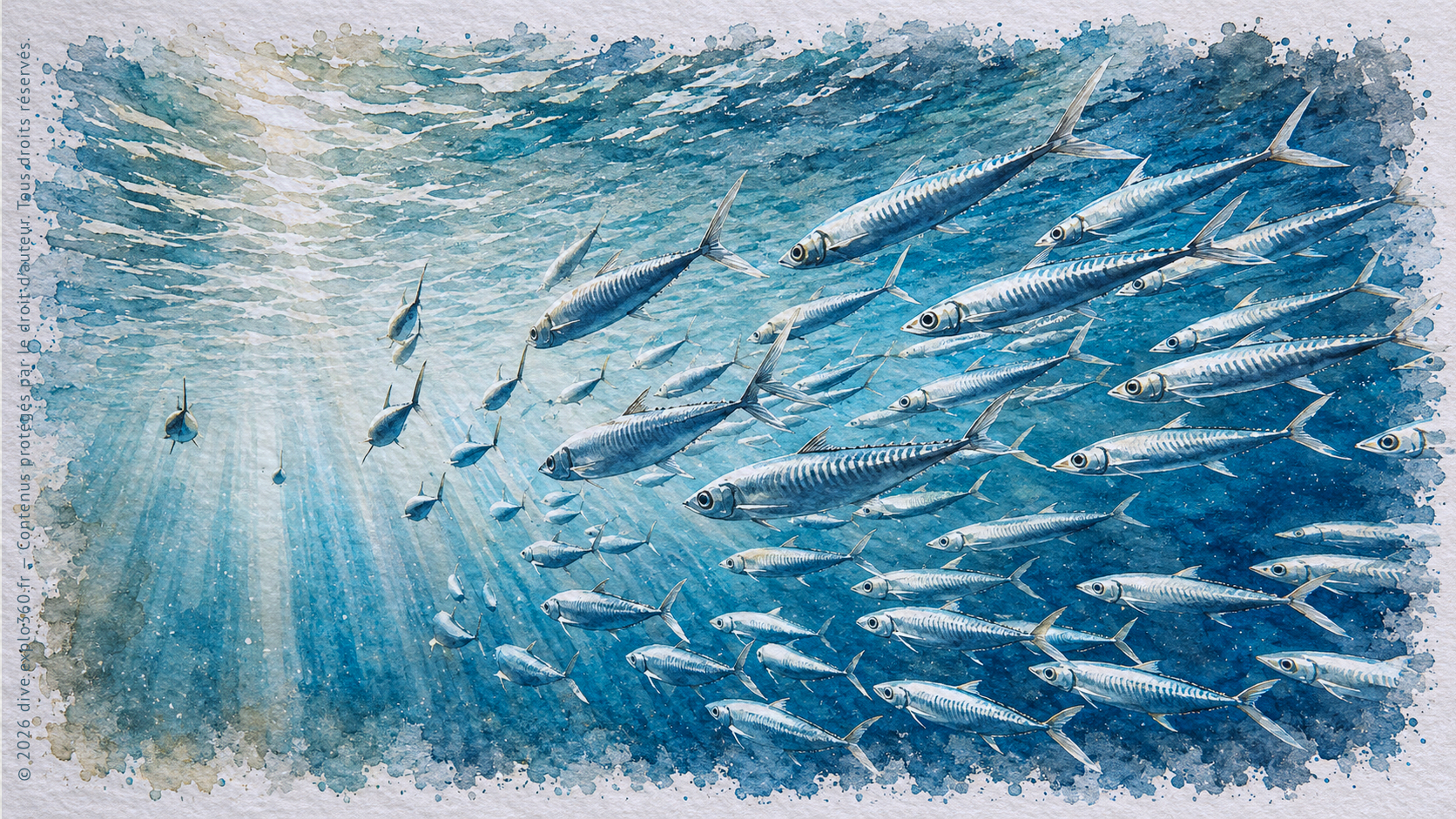
A school of fish fleeing
© dive.explo360.fr — All rights reserved. Reproduction prohibited without permission.
A school can change shape according to the fish’s movements, their environment or the presence of a predator.

These shapes are therefore not necessarily permanent: the group can reorganise quickly.

In a vortex, fish swim in a rotating arrangement.

During an attack, this collective movement can make it harder for a predator to track an individual.

This formation can be observed particularly in social fish such as sardines or herring.

Vortex
The vortex: a rotating movement of the school that can make selecting prey harder for a predator. © dive.explo360.fr — All rights reserved. Reproduction prohibited without permission.
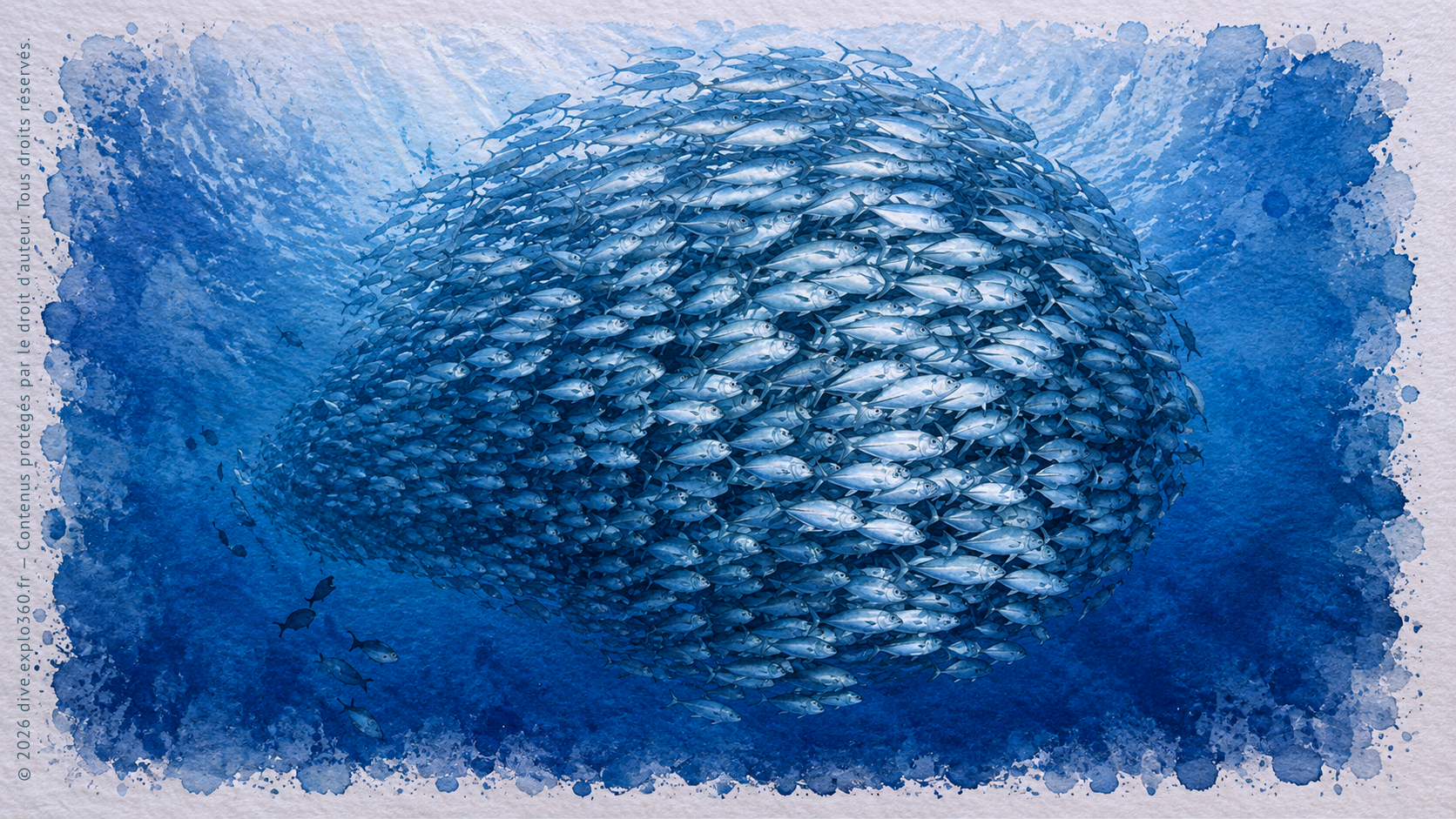
Ball
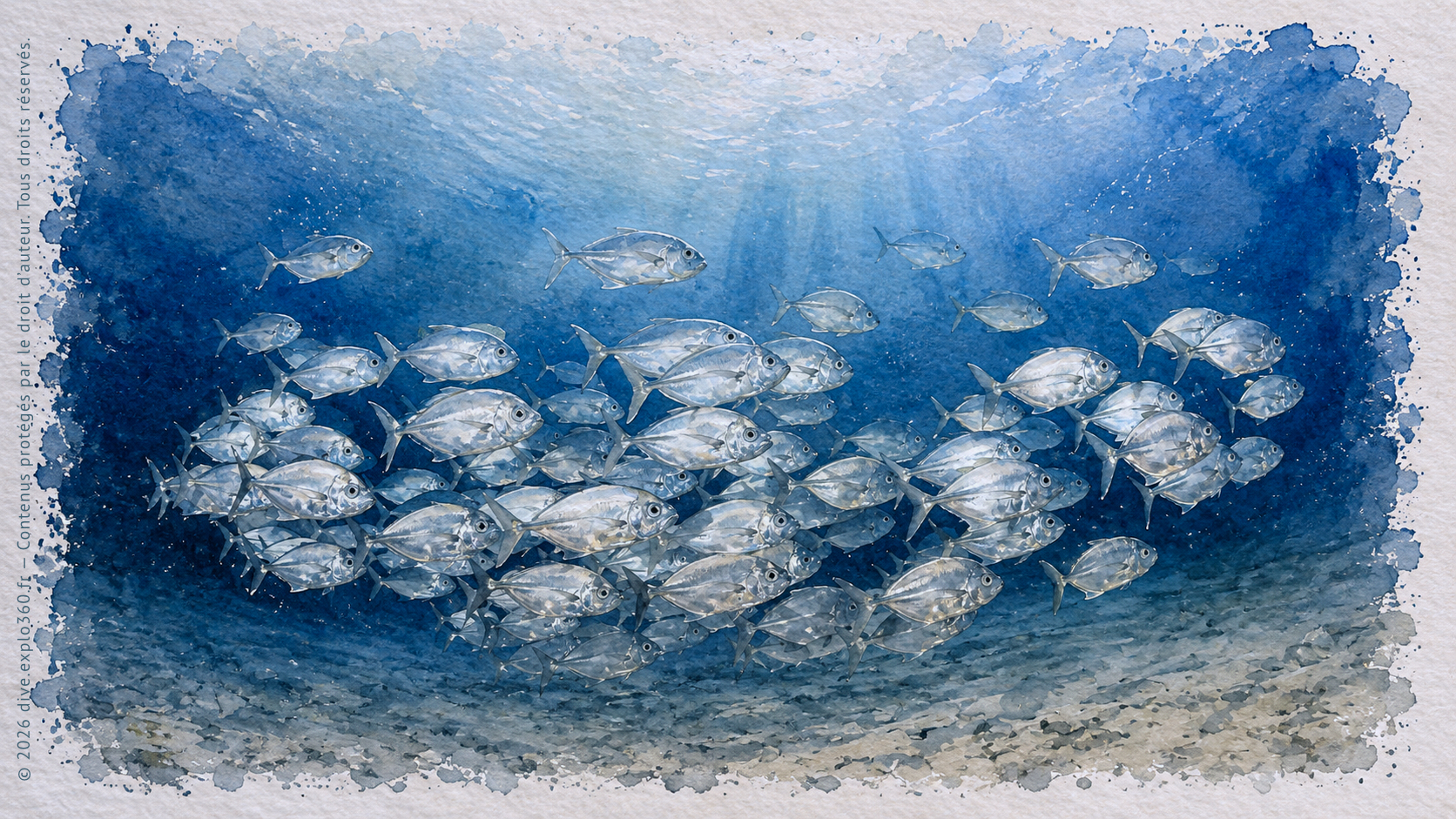
The ball: fish gather in a very compact formation when threatened. © dive.explo360.fr — All rights reserved. Reproduction prohibited without permission.
When threatened, some schools become very compact.

The fish then form a dense mass called a ball. Grouping changes how the predator can attack the school, although individuals on the edge remain particularly exposed.

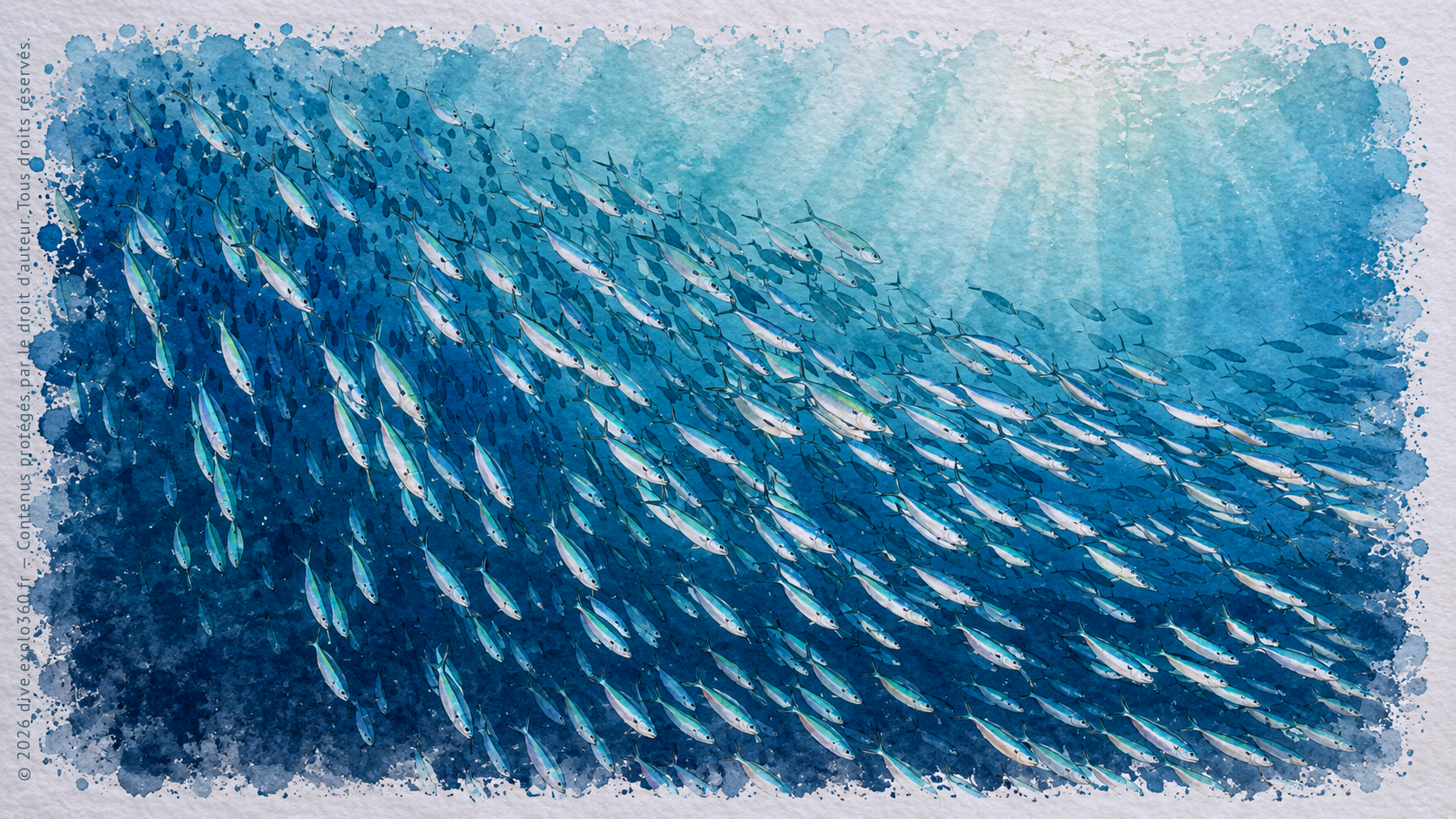
Fish can also move in an elongated formation.

This arrangement allows the group to cover a large area and may be used when travelling or searching for food.
Linear school
The linear school: an elongated formation suited to collective movement. © dive.explo360.fr — All rights reserved. Reproduction prohibited without permission.
Fountain
The fountain: the school’s paths trace an upward and then downward movement. © dive.explo360.fr — All rights reserved. Reproduction prohibited without permission.
In this formation, part of the school rises and then changes direction, giving the collective movement a fountain-like shape.

The article particularly associates this arrangement with searching for and catching small prey.

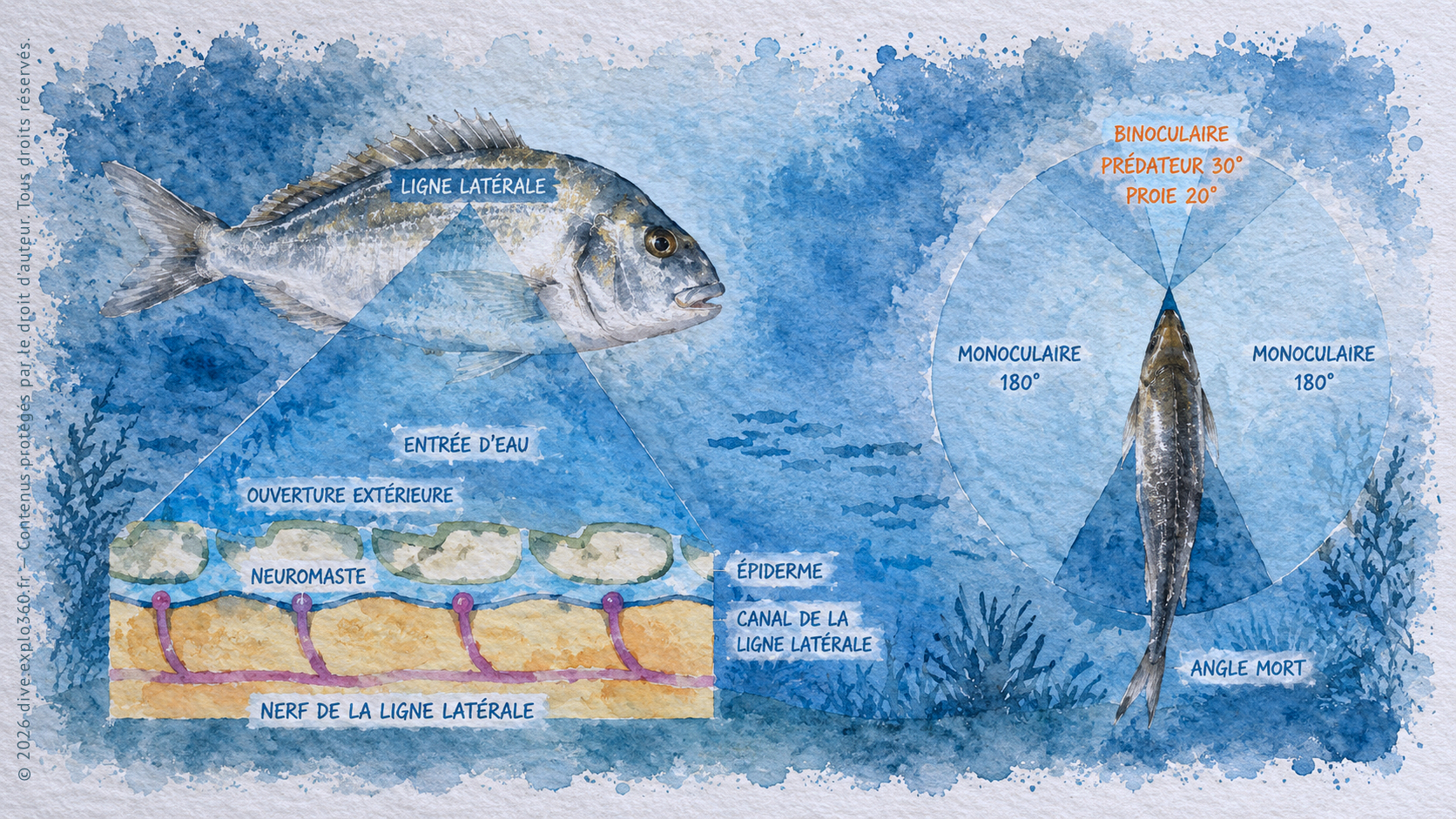
Fish use their vision, in particular, to identify their neighbours’ positions and movements.

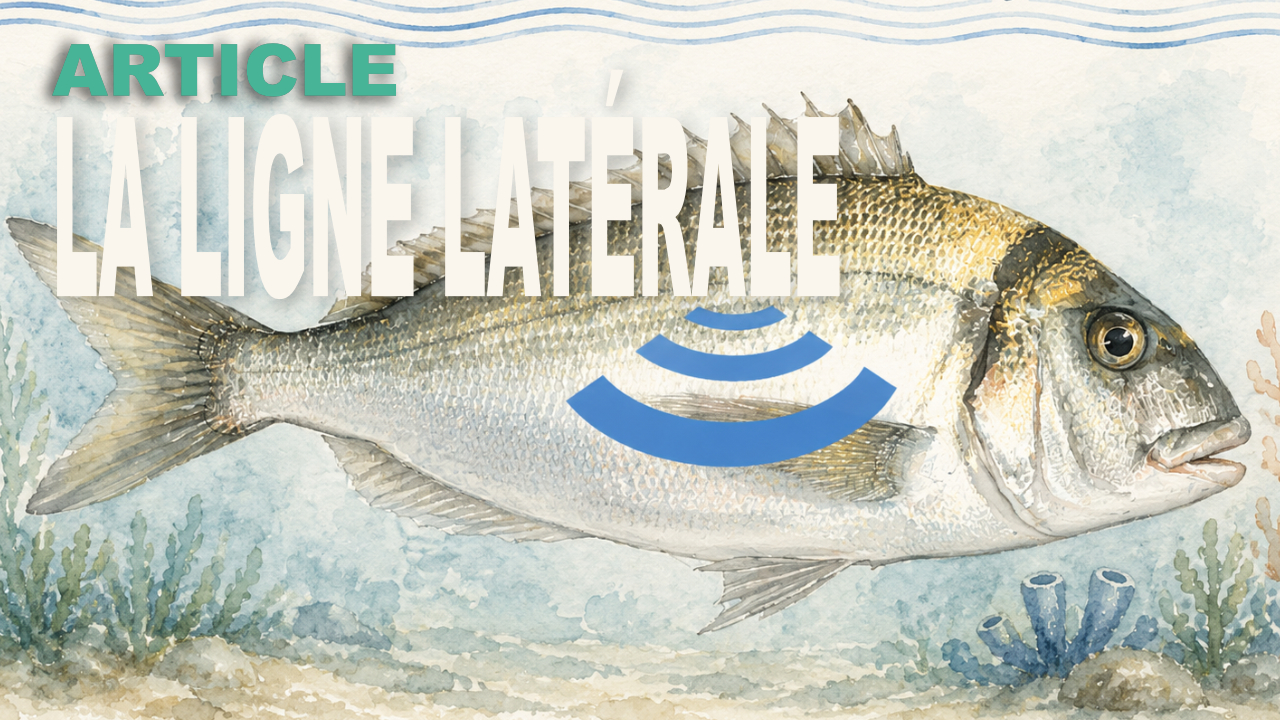
They also have a lateral line, a sensory system able to detect water movements and mechanical changes produced around them.

This information allows each fish to adjust its movement quickly.
Lateral line and vision
Vision and the lateral line provide information about neighbouring fish’s positions and movements. © dive.explo360.fr — All rights reserved. Reproduction prohibited without permission.
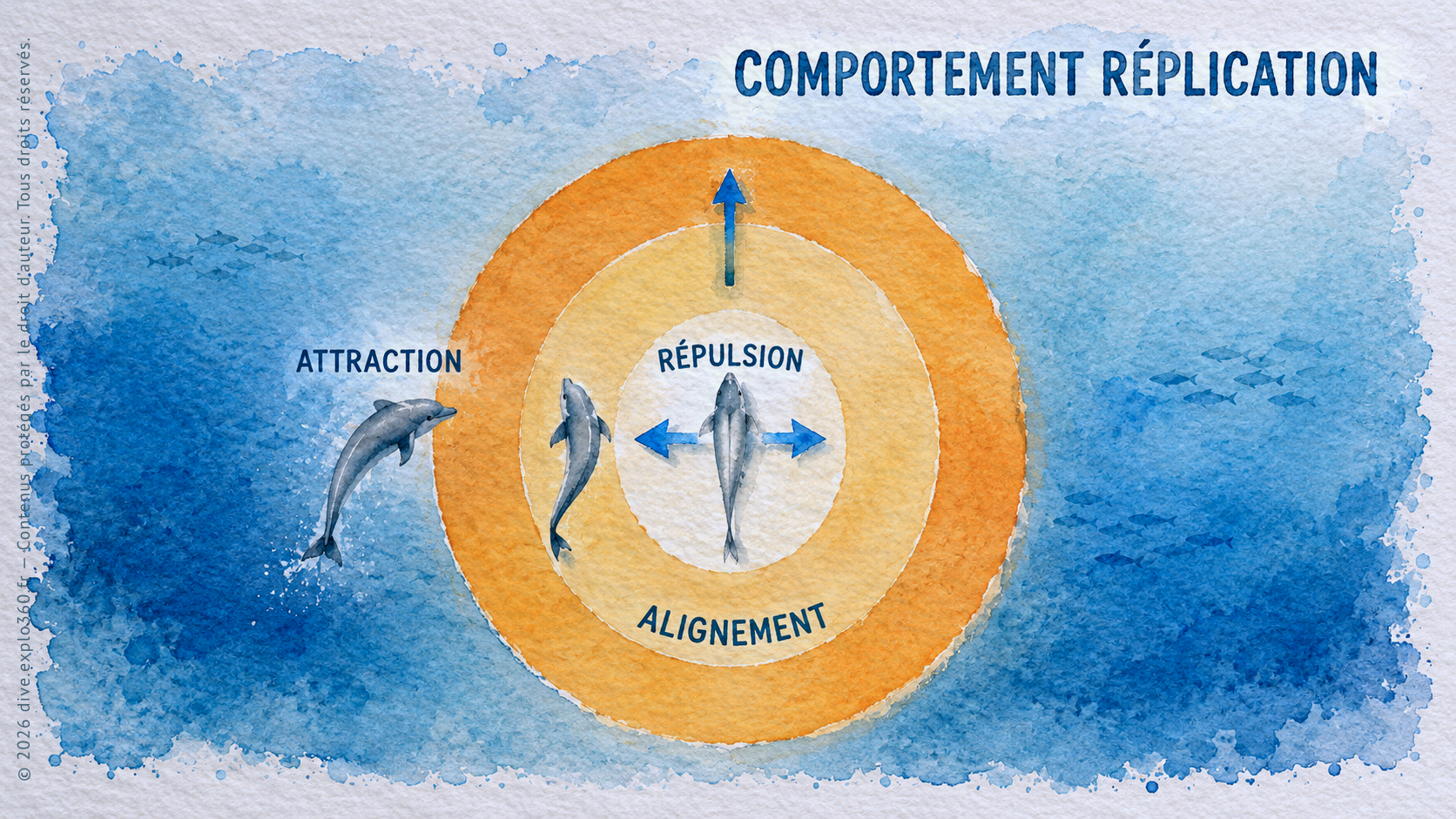
Schooling behaviours
Attraction, alignment and repulsion allow the school to stay together while avoiding collisions. © dive.explo360.fr — All rights reserved. Reproduction prohibited without permission.
Coordination can be described through three simple behaviours.

Attraction: staying close enough to others to maintain group cohesion.

Alignment: adjusting direction to match neighbouring fish.

Repulsion: keeping a minimum distance to avoid collisions.

Combining these three behaviours produces complex collective movements without one fish necessarily directing the whole school.

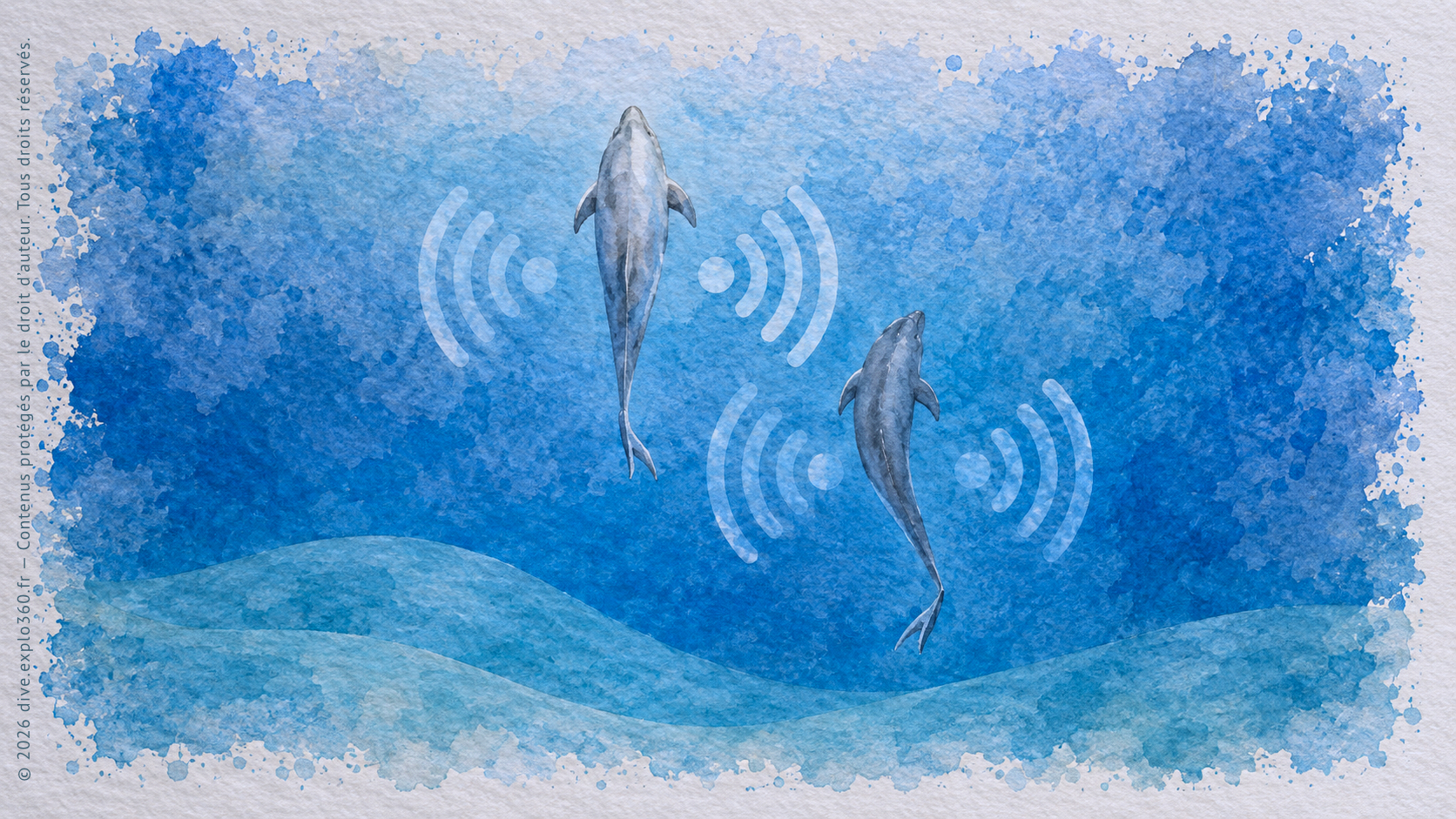
Fish can obtain different information through visual, chemical or mechanical signals.

The lateral line plays a particularly important role in sensing water movements produced by nearby fish.

A reaction can thus spread quickly from one individual to its neighbours.
Lateral line communication
The information perceived by each fish contributes to group coordination. © dive.explo360.fr — All rights reserved. Reproduction prohibited without permission.
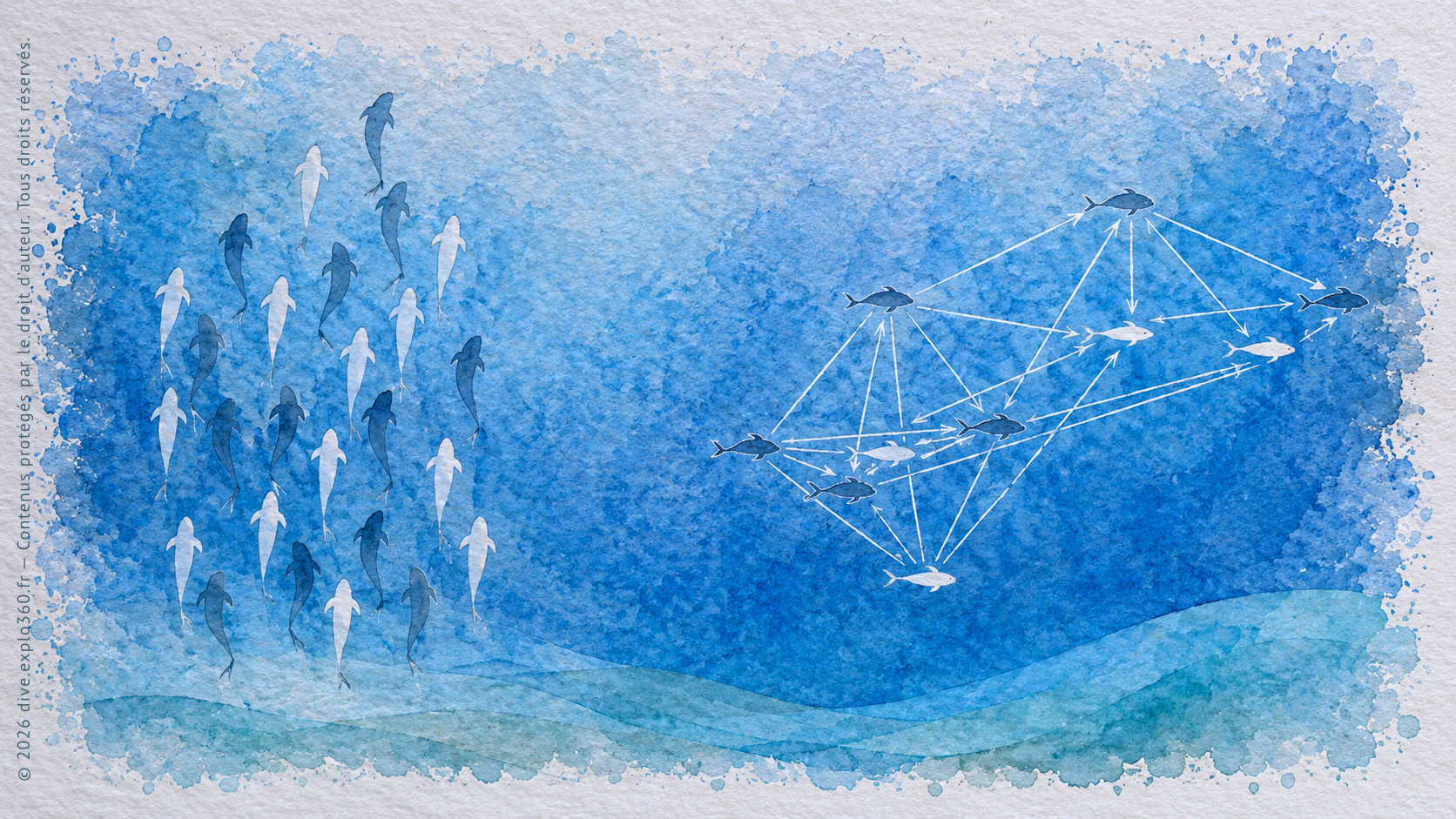
School leader
Each fish reacts locally to its neighbours, thereby contributing to the movement of the whole school. © dive.explo360.fr — All rights reserved. Reproduction prohibited without permission.
A school is not necessarily directed by a permanent leader.

Each fish can change its path according to its neighbours. If a few individuals suddenly change direction after detecting danger, their neighbours react, followed by those neighbours’ neighbours.

Information can thus spread quickly through the whole group.

This is an example of self-organised collective behaviour.

Interactive quiz

Test your knowledge

3 question(s) to test your knowledge.

Conclusion

The spectacular movements of schools result from many interactions between fish.

Group life can bring advantages for protection, feeding and reproduction. Through their senses and a few simple behavioural rules, fish can produce complex collective movements.

A school thus shows how simple individual behaviours can give rise to highly elaborate collective organisation.

Sources