A predator built for pursuit
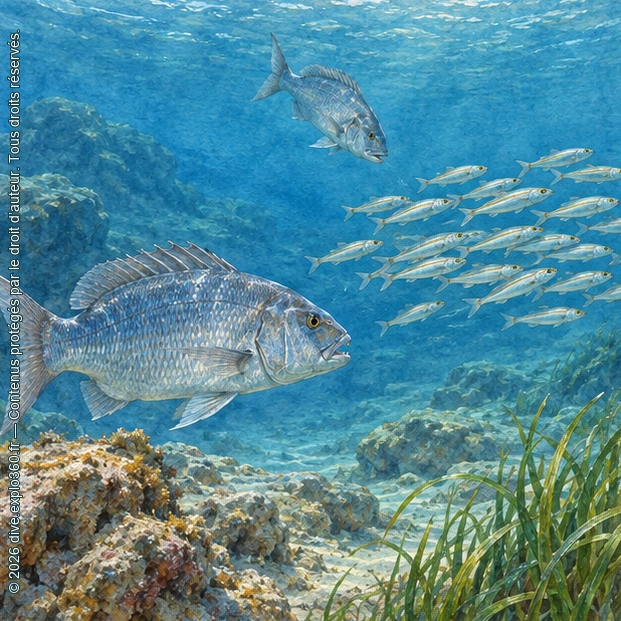
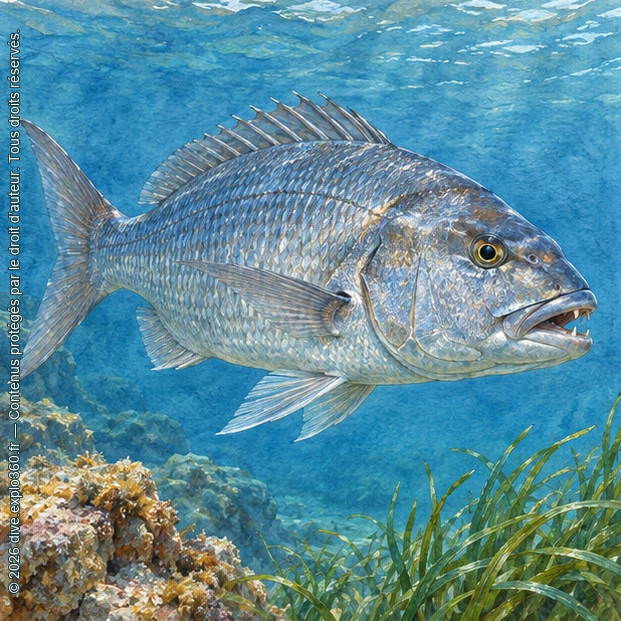
The common dentex belongs to the sea bream family, the sparids. Its pointed teeth are well suited to gripping prey on the move. Its sturdy body is flattened from side to side. It has a powerful head and a mouth lined with large conical teeth. The largest teeth sit at the front of the jaws, where they help it grip moving prey.
The dentex mainly hunts fish. It also eats cephalopods and, to a lesser extent, crustaceans. Its diet varies with its size and what is available. A large dentex can catch prey too big for a juvenile to swallow. Its power extends beyond its jaws.
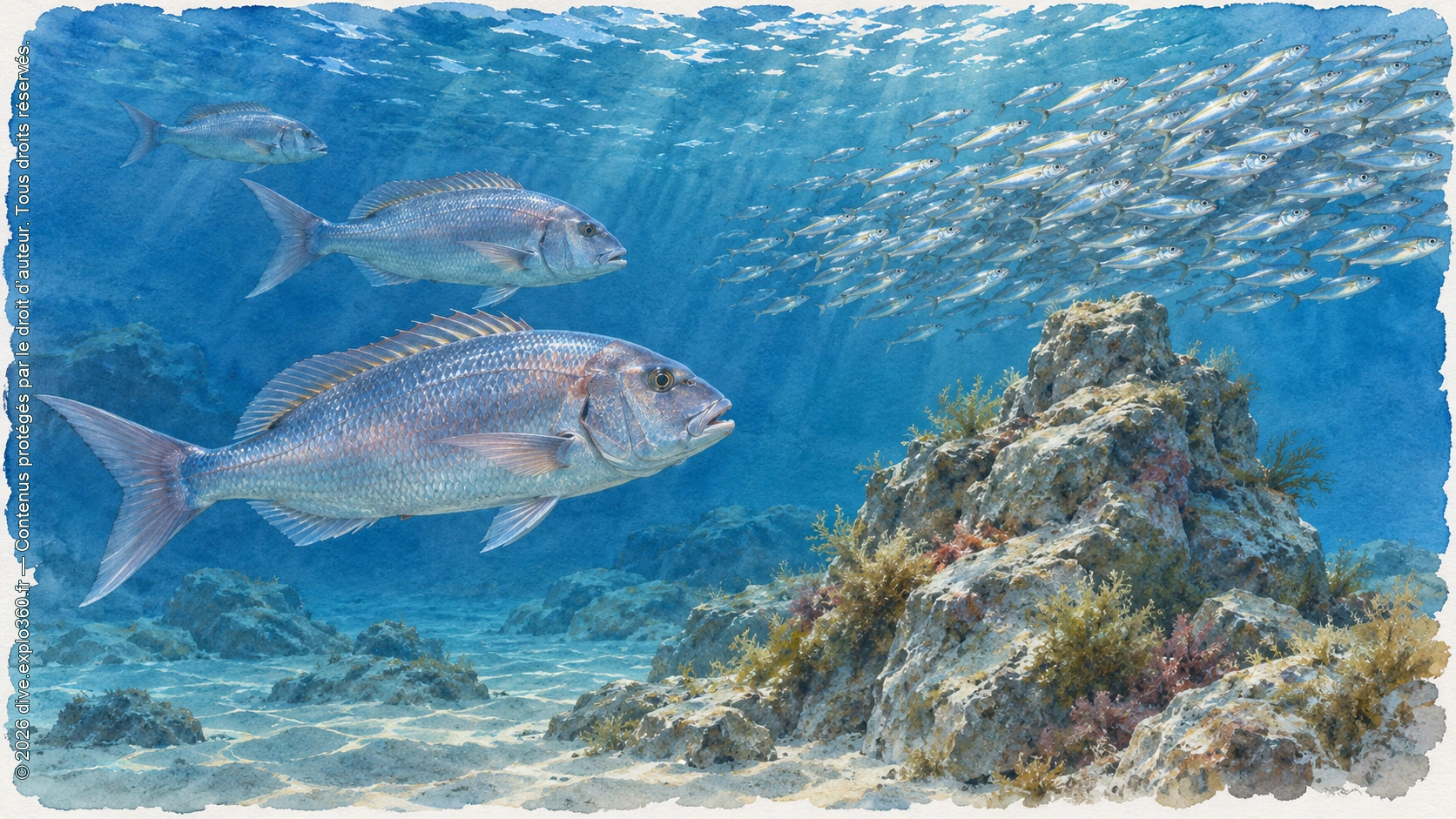
The tail fin, muscles and shape of the body allow it to accelerate quickly. It can switch from steady swimming to a sudden lunge at its prey. That change of pace is one of the most striking things about the way it moves. There is little to gain, however, from chasing an escaping fish indefinitely.
An attack costs energy. It can fail if the prey spots danger early enough or reaches shelter. To feed, the dentex needs to find prey within reach, get close and seize the right moment. That is where the shape of the seabed comes in.
A rocky pinnacle brings fish together
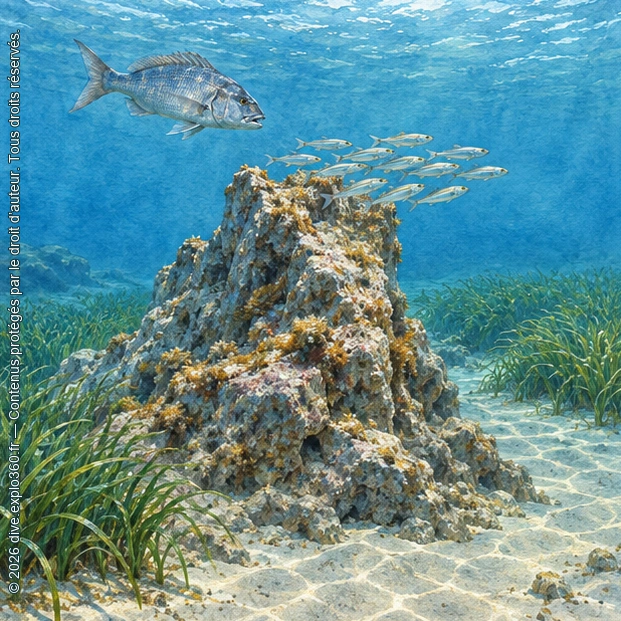
A rocky pinnacle rising from a sandy flat can draw fish from the surrounding seabed. The rock offers shelter and feeding spots and changes the way water flows past. Some keep close to the bottom. Others travel over the rock or along its slopes. Common dentex frequent coastal rocky areas, drop-offs and the edges of Posidonia seagrass meadows.
These habitats let them move between different environments. Schools may skim along the rock, pass over its crest or cross the open water nearby. Predators that use the same area are then more likely to encounter them. The pinnacle also provides a landmark in an otherwise uniform landscape.
In some marine reserves, large groups of dentex have been seen around rocky shoals, sometimes for much of the year. That tells us little about whether the fish use the rock to set up coordinated ambushes. It does show that some rocky features can hold a concentration of predators for long periods. When a school moves past, several dentex may thus be in the same place at the same time.
It can look like a group hunt. What matters is how the hunters respond to one another.
Hunting together or hunting in the same place?
Cooperative hunters adjust what they do to the actions of their partners. Individuals coordinate their movements, take different roles or change their behaviour in response to that of their partners. For the common dentex, the evidence so far shows fish gathering and sometimes pursuing the same prey. Observations confirm that dentex can form groups and that these groups are more frequent during daylight.
The simultaneous presence of several dentex cannot by itself establish that they coordinate their attacks. There is a simpler explanation. Several predators may be drawn to the same school because it offers a large concentration of food. Each can then pursue prey as opportunities arise.
Their movements may look synchronised simply because all are responding to the same turns by the school. One dentex accelerates. The bogue change direction. A second dentex, in a different position, reacts in turn. To an observer it can look like a planned manoeuvre. Sharing information or taking different roles is unnecessary for this pattern to arise.
Complex interactions may still be possible. What we know so far does not establish cooperative hunting like that documented in some other predatory fish.
A group of hunters need not be a team.