Making light with very little heat

An electric bulb converts some of the energy it receives into light. It releases another part as heat.

Bioluminescent organisms produce light by a different mechanism. A chemical reaction releases some of its energy directly as light.This is bioluminescence.In many organisms, the reaction involves a substance called luciferin and an enzyme called luciferase. When the necessary reactants are present, the reaction releases energy that can be emitted as photons, the elementary particles of light.The reaction requires no external light source.Compared with a flame, it typically produces very little heat for the amount of light it emits. This is why it is sometimes called cold light.The chemistry of bioluminescence varies among organisms, both in the luciferins they use and in how they produce light. Some make light in their own cells. Others house bacteria that make it for them.The colours vary too. Blue and green emissions are particularly common in the ocean. These wavelengths travel relatively well through seawater, while red light is usually absorbed more quickly.These emissions serve many purposes beyond lighting up the surroundings. Some last only an instant, like the flashes that appear on the surface of waves.
The first clue is the source of the energy. The flash begins inside a living organism.

The mystery of glowing waves

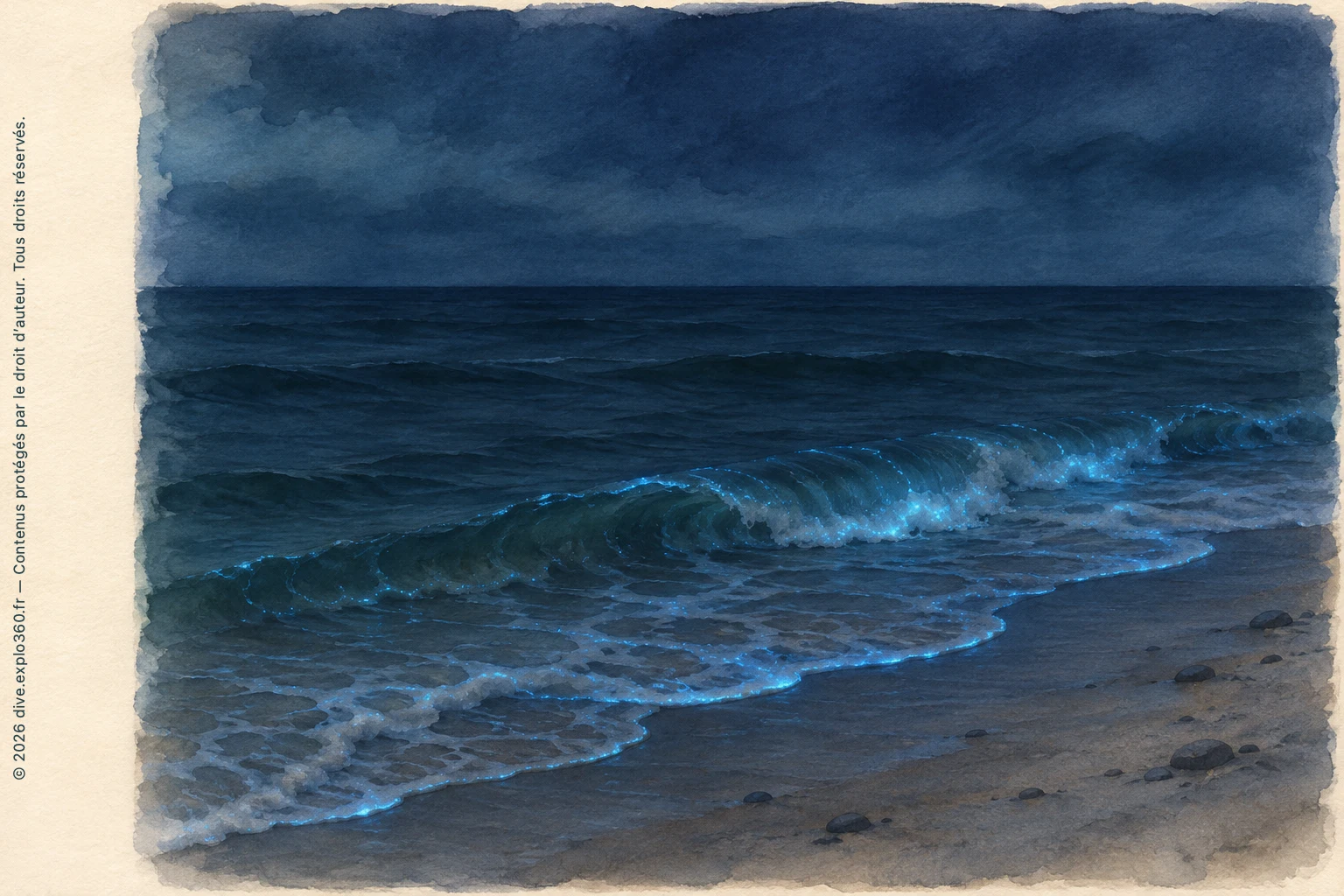
Watch the path of the light. It follows the breaking wave, fades and starts again with the next one.

On a dark beach, a breaking wave can leave a line of blue sparks in the foam.

Some of those flashes come from tiny plankton called dinoflagellates.One is the sea sparkle, Noctiluca scintillans, a single-celled organism found in many parts of the ocean.When the water around a light-producing cell is disturbed, changes inside the cell can set off a brief flash.A breaking wave, a passing fish or the wake of a boat can jostle many cells at once.One flash would be easy to miss. Where enough cells are present, their combined light can trace the shape of the wave or wake.The flash may also have a role in defence.Experiments with some dinoflagellates have explored whether the light startles a small predator or draws a larger hunter towards it.The second possibility is known as the burglar alarm hypothesis. A flash may give away the position of the animal that disturbed the cell.Whether it does so depends on which organisms are involved and how they respond.Some populations of Noctiluca have lost the ability to produce light.Whether a wave sparkles depends on which cells are present, how many there are and the conditions in which we see them.

The jellyfish that shines at night

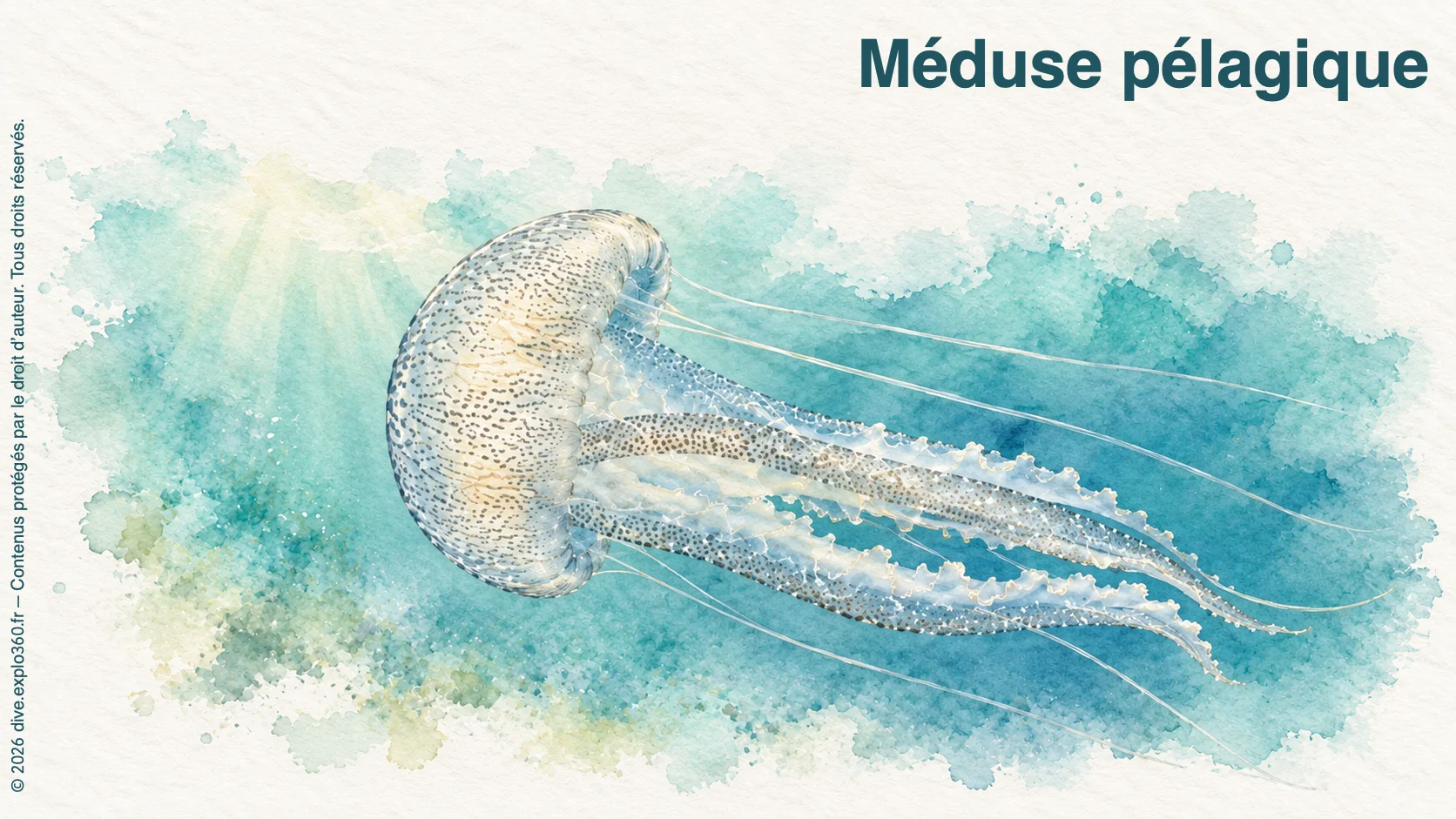
In the Mediterranean, divers often encounter the mauve stinger, Pelagia noctiluca, a pink or purple jellyfish with eight tentacles around the bell and four long oral arms.

Its name, noctiluca, means “shining at night”.A disturbance can prompt the jellyfish to flash.Its daytime colour and its flash have different origins.The pink or mauve colour depends on which wavelengths its tissues absorb and reflect. A flash comes from a chemical reaction that gives off light.What might that flash do for the jellyfish?It may affect an encounter with another animal. Seeing a flash after contact tells us little about whether it drives a predator away.The response is the part researchers need to see.They look for what triggered the flash and how the animals nearby behaved afterwards.In deep water, an anglerfish carries its light right where it could bring a meal within reach.
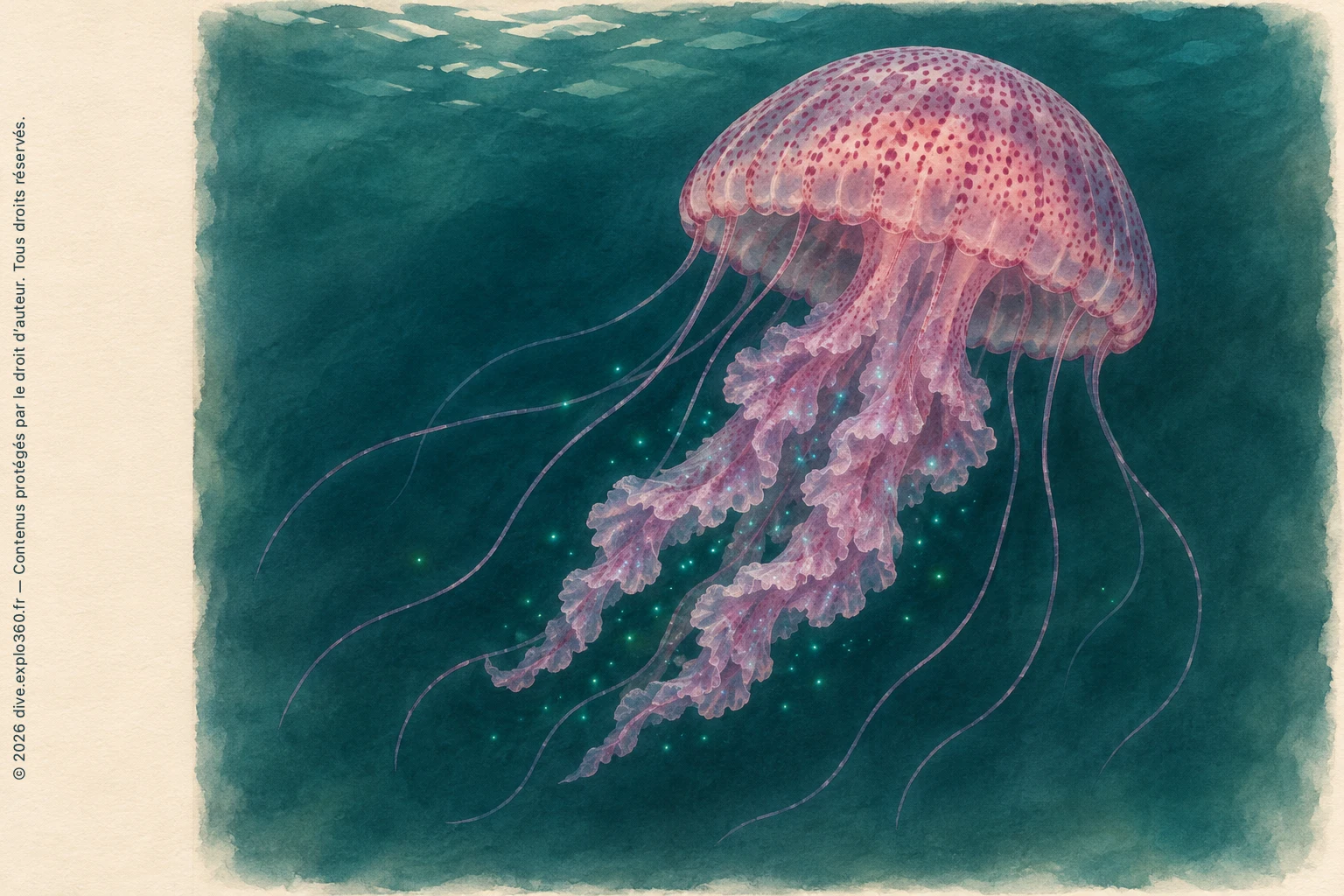
A mauve stinger jellyfish in dark water.
The mauve stinger looks pink or mauve under external light. The glowing points represent an emission triggered by disturbance. This is an illustrative reconstruction. © dive.explo360.fr — All rights reserved. Reproduction requires permission.
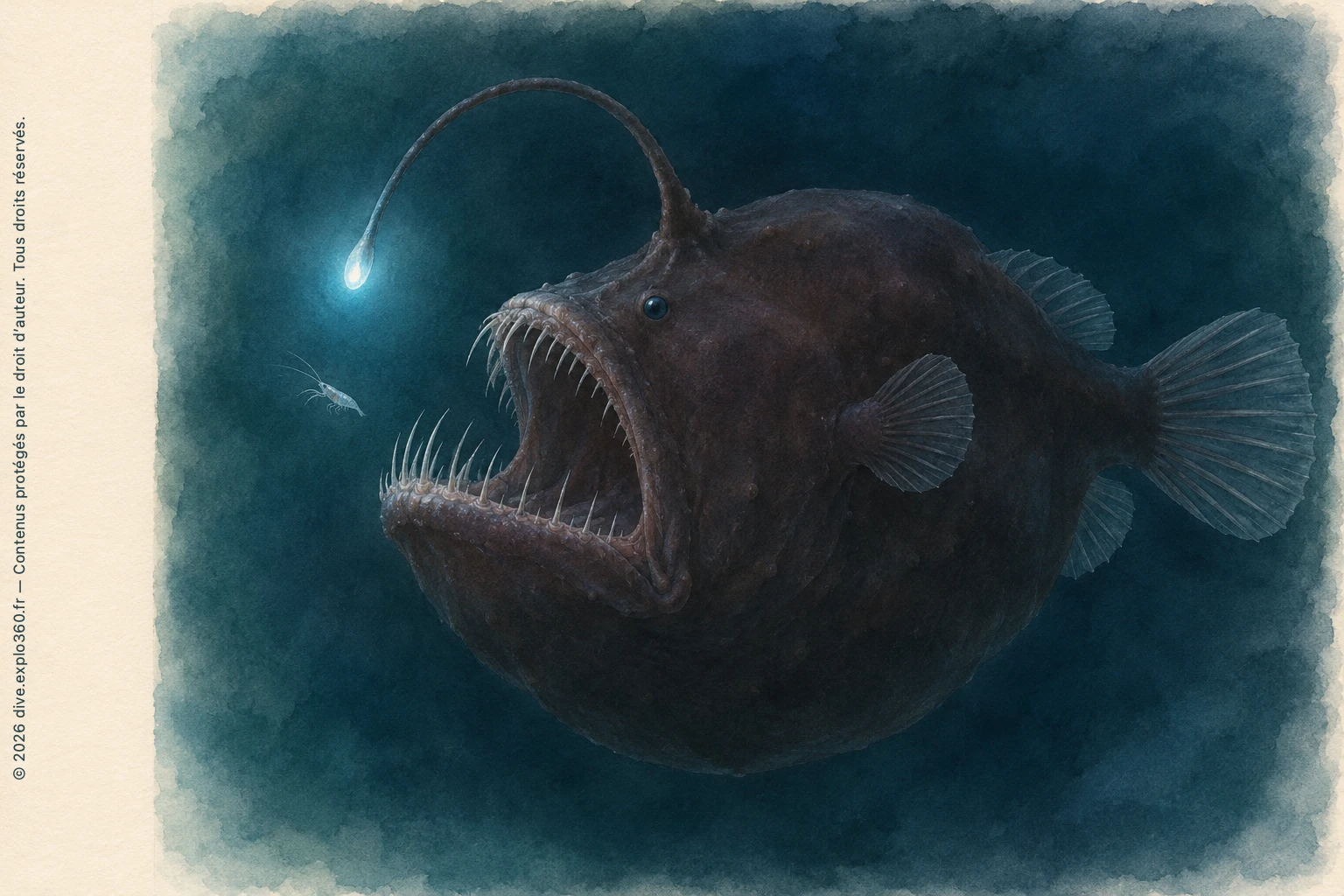
Female humpback blackdevil with a glowing lure above its mouth.
In the female humpback blackdevil, the organ at the tip of the stalk houses luminous bacteria. Prey approaching the lure may come within reach of the mouth. © dive.explo360.fr — All rights reserved. Reproduction requires permission.

A light above the jaws

At great depth, where sunlight no longer reaches, food can be hard to find.

Deep-sea anglerfish live in these waters.The female humpback blackdevil, Melanocetus johnsonii, has a large head, long teeth and a slender stalk above her mouth.A small light organ sits at the tip.The stalk evolved from a dorsal fin ray and holds the lure out in front of the fish.An animal that detects the glow can come close enough for the anglerfish to seize it.The light comes from within the lure.Bioluminescent bacteria living there produce it.The organ gives the bacteria a place to live, and their glow is available to the fish.Biologists call this close association between different organisms a symbiosis.A vertebrate can use light made by microscopic partners to bring prey within reach.Some coastal anglerfish use unlit lures shaped like small animals.For some species in the deep sea, a glow can make a lure detectable in the dark.Where faint daylight still reaches, a glow can also make an animal harder to see.

Lighting up to become harder to see

Picture a small fish swimming several hundred metres below the surface.

To a predator looking up, its outline can stand out against the faint light filtering down.The fish appears dark because its body blocks some of that light.Some species have light organs called photophores on their undersides.The organs direct light downwards. A close match with the brightness of the water overhead reduces the contrast of the fish’s outline.From below, the fish can be harder to pick out.This is called counterillumination.Some fishes and squid use it.The effect depends on the faint daylight coming mostly from above.A glow from underneath fills in some of the dark outline.The light serves as camouflage.Some animals can adjust their output as the ambient light changes.The effect varies with depth, brightness and the observer’s position.A glow can hide a fish from one angle while leaving it visible from another.

Continue reading

AMIGANSEAU CONTENT

The rest of this article is for subscribers

Log in with your AMIGANSEAU licence to continue reading.

All active AMIGANSEAU licences give access to the full article.