Habitat
 Depth
 Group
 Role
WHAT DOES IT LOOK LIKE?
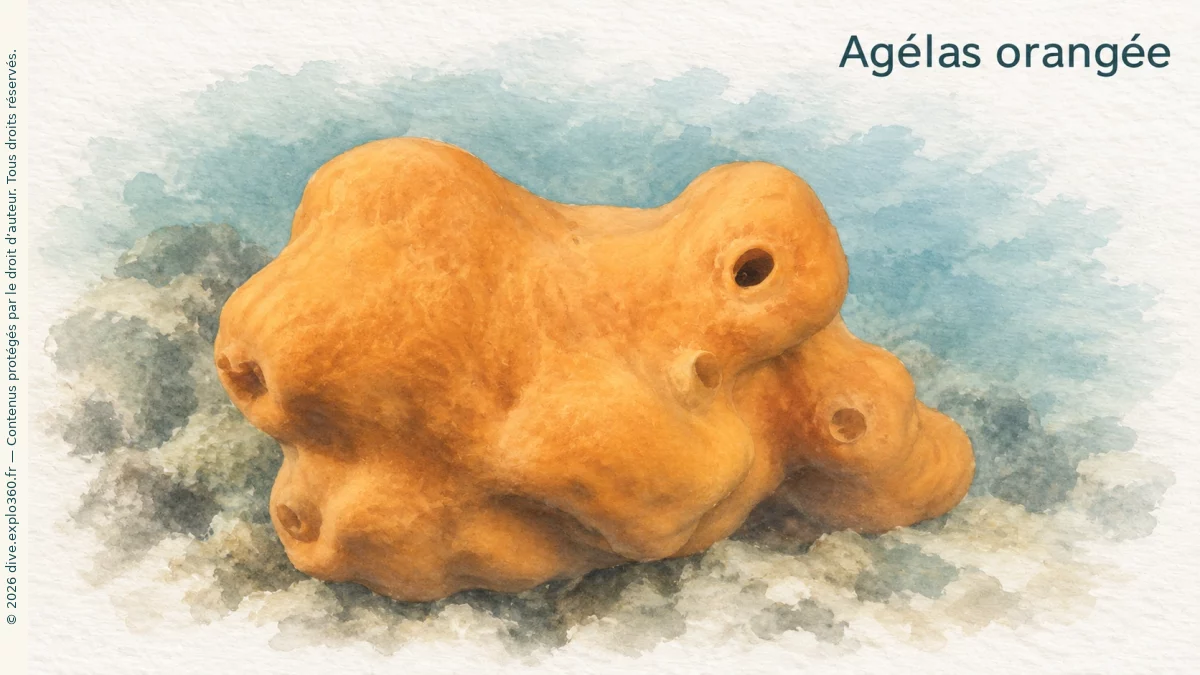
It forms yellow to orange masses of irregular, often stout lobes. Some can reach around twenty centimetres high. Outlines vary, with broad openings topping rounded or elongated lobes.
Oscula, the water outlets, are conspicuous. Small projections mark the surface. Spongin fibres, organic support material, and spicules, tiny mineral elements, contribute to the skeleton. Consistency should not be tested by squeezing.
WHERE DOES IT LIVE?
It uses dim rocky surfaces, notably beneath overhangs and in semi-dark cave zones. French records include Provence and Corsica. Surfaces may be vertical or downward-facing.
Depth alone does not describe the habitat: a shallow cavity may be darker than a deeper wall. Water movement and refuge shape also contribute to conditions.
WHAT DOES IT EAT?
Water enters many pores, passes through the body and leaves through oscula. Specialised cells bearing a moving filament maintain flow and help capture bacteria and other microscopic food.
The sponge also houses microbial communities in its tissues. Pumping, food retention and microbial partnerships are complementary aspects.
GO FURTHER WITH AMIGANSEAU
Unlock the full profile
Deepen your knowledge with the exclusive chapters and interactive resources included in an AMIGANSEAU licence.
- HOW DOES IT REPRODUCE?
- OUR OBSERVATIONS
- ARTICLE
Also included in the full profile
- Advanced navigation between description, ecological context, observations and behaviour
- Interactive food chain to explore the species’ feeding relationships