Habitat
 Depth
 Group
 Role
 Size
WHAT DOES IT LOOK LIKE?
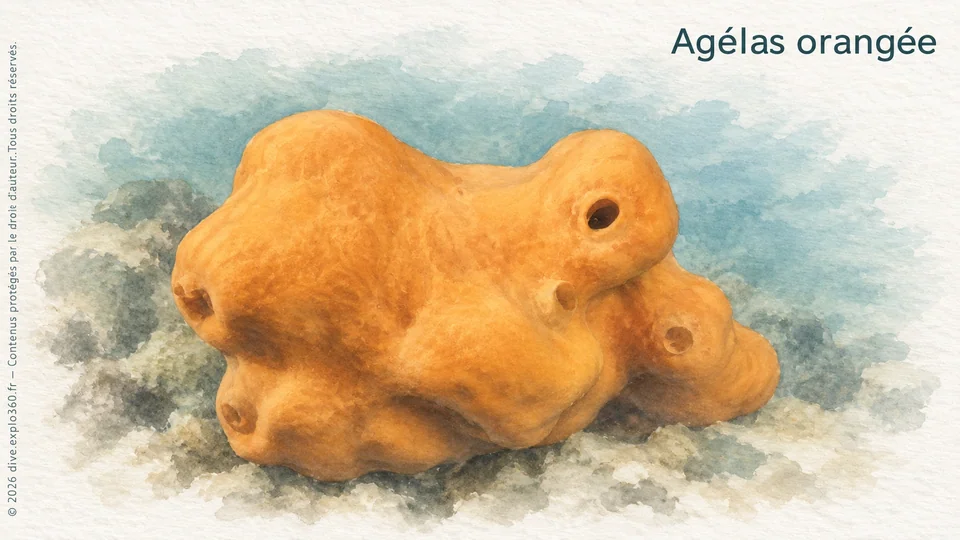
Broad openings often crown the lobes of the orange sponge (Agelas oroides). Called oscules, they stand out on a yellow to orange mass with an irregular outline. Lobes may be squat or more elongated, up to about twenty centimetres high, with little bumps across their surface.
WHERE DOES IT LIVE?
It uses dim rocky surfaces, notably beneath overhangs and in semi-dark cave zones. French records include Provence and Corsica. Surfaces may be vertical or downward-facing.
Depth alone does not describe the habitat: a shallow cavity may be darker than a deeper wall. Water movement and refuge shape also contribute to conditions.
WHAT DOES IT EAT?
The orange agelas sponge’s pores let in water carrying several kinds of food. Fine particles, including bacteria, may be trapped by its filtering system. Dissolved organic material is another resource, with uptake measured in this species. The sponge hosts a large microbial community that helps the whole system obtain nutrients. Water then leaves through the oscula after passing through the network of channels. Food is invisible in two ways: some is microscopic and some dissolved.
GO FURTHER WITH AMIGANSEAU
Unlock the full profile
Deepen your knowledge with the exclusive chapters and interactive resources included in an AMIGANSEAU licence.
Subscribing to Dive.Explo360 means supporting a different way to discover marine life.
Our independent platform is entirely self-funded and relies solely on subscriptions. Every licence helps us continue our work, create new content, and share what we know about the marine world with as many people as possible.
Starting at €80 per year, your support makes all the difference.
 Understand the species