Habitat
 Depth
 Group
 Role
WHAT DOES IT LOOK LIKE?
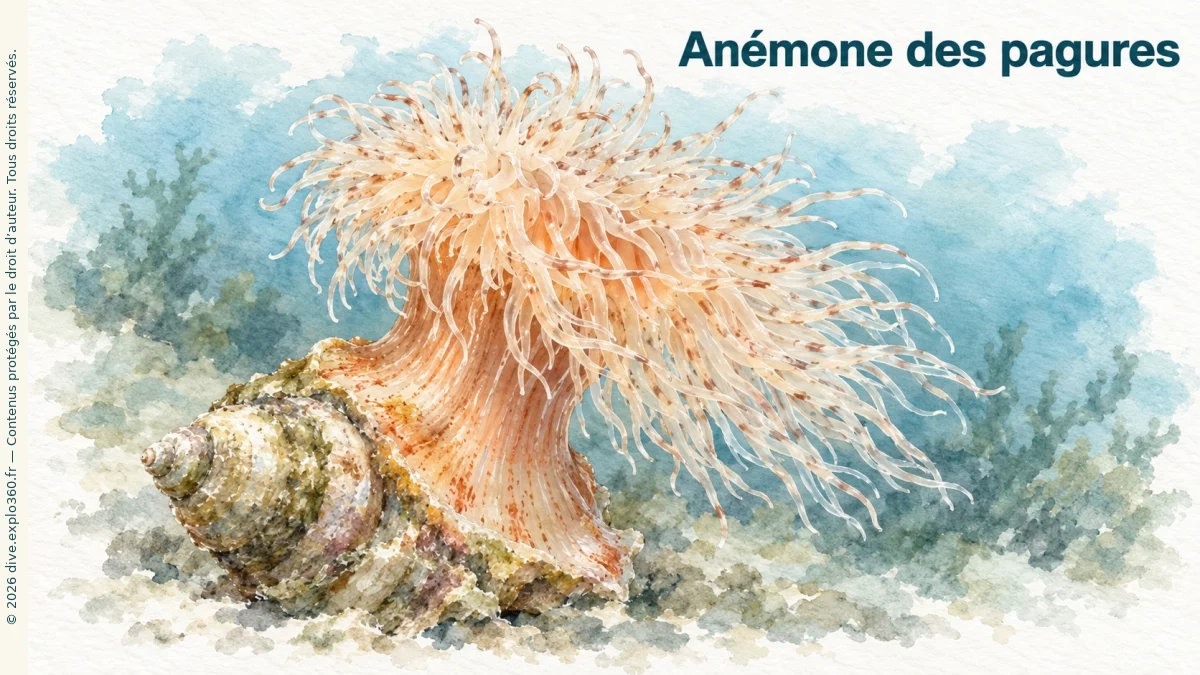
The column is beige, brown or yellowish, with irregular paler lengthwise lines. Small dark, red or violet spots may occur. Large animals can approach ten centimetres high, although appearance changes considerably with body extension.
The oral disc, the mouth-bearing surface, is surrounded by numerous fine cream tentacles, sometimes brown-striped. Closed, the anemone forms an elongated mass. If disturbed, it may release white to mauve acontia, sticky threads packed with stinging cells.
WHERE DOES IT LIVE?
It often occurs on a shell occupied by a hermit crab, including Dardanus calidus or Dardanus arrosor in the Mediterranean. Several anemones may cover one shell. It also occurs in the Atlantic and English Channel with other partners.
The association is optional: stone or shell can support it without a crab. Surface type and any occupant are therefore separate details to record.
WHAT DOES IT EAT?
It consumes animal prey caught by sticky, stinging tentacles and brought to the mouth. Scraps from the crab’s meals may also be collected.
Experiments on Dardanus–Calliactis associations showed that anemones could reduce octopus attacks. This is an effect documented under particular conditions, not an absolute guarantee against every predator.
GO FURTHER WITH AMIGANSEAU
Unlock the full profile
Deepen your knowledge with the exclusive chapters and interactive resources included in an AMIGANSEAU licence.
- HOW DOES IT REPRODUCE?
- OUR OBSERVATIONS
- ARTICLE
Also included in the full profile
- Advanced navigation between description, ecological context, observations and behaviour
- Interactive food chain to explore the species’ feeding relationships