Partners and information

Contact us

Verification code

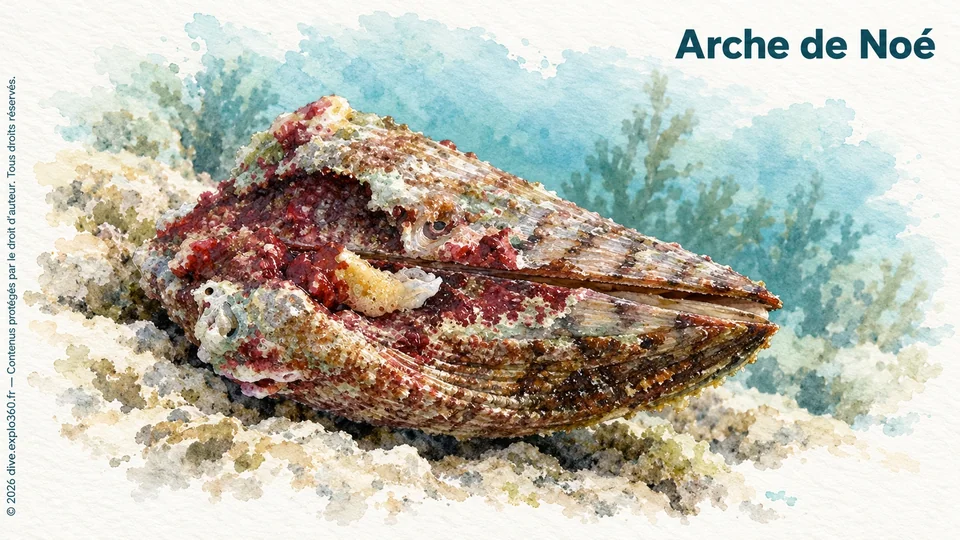
Noah’s ark shell

Distribution : Mediterranean

Six shell fragments found at the ancient town of Olbia, near Hyères in southern France, attracted the attention of specialists studying archaeological shell remains. They may belong to Noah's ark shell, a Mediterranean mollusc with a thick, strongly ribbed shell. The identification remains uncertain. Living specimens are often so heavily covered with sponges and algae that their shells are difficult to recognise underwater.

Images being acquired · Your video or photos here

Habitat of Noah’s ark shell Habitat
Rocky habitat
Depth range of Noah’s ark shell Depth
0-100 m
Biological group of Noah’s ark shell Group
Ecological role of Noah’s ark shell Role
Filter feeder

Size

5–8 cm

WHAT DOES IT LOOK LIKE?

The Noah’s ark shell has a long straight hinge joining its two valves. The thick shell often measures 5 to 8 cm. Close-set ridges radiate over a yellowish background striped brown, frequently obscured by algae or a sponge.

GO FURTHER WITH AMIGANSEAU

Unlock the full profile

Deepen your knowledge with the exclusive chapters and interactive resources included in an AMIGANSEAU licence.

Choose my licence
  • WHERE DOES IT LIVE?
  • WHAT DOES IT EAT?
  • HOW DOES IT REPRODUCE?
  • OUR OBSERVATIONS

Also included in the full profile

  • Advanced navigation between description, ecological context, observations and behaviour
  • Interactive food chain to explore the species’ feeding relationships
An active licence gives access to enriched profiles and AMIGANSEAU exploration tools.
Noah’s ark shell

Understand the species

What is this species’ ecological role?

AMIGANSEAU Explorer Premium

Access enriched species profiles with advanced content (audio, infographics and detailed articles).

Explore all species easily through a single interface.

Enjoy a smooth, fast learning experience suited to every level.

🔒 The full profile is available with a paid subscription only.

Discover licences

POURSUIVRE L’EXPLORATION

Explore further

ArticleWhat marine animals do and why it mattersRead the article →ArticlePHYLA WITHOUT THE FUSSRead the article →