Habitat
 Depth
 Group
 Role
WHAT DOES IT LOOK LIKE?
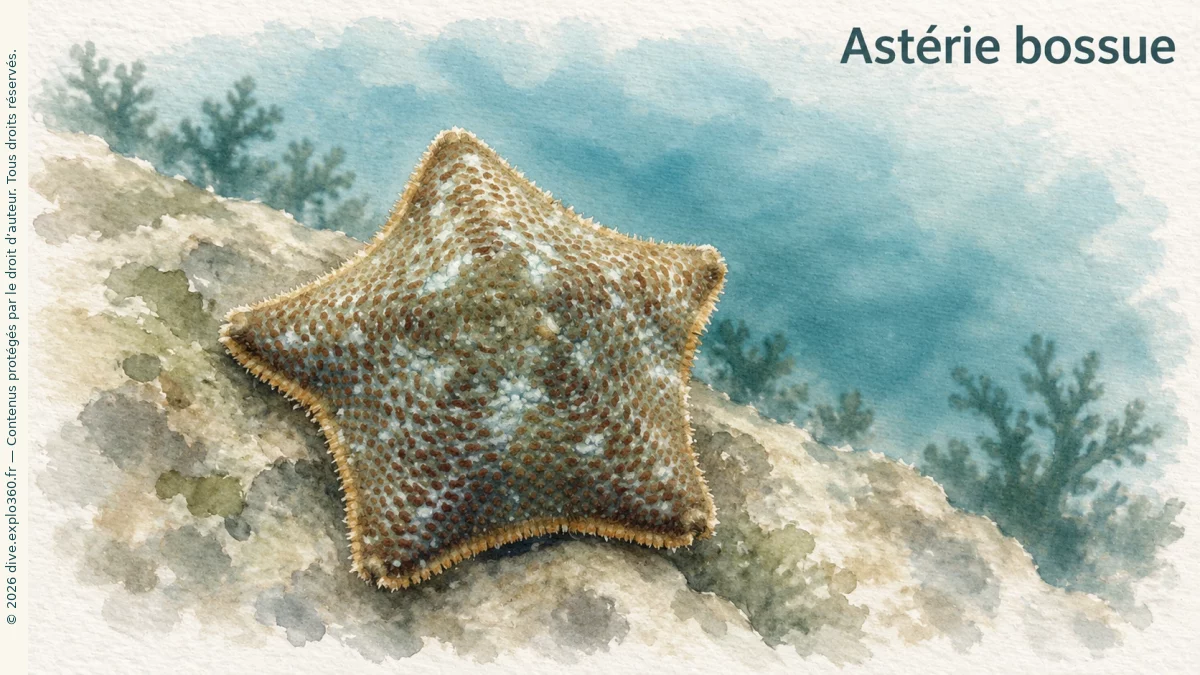
The cushion star has five very short arms and a slightly raised central disc. Juveniles can be almost pentagonal. The beige, brown, greenish or grey upper surface bears very short spines producing a rough appearance.
On the underside, tube feet, extendable tubes ending in an adhesive area, lie in the arm grooves. They help the starfish move and anchor to surfaces.
WHERE DOES IT LIVE?
It occurs beneath stones, in cracks, among algae and in seagrass. It inhabits shallow French Mediterranean waters and some lagoons, notably Thau.
An undisturbed sighting reveals the shelter used.
WHAT DOES IT EAT?
It uses varied resources, including small seabed organisms, animal remains and material on surfaces. This supports describing it as omnivorous.
It can extend part of its stomach over food, begin digestion outside the body and recover the prepared material. This differs from taking pieces with a jaw.
GO FURTHER WITH AMIGANSEAU
Unlock the full profile
Deepen your knowledge with the exclusive chapters and interactive resources included in an AMIGANSEAU licence.
- HOW DOES IT REPRODUCE?
- OUR OBSERVATIONS
- ARTICLE
Also included in the full profile
- Advanced navigation between description, ecological context, observations and behaviour
- Interactive food chain to explore the species’ feeding relationships