Habitat
 Depth
 Group
 Role
 Size
WHAT DOES IT LOOK LIKE?
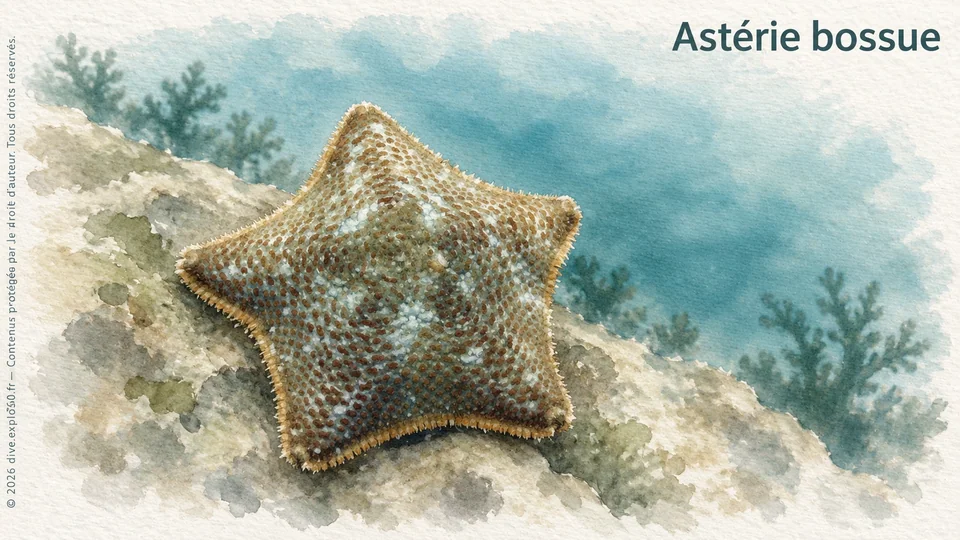
Young cushion stars (Asterina gibbosa) are nearly five-sided. The star has very short arms and a slightly domed centre. Tiny spines give its upper surface a rough appearance. The colour can be beige, brown, greenish or grey. On the underside, small flexible tubes line the grooves along its arms.
WHERE DOES IT LIVE?
It occurs beneath stones, in cracks, among algae and in seagrass. It inhabits shallow French Mediterranean waters and some lagoons, notably Thau.
An undisturbed sighting reveals the shelter used.
WHAT DOES IT EAT?
The cushion star feeds chiefly at night on bottom resources. Molluscs, worms and small brittle stars are consumed alongside invertebrate remains, microorganisms and microalgae. Both living food and fragmented organic material are used. With its stomach extended outside its body, it can start digesting the food directly. It then draws the softened tissues and particles inside without using a chewing apparatus like a sea urchin’s.
GO FURTHER WITH AMIGANSEAU
Unlock the full profile
Deepen your knowledge with the exclusive chapters and interactive resources included in an AMIGANSEAU licence.
Subscribing to Dive.Explo360 means supporting a different way to discover marine life.
Our independent platform is entirely self-funded and relies solely on subscriptions. Every licence helps us continue our work, create new content, and share what we know about the marine world with as many people as possible.
Starting at €80 per year, your support makes all the difference.
 Understand the species