Habitat
 Depth
 Group
 Role
 Average size
WHAT DOES IT LOOK LIKE?
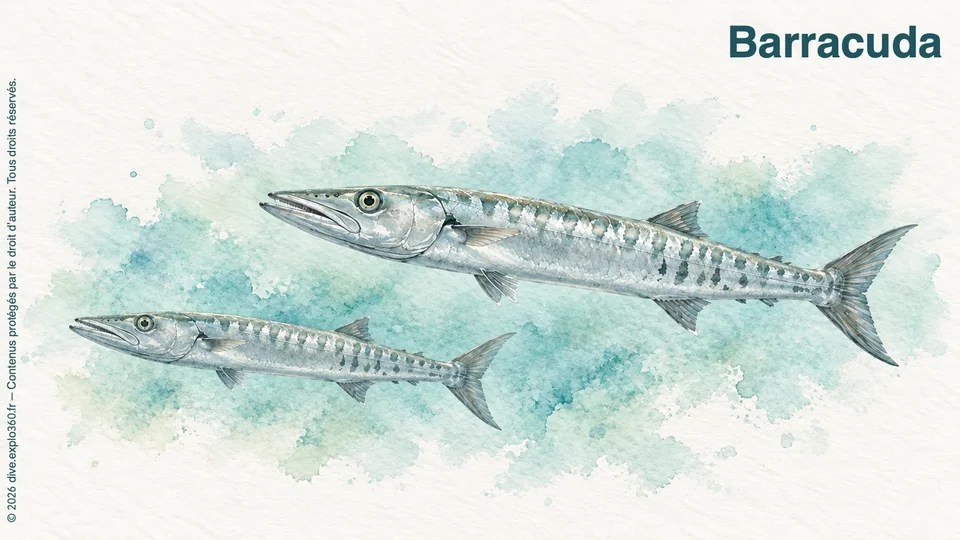
The yellowmouth barracuda (Sphyraena viridensis) has a narrow, pointed head with large eyes and long teeth. Its lower jaw juts out beyond the upper jaw, making the profile look even more pointed.
The very elongated body is silvery grey, with dark bars on the upper sides. Two short fins stand separately on the back, and the tail is deeply forked. Large fish can reach about 1.20 m. Several barracudas nevertheless have similar outlines.
WHERE DOES IT LIVE?
Drop-offs and rocky seabeds provide landmarks beneath barracuda schools, while the fish occupy open water and sometimes occur alone. Their coastal habitat generally extends from the surface to around fifty metres. In the Mediterranean and eastern Atlantic, approaches to shore are frequent during the warm season.
WHAT DOES IT EAT?
A yellowmouth barracuda attack can abruptly interrupt slow swimming. The fish locates prey by sight, accelerates and seizes it with its toothed mouth. Fish are an important part of its diet; cephalopods and crustaceans are also eaten. Dominant prey may differ between areas. Capture is a shorter event and harder to encounter.
GO FURTHER WITH AMIGANSEAU
Unlock the full profile
Deepen your knowledge with the exclusive chapters and interactive resources included in an AMIGANSEAU licence.
- HOW DOES IT REPRODUCE?
- OUR OBSERVATIONS
- ARTICLE
Also included in the full profile
- Advanced navigation between description, ecological context, observations and behaviour
- Interactive food chain to explore the species’ feeding relationships
- Natural history podcast and dive debrief
- Infographic and illustrated summary profile
- Additional photographic observations
 Understand the species