Habitat
 Depth
 Group
 Role
WHAT DOES IT LOOK LIKE?
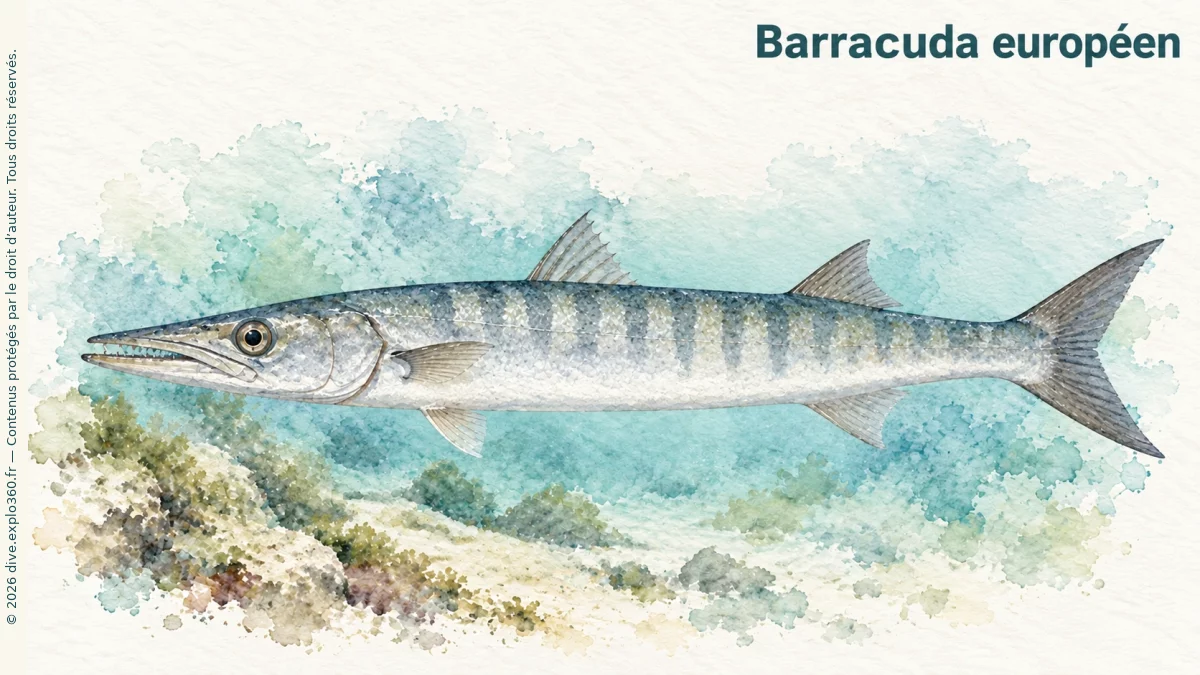
The European barracuda has a very elongated subcylindrical body, long pointed head and projecting mandible. Strong canine-like teeth arm the jaws and mouth roof. Widely separated dorsals and an anal opposite the second accompany short pectorals that do not reach the pelvics. Grey-blue to greenish upper colour fades to silver sides, where upper transverse bars can be weak.
WHERE DOES IT LIVE?
It inhabits coastal waters above rock and sand down to around 100 m. Young generally remain closer to the bottom. The range includes the Mediterranean and eastern Atlantic. Historical names and uncertain identifications can complicate geographical comparisons. A large barracuda shoal does not securely establish this species without readable characters.
WHAT DOES IT EAT?
Food is chiefly fish, supplemented by cephalopods and crustaceans. Elongated jaws and strong teeth support mobile-prey capture without describing intentions towards an observer. Do not feed fish to bring them closer or manufacture feeding. Undisturbed interactions allow pursuit and capture to be described without introducing provoked behaviour.
GO FURTHER WITH AMIGANSEAU
Unlock the full profile
Deepen your knowledge with the exclusive chapters and interactive resources included in an AMIGANSEAU licence.
- HOW DOES IT REPRODUCE?
- OUR OBSERVATIONS
- ARTICLE
Also included in the full profile
- Advanced navigation between description, ecological context, observations and behaviour
- Interactive food chain to explore the species’ feeding relationships