Habitat
 Depth
 Group
 Role
 Average size
 Good to know
WHAT DOES IT LOOK LIKE?
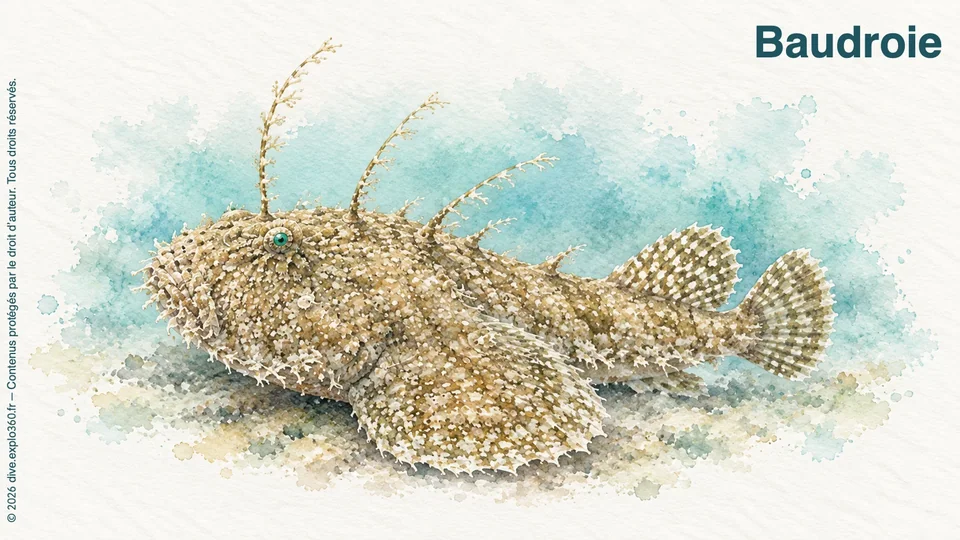
A little “fishing rod” sticks up above the mouth of the anglerfish (Lophius piscatorius). The slender rod has a fleshy tip and serves as a lure. Below it, the broad head makes up much of the fish’s flat outline.
The eyes sit on top of the head. The huge mouth bears thin teeth curving inwards. Flaps fringe the edges of the soft, scaleless body.
WHERE DOES IT LIVE?
Resting on sand, mud or gravel, the anglerfish remains closely associated with the substrate. Its habitat extends from coastal areas to seabeds several hundred metres deep and sometimes beyond. Young fish often use shallower areas than adults, so dive-accessible habitats reveal only part of its range.
WHAT DOES IT EAT?
Waiting is a major part of the anglerfish’s hunting. It can move its lure in front of the mouth to bring prey within close range. Capture then depends on sudden expansion of the mouth cavity, setting water in motion and drawing the animal inside. This suction mechanism permits a rapid strike without a long pursuit. Fish are the adult’s main food, with crustaceans and cephalopods also consumed.
GO FURTHER WITH AMIGANSEAU
Unlock the full profile
Deepen your knowledge with the exclusive chapters and interactive resources included in an AMIGANSEAU licence.
- HOW DOES IT REPRODUCE?
- OUR OBSERVATIONS
- ARTICLE
Also included in the full profile
- Advanced navigation between description, ecological context, observations and behaviour
- Interactive food chain to explore the species’ feeding relationships
- Natural history podcast and dive debrief
- Infographic and illustrated summary profile
 Understand the species