Partners and information

Contact us

Verification code

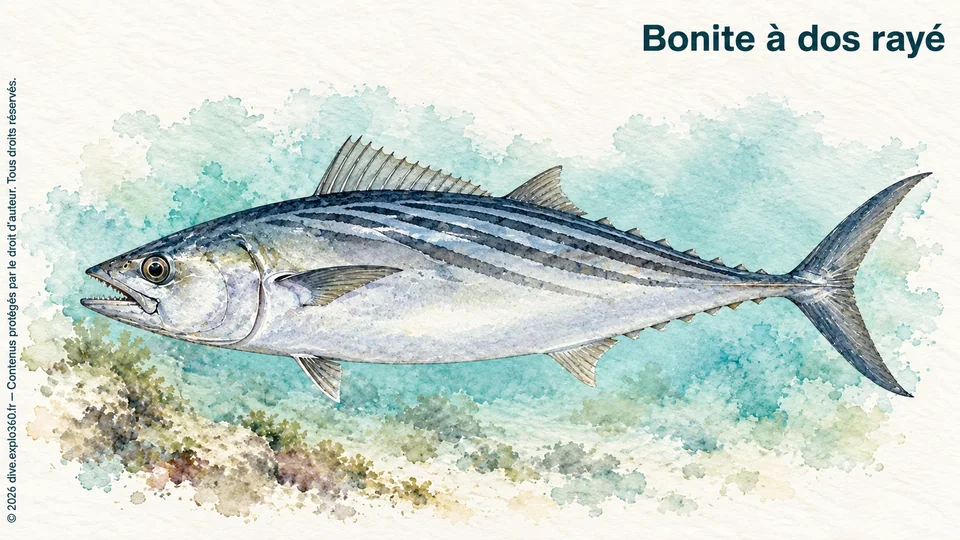
Atlantic bonito

Distribution : Atlantic and Mediterranean including the Black Sea. DORIS describes near-surface encounters; FishBase also reports 80–200 m. The combined 0–200 m interval does not imply uniform frequency.

In Istanbul, bonito is called palamut. Cooks chill it in icy water and salt it to make lakerda. A swimming bonito has dark stripes that flicker against its silver back.

Images being acquired · Your video or photos here

Habitat of Atlantic bonito Habitat
Open water
Depth range of Atlantic bonito Depth
0-200 m
Biological group of Atlantic bonito Group
Ecological role of Atlantic bonito Role
Predator

Size

About 50 cm; maximum 91.4 cm in DORIS

WHAT DOES IT LOOK LIKE?

The Atlantic bonito’s dark bands stay on the back and upper flanks; its belly is pale and plain. The long head carries a large mouth. Two closely spaced fins occupy the back, followed by finlets, tiny fins lined up before the tail.

GO FURTHER WITH AMIGANSEAU

Unlock the full profile

Deepen your knowledge with the exclusive chapters and interactive resources included in an AMIGANSEAU licence.

Choose my licence
  • WHERE DOES IT LIVE?
  • WHAT DOES IT EAT?
  • HOW DOES IT REPRODUCE?
  • OUR OBSERVATIONS

Also included in the full profile

  • Advanced navigation between description, ecological context, observations and behaviour
  • Interactive food chain to explore the species’ feeding relationships
An active licence gives access to enriched profiles and AMIGANSEAU exploration tools.
Atlantic bonito

Understand the species

What is this species’ ecological role?

AMIGANSEAU Explorer Premium

Access enriched species profiles with advanced content (audio, infographics and detailed articles).

Explore all species easily through a single interface.

Enjoy a smooth, fast learning experience suited to every level.

🔒 The full profile is available with a paid subscription only.

Discover licences

POURSUIVRE L’EXPLORATION

Explore further

ArticleWHAT IF IT ALL HAPPENED UNDERWATER?Read the article →ArticleWhat marine animals do and why it mattersRead the article →ArticlePHYLA WITHOUT THE FUSSRead the article →