Habitat
 Depth
 Group
 Role
WHAT DOES IT LOOK LIKE?
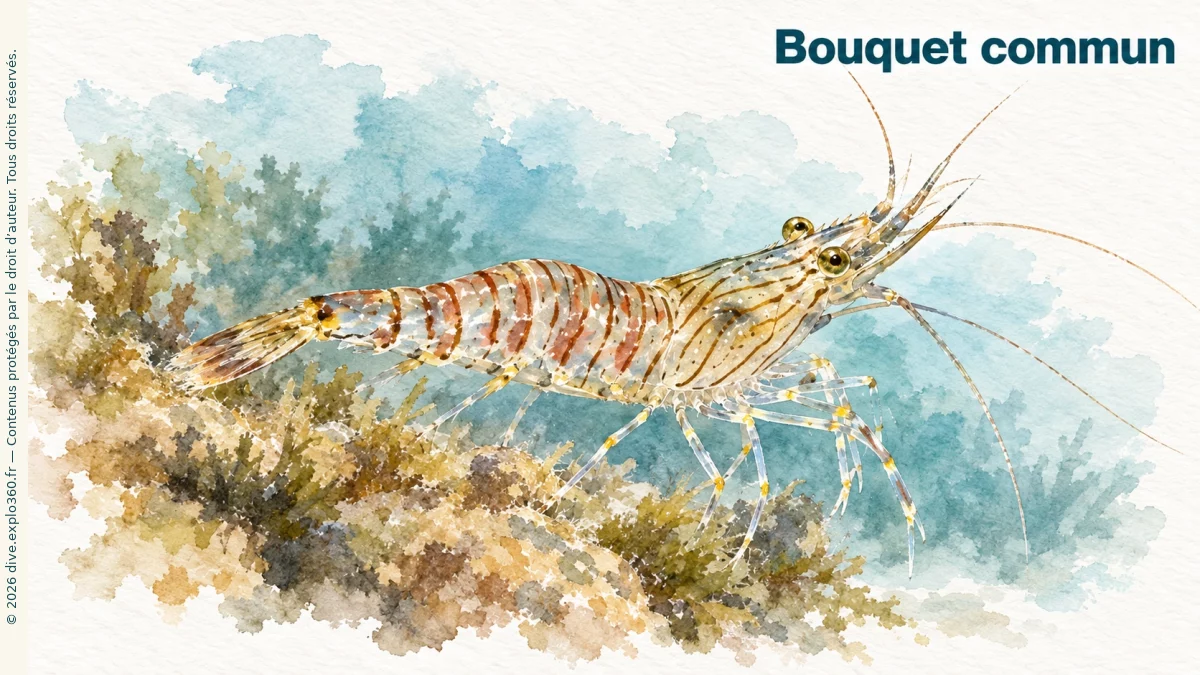
The common prawn has a transparent body around five to eleven centimetres long. The abdomen carries transverse bands and dark lines; the carapace has oblique or lengthwise reddish-brown streaks and yellow dots. Slender antennae extend well ahead of the head.
The rostrum, the toothed projection from the head, is long and slightly upturned towards the tip. This feature and tooth arrangement help distinguish it from other Palaemon species. The pink colour associated with cooked prawns does not describe its living appearance.
WHERE DOES IT LIVE?
It inhabits rocky seabeds, seagrass and sandy-mud areas, from the surface to around forty metres. In very shallow water, shaded corners may suit it. Plants and rocks structure the spaces through which it moves.
It occurs in the Mediterranean, Atlantic, English Channel and North Sea. A Mediterranean shallow-water encounter therefore belongs to a much wider distribution, without every population experiencing identical temperatures or changes in salinity, the amount of salts in the water.
WHAT DOES IT EAT?
It is omnivorous, using plant and animal foods. Algae, small crustaceans, worms and sometimes small gastropods form part of its diet. Small claws and mouthparts grasp and process pieces.
A prawn sitting on an alga is not necessarily eating its tissue at that moment.
GO FURTHER WITH AMIGANSEAU
Unlock the full profile
Deepen your knowledge with the exclusive chapters and interactive resources included in an AMIGANSEAU licence.
- HOW DOES IT REPRODUCE?
- OUR OBSERVATIONS
- ARTICLE
Also included in the full profile
- Advanced navigation between description, ecological context, observations and behaviour
- Interactive food chain to explore the species’ feeding relationships