Habitat
 Depth
 Group
 Role
 Size
 Good to know
WHAT DOES IT LOOK LIKE?
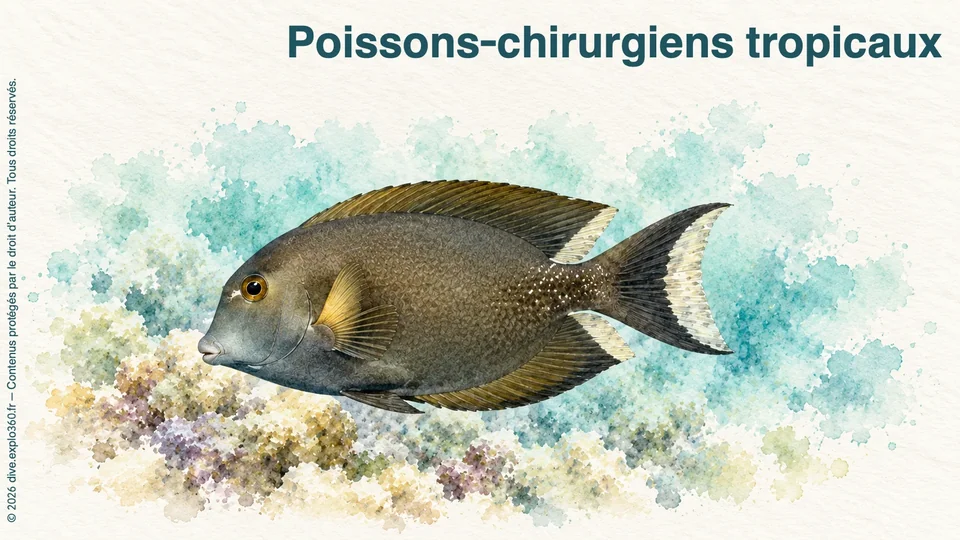
Surgeonfishes have one or more sharp structures on each side of the caudal peduncle, just before the tail fin. Depending on the species, these may be movable spines or fixed cutting plates. They are a distinctive feature of this fish family.
A small mouth, a body flattened from side to side and a long back fin complete the general outline. Sizes, colours and tail structures differ, so this group entry does not describe a single species.
WHERE DOES IT LIVE?
Close to reef surfaces or higher in the water, surgeonfish occupy different positions. Most remain associated with tropical reefs. Each species nevertheless has its own geographic range and occupied depths, rather than a shared limit for the entire family.
WHAT DOES IT EAT?
Surgeonfish diets differ by species. In the Red Sea, the sohal surgeonfish grazes algae attached to the reef. The striated surgeonfish uses fine teeth to collect organic detritus, diatoms and tiny organisms from surfaces. The sleek unicornfish feeds mainly on zooplankton in open water. Despite their similarities, these fish exploit different food sources.
GO FURTHER WITH AMIGANSEAU
Unlock the full profile
Deepen your knowledge with the exclusive chapters and interactive resources included in an AMIGANSEAU licence.
Subscribing to Dive.Explo360 means supporting a different way to discover marine life.
Our independent platform is entirely self-funded and relies solely on subscriptions. Every licence helps us continue our work, create new content, and share what we know about the marine world with as many people as possible.
Starting at €80 per year, your support makes all the difference.
 Understand the species