Habitat
 Depth
 Group
 Role
WHAT DOES IT LOOK LIKE?
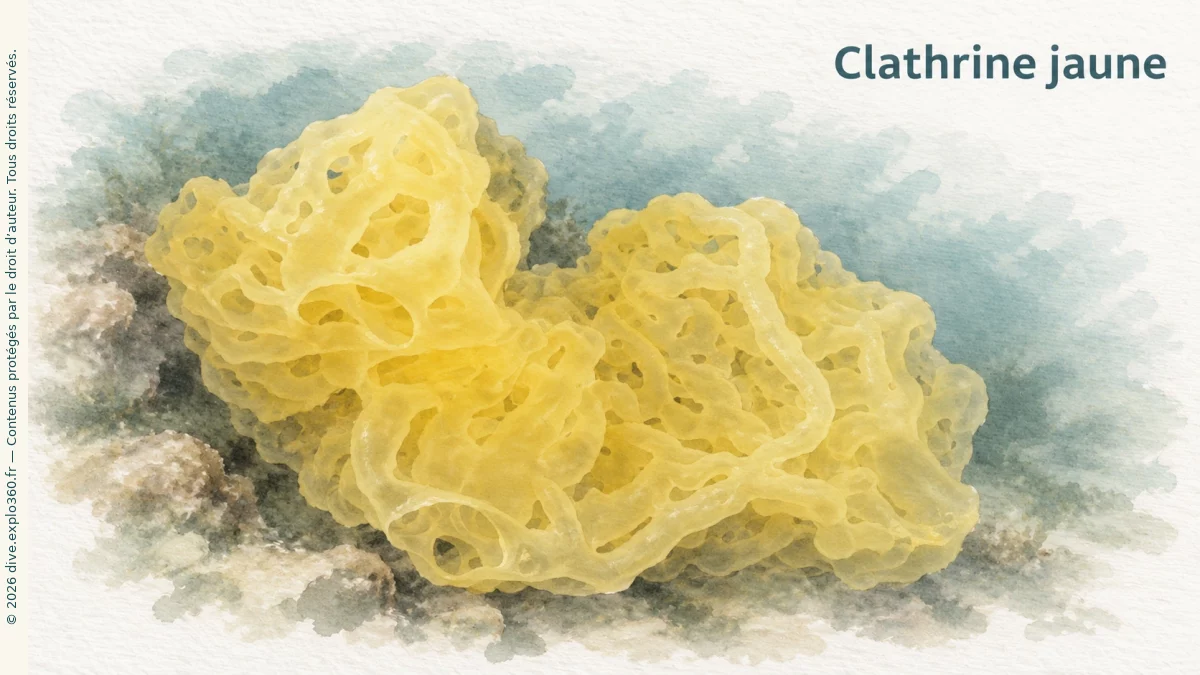
The yellow clathrina forms open cushions of winding, interconnected tubes. Yellow colour and the net-like appearance are the first clues. Tube dimensions and the overall outline vary between individuals and with their condition.
Its skeleton contains spicules, tiny supporting elements made of calcite. Three-rayed pieces help confirm identification under a microscope. A calcareous sponge can therefore remain soft: its skeleton is not a continuous shell.
WHERE DOES IT LIVE?
It attaches to dim rocky surfaces in crevices, beneath overhangs and inside cavities. These conditions occur in shallow water along French Mediterranean coasts.
Depth alone does not describe exposure. Rock shape, orientation and an overhead roof affect the light reaching the sponge.
WHAT DOES IT EAT?
Water passes through the tubular body, carrying microscopic food. Choanocytes, cells with a collar and a moving filament, maintain flow and help capture food.
Feeding therefore relies on exchanges at cell scale. Looking at cushion size alone cannot reveal pumping rate or the amount of food retained.
GO FURTHER WITH AMIGANSEAU
Unlock the full profile
Deepen your knowledge with the exclusive chapters and interactive resources included in an AMIGANSEAU licence.
- HOW DOES IT REPRODUCE?
- OUR OBSERVATIONS
- ARTICLE
Also included in the full profile
- Advanced navigation between description, ecological context, observations and behaviour
- Interactive food chain to explore the species’ feeding relationships