Habitat
 Depth
 Group
 Role
 Size
WHAT DOES IT LOOK LIKE?
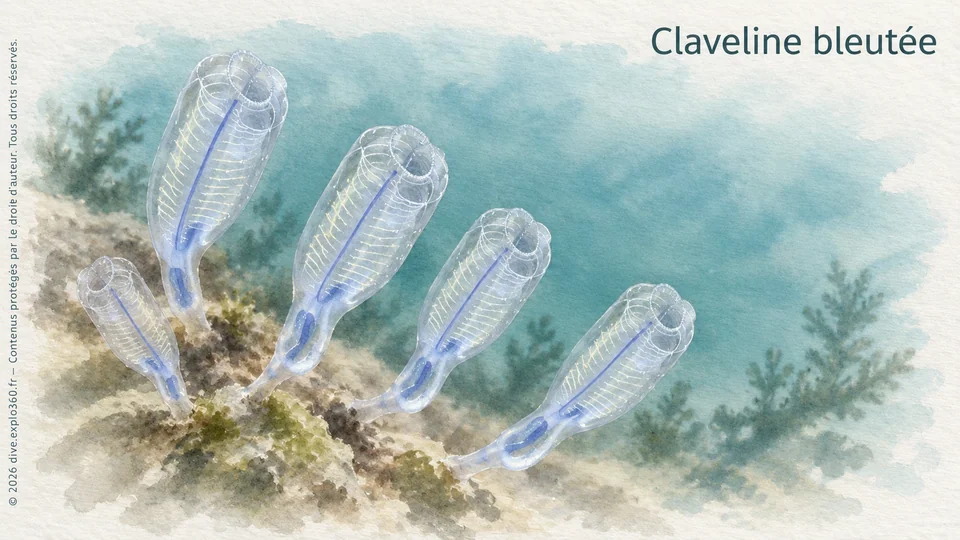
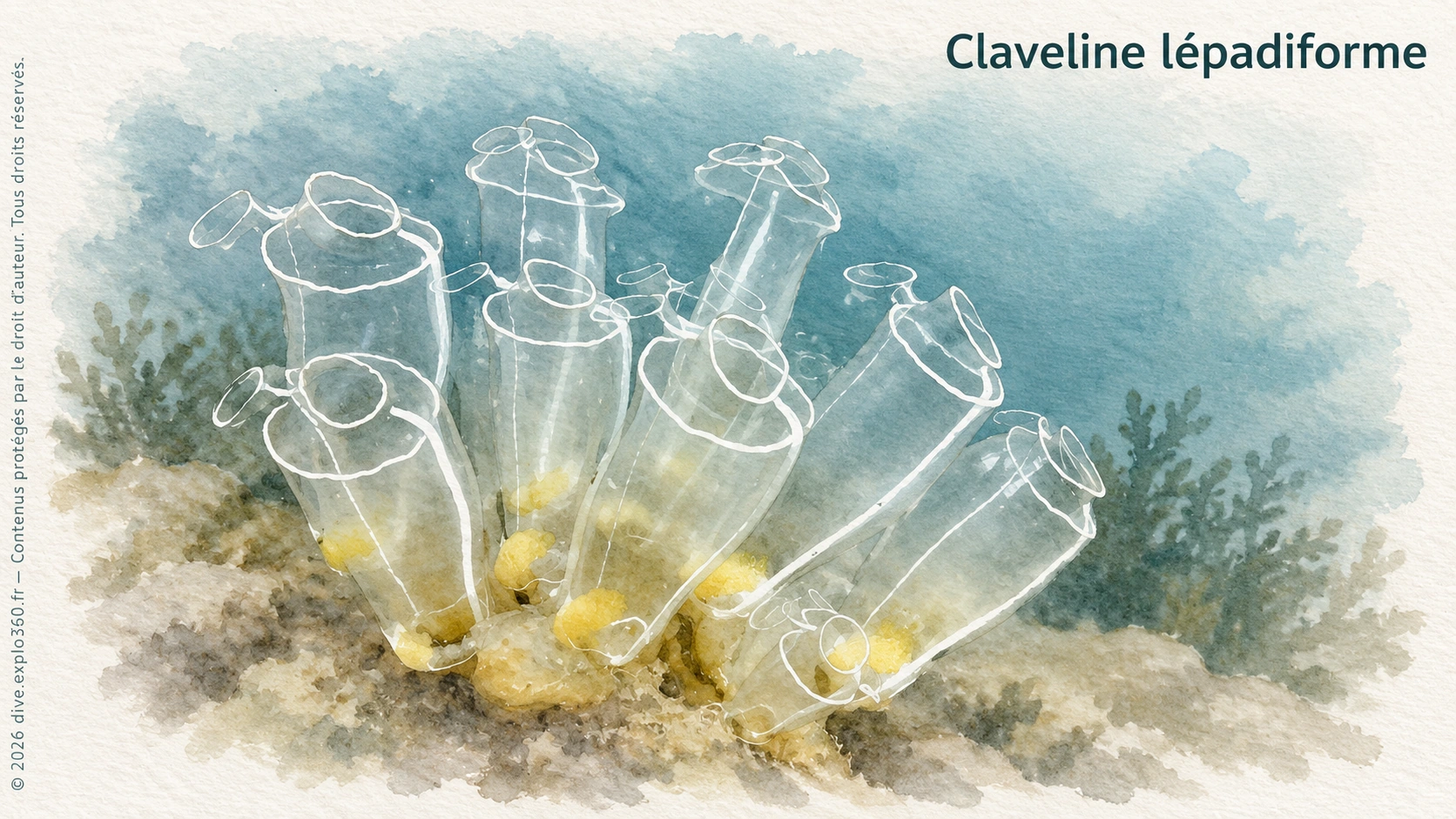
The transparent body of the blue-tinted sea squirt (Clavelina dellavallei) reveals pale yellow stripes, a violet-blue line and a short loop of the same colour. Its bell-shaped body sits on a short stalk called a peduncle. Two distinct openings called siphons sit close together at the top.
WHERE DOES IT LIVE?
It attaches to rocks, coralligenous formations and sometimes organisms such as gorgonians. It occurs along French Mediterranean coasts, notably on rocky sites beyond the very shallowest water.
Zooids, the colony’s individual units, may stand apart or form a cluster. Fine stolons, creeping basal extensions, link them without necessarily forming a large common mass.
WHAT DOES IT EAT?
Transparency reveals part of the blue-striped light-bulb tunicate’s feeding system. The oral siphon admits particle-bearing water; sensory tentacles can exclude large objects. Mucus gathers food in the branchial sac, and cilia convey it to the oesophagus and stomach. Filtered water crosses branchial slits and leaves through the exhalant siphon. Digestive residues also reach the outlet route after intestinal passage. Food therefore follows a longer path than water.
GO FURTHER WITH AMIGANSEAU
Unlock the full profile
Deepen your knowledge with the exclusive chapters and interactive resources included in an AMIGANSEAU licence.
Subscribing to Dive.Explo360 means supporting a different way to discover marine life.
Our independent platform is entirely self-funded and relies solely on subscriptions. Every licence helps us continue our work, create new content, and share what we know about the marine world with as many people as possible.
Starting at €80 per year, your support makes all the difference.
 Understand the species