Habitat
 Depth
 Group
 Role
WHAT DOES IT LOOK LIKE?
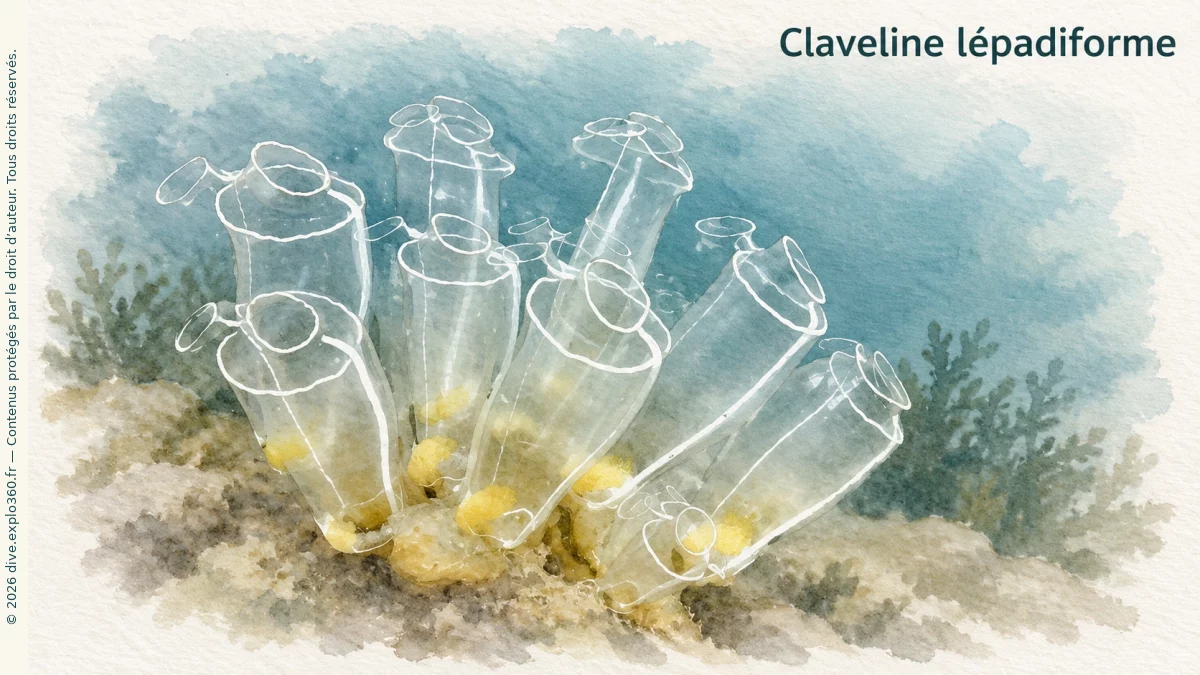
The light-bulb sea squirt is a colonial ascidian, an attached filter-feeding animal with individuals linked at the base. Each zooid, an individual unit of the colony, resembles a small transparent bell marked with white rings and lines.
Two siphons, the water inlet and outlet, lie near the top. Transparency reveals the branchial basket, the internal filter, and part of the digestive tract. Stolons, creeping extensions, link the bases.
WHERE DOES IT LIVE?
It attaches to rocks, shells and other hard natural or artificial surfaces. French Mediterranean records notably concern rocky walls, while the group also occurs in harbours.
Habitat should accompany every seasonal account. A harbour cluster does not directly represent an open-coast population’s functioning.
WHAT DOES IT EAT?
Water enters the oral siphon and crosses the branchial filter. A mucus net retains food particles; cilia, fine moving cell projections, then convey material towards the oesophagus and stomach.
Filtered water follows another route and leaves through the exhalant siphon. The animal extracts food without swallowing the entire current into its digestive tract.
GO FURTHER WITH AMIGANSEAU
Unlock the full profile
Deepen your knowledge with the exclusive chapters and interactive resources included in an AMIGANSEAU licence.
- HOW DOES IT REPRODUCE?
- OUR OBSERVATIONS
- ARTICLE
Also included in the full profile
- Advanced navigation between description, ecological context, observations and behaviour
- Interactive food chain to explore the species’ feeding relationships