Habitat
 Depth
 Group
 Role
 Size
WHAT DOES IT LOOK LIKE?
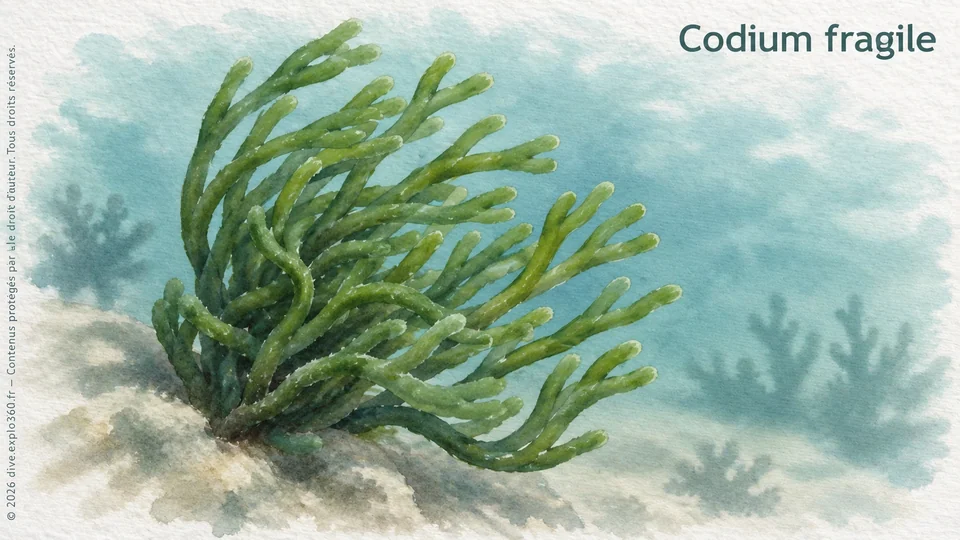
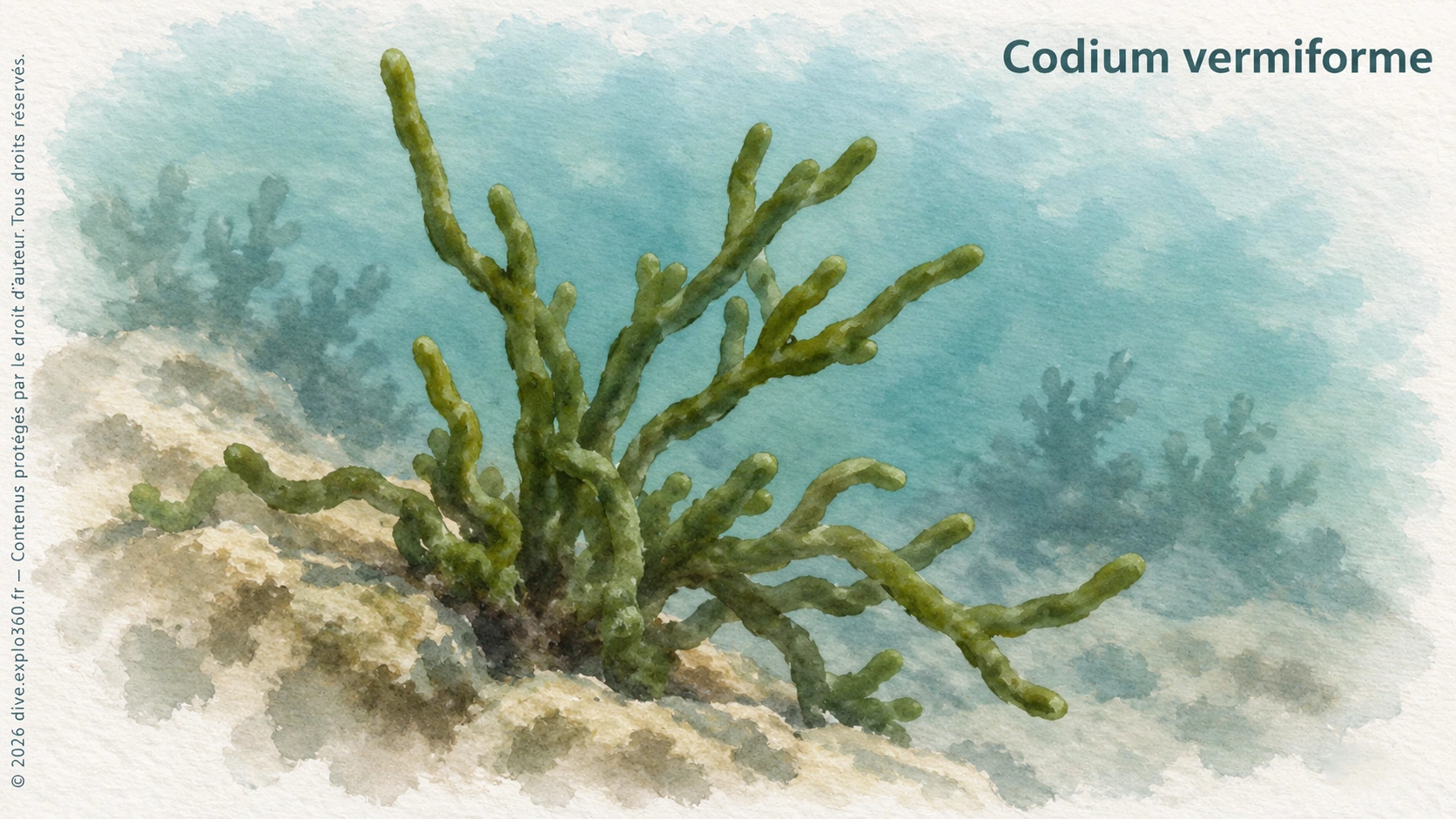
The green, cylindrical branches of green sea fingers (Codium fragile) fork repeatedly to form an upright tuft that can look quite hairy. Other Codium algae look similar, so you need a microscope to tell them apart reliably.
WHERE DOES IT LIVE?
It occupies hard natural or artificial shallow-water surfaces and some coastal lagoons. Its origin lies in the Pacific; the introduced form is widely documented in the Mediterranean.
Codium fragile can attach to rocks, shells and submerged artificial structures. In sheltered areas, its tufts sometimes grow alongside other branched green algae, some of which have a very similar outline.
WHAT DOES IT EAT?
Codium fragile produces its organic matter through photosynthesis. Chlorophyll pigments in its branches capture light energy, enabling the production of sugars from inorganic carbon dissolved in seawater. The alga also absorbs mineral nutrients needed for growth. It does not catch prey: it relies on light and dissolved substances to develop.
GO FURTHER WITH AMIGANSEAU
Unlock the full profile
Deepen your knowledge with the exclusive chapters and interactive resources included in an AMIGANSEAU licence.
- HOW DOES IT REPRODUCE?
- OUR OBSERVATIONS
- ARTICLE
Also included in the full profile
- Advanced navigation between description, ecological context, observations and behaviour
- Interactive food chain to explore the species’ feeding relationships
 Understand the species