Partners and information

Contact us

Verification code

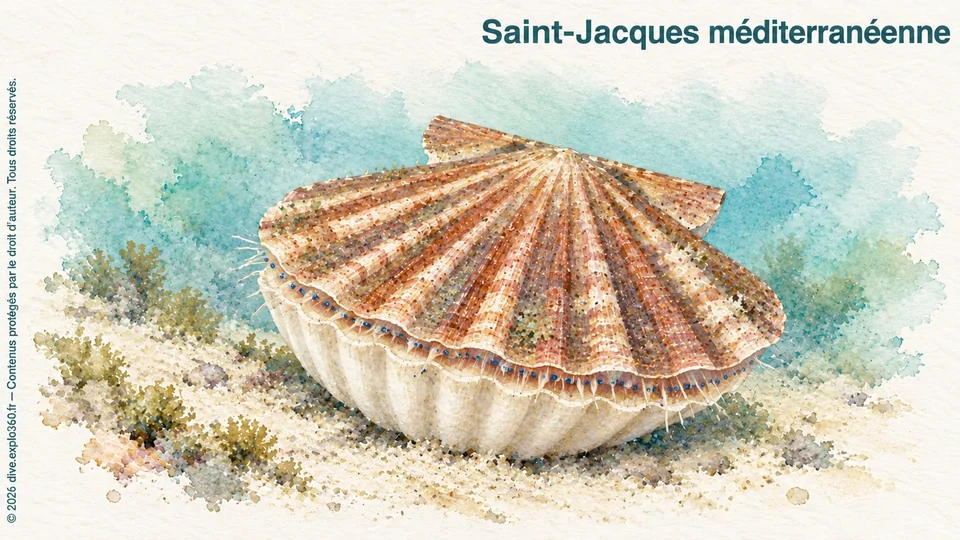
Mediterranean scallop

Distribution : Mediterranean soft bottoms, usual 15–50 m interval described by DORIS. Distinct from Pecten maximus.

The Mediterranean scallop can leave the seabed by snapping its two shell halves together. The water it pushes out sends it forward in bursts. When it opens slightly, a row of tiny eyes comes into view.

Images being acquired · Your video or photos here

Habitat of Mediterranean scallop Habitat
Sand, Mud, Detrital bottom
Depth range of Mediterranean scallop Depth
15-50 m
Biological group of Mediterranean scallop Group
Ecological role of Mediterranean scallop Role
Filter feeder

Size

Shell up to 15 cm according to DORIS

WHAT DOES IT LOOK LIKE?

The two valves, the shell halves of the Mediterranean scallop, differ: one is domed and pale, the other flat and brown. Fourteen to sixteen ribs radiate in a fan. Two equal-sized ears frame the hinge.

GO FURTHER WITH AMIGANSEAU

Unlock the full profile

Deepen your knowledge with the exclusive chapters and interactive resources included in an AMIGANSEAU licence.

Choose my licence
  • WHERE DOES IT LIVE?
  • WHAT DOES IT EAT?
  • HOW DOES IT REPRODUCE?
  • OUR OBSERVATIONS

Also included in the full profile

  • Advanced navigation between description, ecological context, observations and behaviour
  • Interactive food chain to explore the species’ feeding relationships
An active licence gives access to enriched profiles and AMIGANSEAU exploration tools.
Mediterranean scallop

Understand the species

What is this species’ ecological role?

AMIGANSEAU Explorer Premium

Access enriched species profiles with advanced content (audio, infographics and detailed articles).

Explore all species easily through a single interface.

Enjoy a smooth, fast learning experience suited to every level.

🔒 The full profile is available with a paid subscription only.

Discover licences

POURSUIVRE L’EXPLORATION

Explore further

ArticleTHE SECRETS OF SANDRead the article →ArticleWhat marine animals do and why it mattersRead the article →ArticlePHYLA WITHOUT THE FUSSRead the article →