Partners and information

Contact us

Verification code

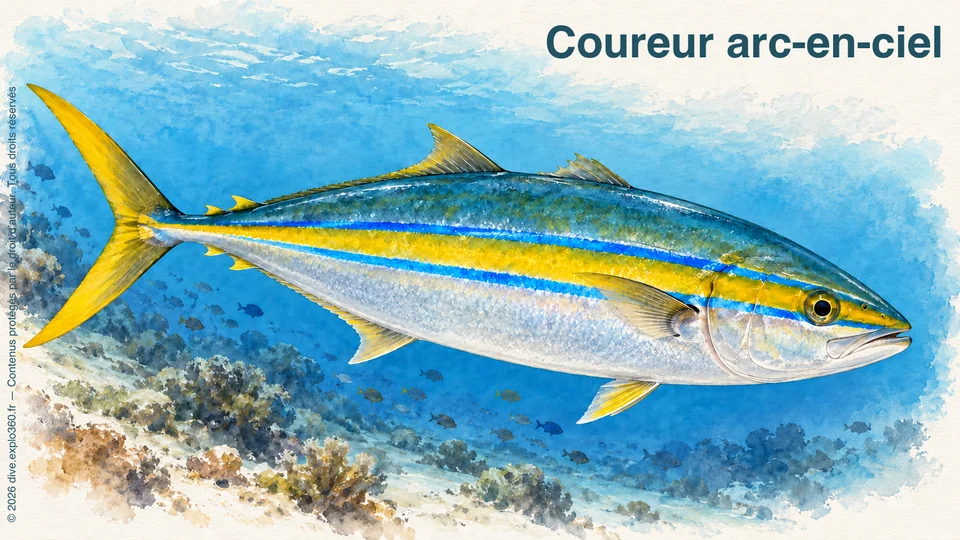
Rainbow runner

Distribution : Warm waters of the Atlantic, Indian and Pacific oceans, including the Maldives; also in the Red Sea.

In 1988, two archaeologists published a study with an evocative title: The Quest for the Rainbow Runner. On the Pacific atolls of Kapingamarangi and Nukuoro, the fish known as te kina features in chants, stories and unusual fishing techniques. Yet an examination of eleven archaeological sites spanning roughly a millennium found that offshore predators, including rainbow runners, accounted for fewer than 15% of nearly 2,000 identified fish remains. The contrast suggests that the fish's importance in local storytelling was far greater than its contribution to the archaeological catch.

Images being acquired · Your video or photos here

Habitat of Rainbow runner Habitat
Open water, Coral reef
Depth range of Rainbow runner Depth
0-150 m
Biological group of Rainbow runner Group
Ecological role of Rainbow runner Role
Predator

Size

Up to 180 cm

Good to know

Observe without touching or feeding animals and keep clear of the coral.

WHAT DOES IT LOOK LIKE?

The rainbow runner (Elagatis bipinnulata) has two tiny fins called finlets just ahead of the tail, one above and one below. Each has two rays. Blue and yellow stripes run along its streamlined body between the dark blue-green back and the pale belly. The snout is pointed and the tail is deeply forked. The largest fish reach about 1.8 m.

WHERE DOES IT LIVE?

It lives in warm seas, around islands and in open water. It occurs in the Atlantic, Indian and Pacific oceans, including the Maldives, and in the Red Sea.

It frequents reefs around oceanic islands and forms schools near the surface. It can also move away into open water. It mainly uses upper waters but has also been found down to 150 m. Schools move beside drop-offs and around isolated underwater features.

WHAT DOES IT EAT?

In open water, the rainbow runner takes prey of different sizes. Small fish and squid feature in its diet alongside planktonic crustaceans. It can exploit both mobile fish and small prey dispersed through the water.

GO FURTHER WITH AMIGANSEAU

Unlock the full profile

Deepen your knowledge with the exclusive chapters and interactive resources included in an AMIGANSEAU licence.

Choose my licence
  • HOW DOES IT REPRODUCE?
  • OUR OBSERVATIONS
  • ARTICLE

Also included in the full profile

  • Advanced navigation between description, ecological context, observations and behaviour
  • Interactive food chain to explore the species’ feeding relationships
An active licence gives access to enriched profiles and AMIGANSEAU exploration tools.
Rainbow runner

Understand the species

What is this species’ ecological role?

AMIGANSEAU Explorer Premium

Access enriched species profiles with advanced content (audio, infographics and detailed articles).

Explore all species easily through a single interface.

Enjoy a smooth, fast learning experience suited to every level.

🔒 The full profile is available with a paid subscription only.

Discover licences

POURSUIVRE L’EXPLORATION

Explore further

ArticleSCHOOLS OF FISHRead the article →ArticleWhat marine animals do and why it mattersRead the article →ArticlePHYLA WITHOUT THE FUSSRead the article →