


 Habitat
 Depth
 Group
 Role
 Average size
 Good to know
WHAT DOES IT LOOK LIKE?
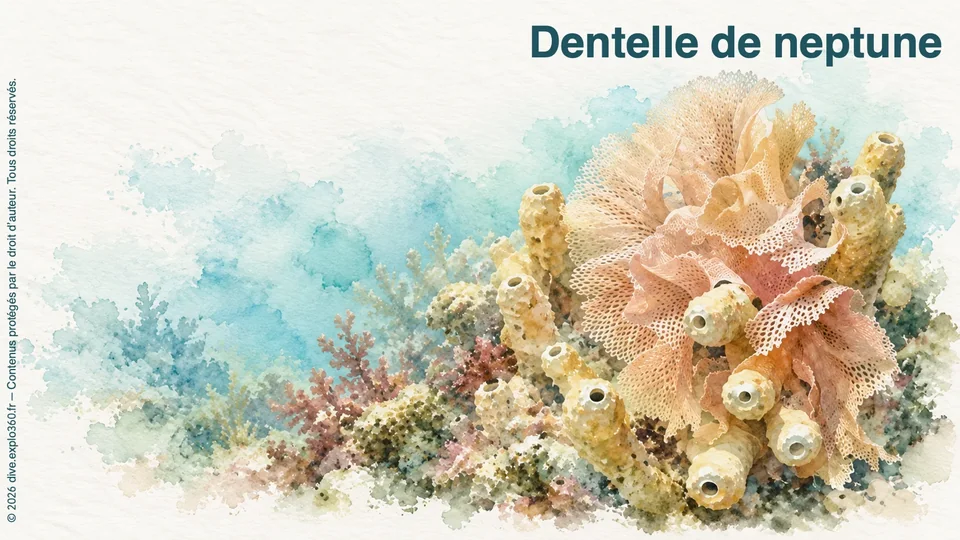
The folds of Neptune’s lace (Reteporella grimaldii) form a rosette or fan of thin sheets patterned like lace. The evenly spaced openings make the colony look delicate. Minerals harden its calcium-rich framework, making it rigid, but it is still very fragile, especially at the edges.
Pink to pale yellow tones cover the sheets housing the zooids, the tiny animals of the colony. The large openings create the lace pattern; individual chambers are much smaller.
WHERE DOES IT LIVE?
Neptune's lace mainly lives in dimly lit areas such as rocky drop-offs, caves, overhangs or coralligenous habitats.
It attaches to hard surfaces, sometimes to living organisms. It occurs in areas with flowing water.
WHAT DOES IT EAT?
Neptune’s lace feeds on tiny organisms and food particles carried by the water, including phytoplankton made up of microscopic algae. Each small animal in the colony extends a lophophore, a crown of tentacles edged with moving cilia. The beating cilia move water and direct particles towards its mouth. Many individuals in the colony can feed at the same time.
GO FURTHER WITH AMIGANSEAU
Unlock the full profile
Deepen your knowledge with the exclusive chapters and interactive resources included in an AMIGANSEAU licence.
- HOW DOES IT REPRODUCE?
- OUR OBSERVATIONS
- ARTICLE
Also included in the full profile
- Advanced navigation between description, ecological context, observations and behaviour
- Interactive food chain to explore the species’ feeding relationships
- Infographic and illustrated summary profile
- Additional photographic observations
 Understand the species
