Habitat
 Depth
 Group
 Role
WHAT DOES IT LOOK LIKE?
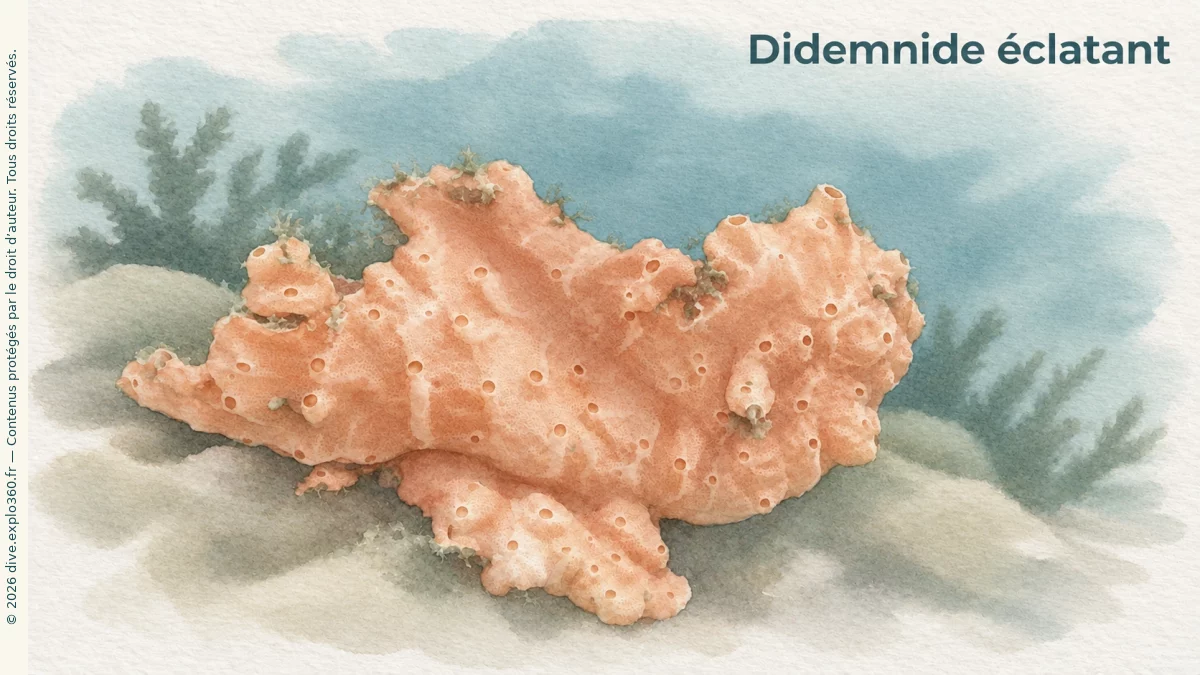
The orange didemnid sea squirt forms orange encrusting colonies with variable thickness and outlines. Zooids, the ascidian’s individual units, are embedded in a common tunic. Outgoing openings can form small raised areas.
Water entrances occur at a much finer scale than the siphons of a large solitary ascidian. Colour draws attention but cannot alone separate all orange seabed crusts.
WHERE DOES IT LIVE?
It occurs on Mediterranean rock and can also grow on Posidonia rhizomes, the creeping stems of these plants. French records notably include the Marseille region.
The visible surface follows its support. Monitoring needs stable landmarks: a fold or changed camera angle can alter projected area without real growth.
WHAT DOES IT EAT?
Each zooid filters microscopic particles from water. Food travels to its digestive tract while water reaches common outgoing pathways.
The tunic also hosts associated bacteria. These differ from microbes captured as food: some inhabitants persist within the colony.
GO FURTHER WITH AMIGANSEAU
Unlock the full profile
Deepen your knowledge with the exclusive chapters and interactive resources included in an AMIGANSEAU licence.
- HOW DOES IT REPRODUCE?
- OUR OBSERVATIONS
- ARTICLE
Also included in the full profile
- Advanced navigation between description, ecological context, observations and behaviour
- Interactive food chain to explore the species’ feeding relationships