Habitat
 Depth
 Group
 Role
 Size
 Good to know
WHAT DOES IT LOOK LIKE?
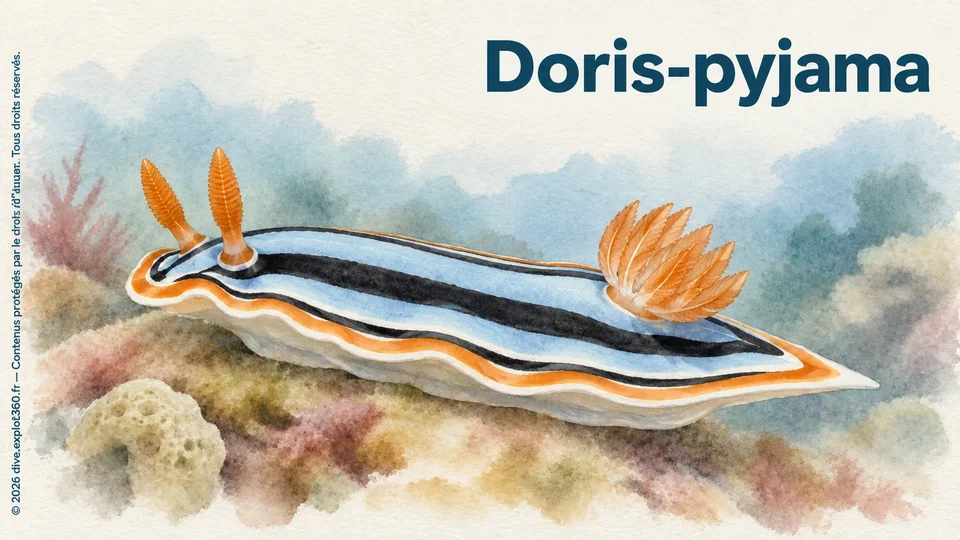
A thin white line runs along the outside of the orange border of the pyjama nudibranch (Chromodoris quadricolor). Black bands alternate with pale blue across its narrow body. Its two upright rhinophores at the front are orange, as is the gill plume at the rear. It grows to about 5 cm and is more slender than the African nudibranch.
WHERE DOES IT LIVE?
The pyjama nudibranch is native to the Red Sea and western Indian Ocean. It uses reef bottoms and their sponges, often between five and thirty metres. Mediterranean records concern occurrence outside this natural area, not a species naturally endemic to the Mediterranean as a whole. It moves over surfaces, including sponges. New records should retain body and margin details to avoid confusion with other striped Chromodoris species.
WHAT DOES IT EAT?
The pyjama chromodorid feeds on certain sponges attached to reefs. It removes small portions of tissue with its radula, a ribbon of tiny teeth inside its mouth. Some substances from the sponges it eats may be retained in the tissues of its mantle and help defend it against predators.
GO FURTHER WITH AMIGANSEAU
Unlock the full profile
Deepen your knowledge with the exclusive chapters and interactive resources included in an AMIGANSEAU licence.
Subscribing to Dive.Explo360 means supporting a different way to discover marine life.
Our independent platform is entirely self-funded and relies solely on subscriptions. Every licence helps us continue our work, create new content, and share what we know about the marine world with as many people as possible.
Starting at €80 per year, your support makes all the difference.
 Understand the species