


 Habitat
 Depth
 Group
 Role
 Size
 Good to know
WHAT DOES IT LOOK LIKE?
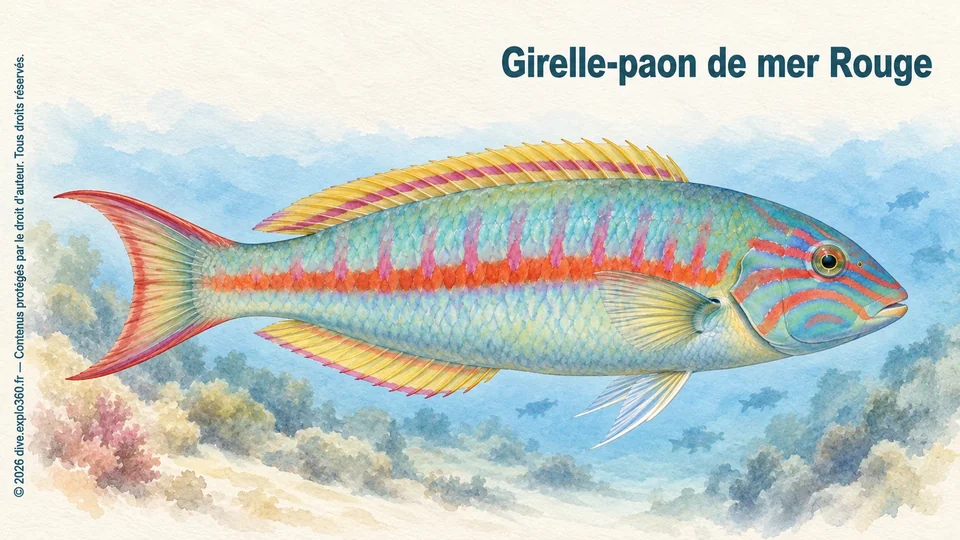
The bright colours of large males represent only one appearance of the Klunzinger’s wrasse (Thalassoma rueppellii). Young fish and females are less colourful. In the large male, the orange band and pink lines contrast with bluish green. The body is long, the mouth small, the tail edge indented. Length approaches twenty centimetres.
WHERE DOES IT LIVE?
The known natural range of this species is the Red Sea. It uses coral reefs, particularly their edges and slopes, and remains mobile above the bottom rather than resting in a burrow. Encounters often occur within the first few tens of metres of water. Endemic means naturally restricted to this region; it does not mean the species is present on every individual reef.
WHAT DOES IT EAT?
On the reef bottom, Klunzinger’s wrasse seeks small invertebrates. These animal resources make up the species’ generally known diet, although its meals remain poorly detailed.
GO FURTHER WITH AMIGANSEAU
Unlock the full profile
Deepen your knowledge with the exclusive chapters and interactive resources included in an AMIGANSEAU licence.
- HOW DOES IT REPRODUCE?
- OUR OBSERVATIONS
- ARTICLE
Also included in the full profile
- Advanced navigation between description, ecological context, observations and behaviour
- Interactive food chain to explore the species’ feeding relationships
 Understand the species