Habitat
 Depth
 Group
 Role
WHAT DOES IT LOOK LIKE?
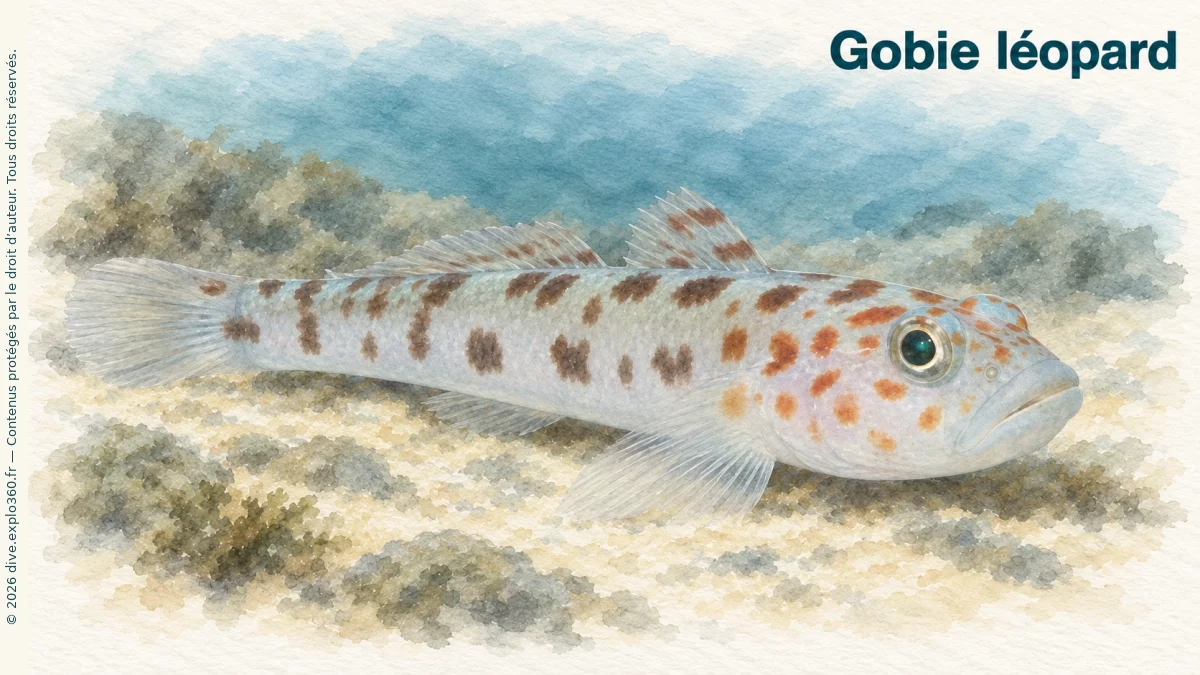
The leopard-spotted goby reaches about thirteen centimetres. Its white to grey background highlights large brown blotches along the flanks and finer orange-red spots on the head. The eyes are dark green, and the body may show iridescent colours.
It has two dorsal fins marked with orange bands, with a black spot at the rear of the first. The pelvic fins beneath the belly join into a disc. The head lacks scales, and the body flattens sideways towards the tail.
WHERE DOES IT LIVE?
It inhabits small shaded areas of sand beside caves, fissures and overhangs. It also uses cracks in vertical rock faces. Sightings are possible from a few metres to roughly forty metres deep.
Its range extends beyond the Mediterranean into the Atlantic and English Channel, reaching north-western European coasts. There too, it remains closely associated with rocky refuges.
WHAT DOES IT EAT?
Its prey consists mainly of small crustaceans. It also eats worms, gastropods, the mollusc group containing snails, and other small organisms. Algae, eggs and larvae are also mentioned in diet accounts.
This varied menu is described as opportunistic: the fish can use several kinds of food available around it.
GO FURTHER WITH AMIGANSEAU
Unlock the full profile
Deepen your knowledge with the exclusive chapters and interactive resources included in an AMIGANSEAU licence.
- HOW DOES IT REPRODUCE?
- OUR OBSERVATIONS
- ARTICLE
Also included in the full profile
- Advanced navigation between description, ecological context, observations and behaviour
- Interactive food chain to explore the species’ feeding relationships