Habitat
 Depth
 Group
 Role
WHAT DOES IT LOOK LIKE?
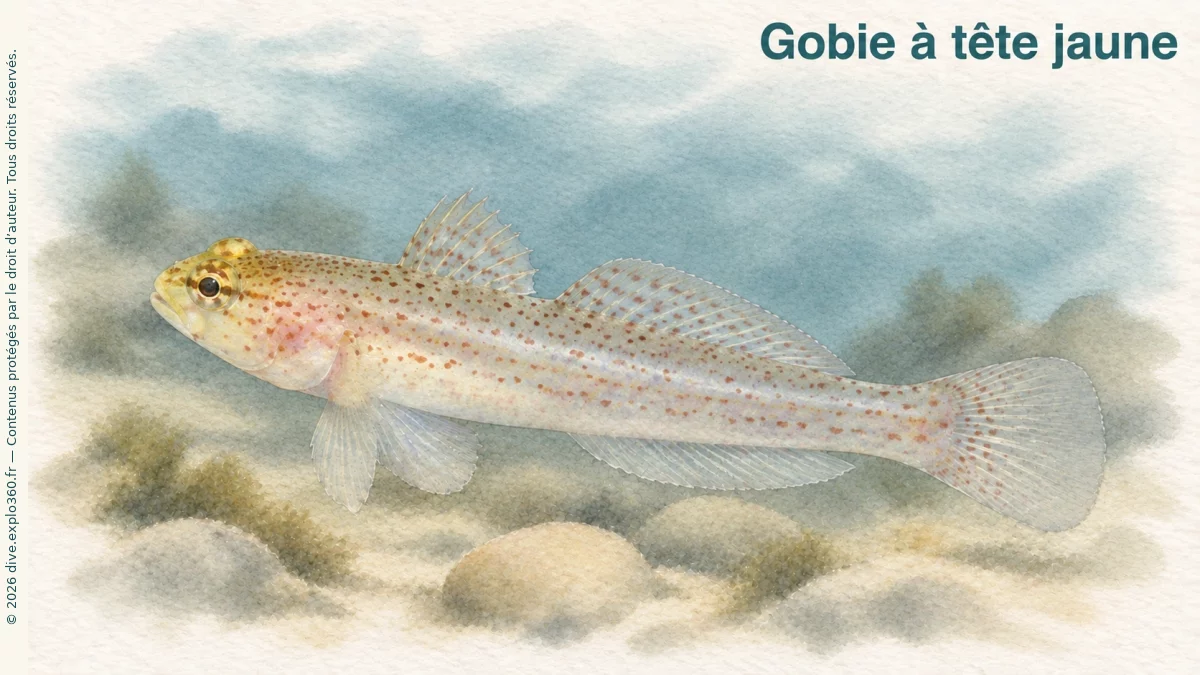
This goby reaches about nine centimetres. Its elongated body has two separate dorsal fins, the first taller than the second, and a fairly robust head with large, closely set eyes. The fins beneath the belly join into a disc.
The head, nape and eyes are tinged yellow. On the greyer or pinkish-beige flanks, red dashes form broken lengthwise lines. At night the body darkens and develops irregular vertical brown bands. Colour alone is therefore not always enough for identification.
WHERE DOES IT LIVE?
It uses rocky crevices, including coralligenous areas, underwater structures partly built by lime-producing algae. It also inhabits seagrass meadows. Sightings are frequent between five and twenty metres, with records down to eighty metres.
Its range includes the western Mediterranean and eastern Atlantic. It is known from the French Mediterranean coast, Corsica and the Iberian Peninsula, as well as Madeira and the Canary Islands.
WHAT DOES IT EAT?
It feeds mainly on decapod crustaceans, such as small shrimps and crabs, along with molluscs and polychaetes, marine worms bearing bristles. Its food is associated with small animals living close to the seabed.
Older information sometimes needs careful interpretation: before the fish was recognised as a separate species, it could be studied under the name golden goby.
GO FURTHER WITH AMIGANSEAU
Unlock the full profile
Deepen your knowledge with the exclusive chapters and interactive resources included in an AMIGANSEAU licence.
- HOW DOES IT REPRODUCE?
- OUR OBSERVATIONS
- ARTICLE
Also included in the full profile
- Advanced navigation between description, ecological context, observations and behaviour
- Interactive food chain to explore the species’ feeding relationships