Habitat
 Depth
 Group
 Role
 Size
 Good to know
WHAT DOES IT LOOK LIKE?
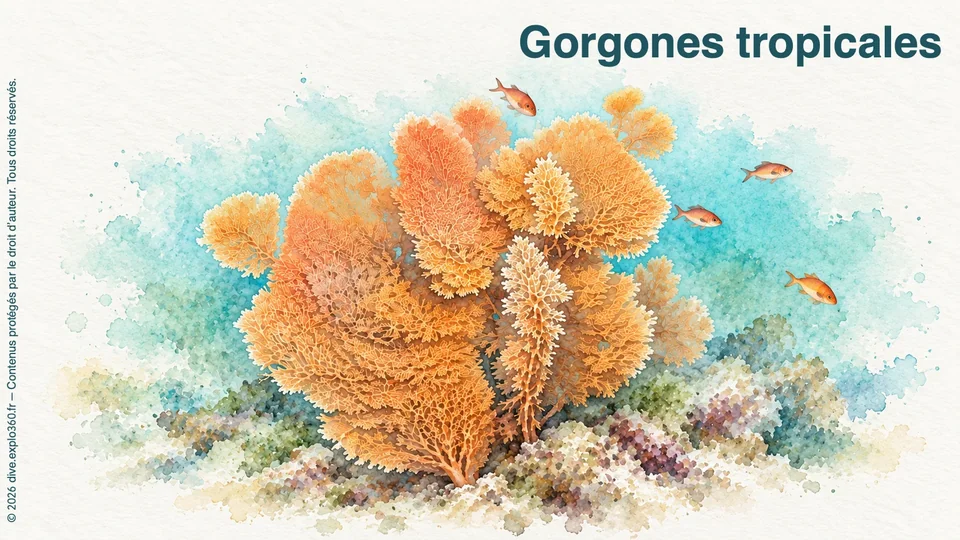
A branching axis gives gorgonians their outline, sometimes fan-shaped and sometimes bushier. The branches carry the polyps, the small animals making up the colony. Each has eight pinnate tentacles, edged with fine branches resembling a feather.
Here the term gorgonian covers several species with a similar general organisation but different colony shapes.
WHERE DOES IT LIVE?
A hard surface anchors the colony, while water movement shapes its immediate surroundings. Different sea fans may occupy different conditions and depths. Without a more precise identification, no single depth range can be assigned to them.
WHAT DOES IT EAT?
The little tentacle crowns on a Red Sea gorgonian’s branches act as capture points. They intercept plankton and organic particles delivered by water. Branching places the polyps within the food-bearing flow. This outlines how feeding occurs without assigning identical prey to every gorgonian: the species grouped under this name differ in their polyps and food resources. They share the small-scale collection of food from surrounding water.
GO FURTHER WITH AMIGANSEAU
Unlock the full profile
Deepen your knowledge with the exclusive chapters and interactive resources included in an AMIGANSEAU licence.
Subscribing to Dive.Explo360 means supporting a different way to discover marine life.
Our independent platform is entirely self-funded and relies solely on subscriptions. Every licence helps us continue our work, create new content, and share what we know about the marine world with as many people as possible.
Starting at €80 per year, your support makes all the difference.
 Understand the species