Habitat
 Depth
 Group
 Role
WHAT DOES IT LOOK LIKE?
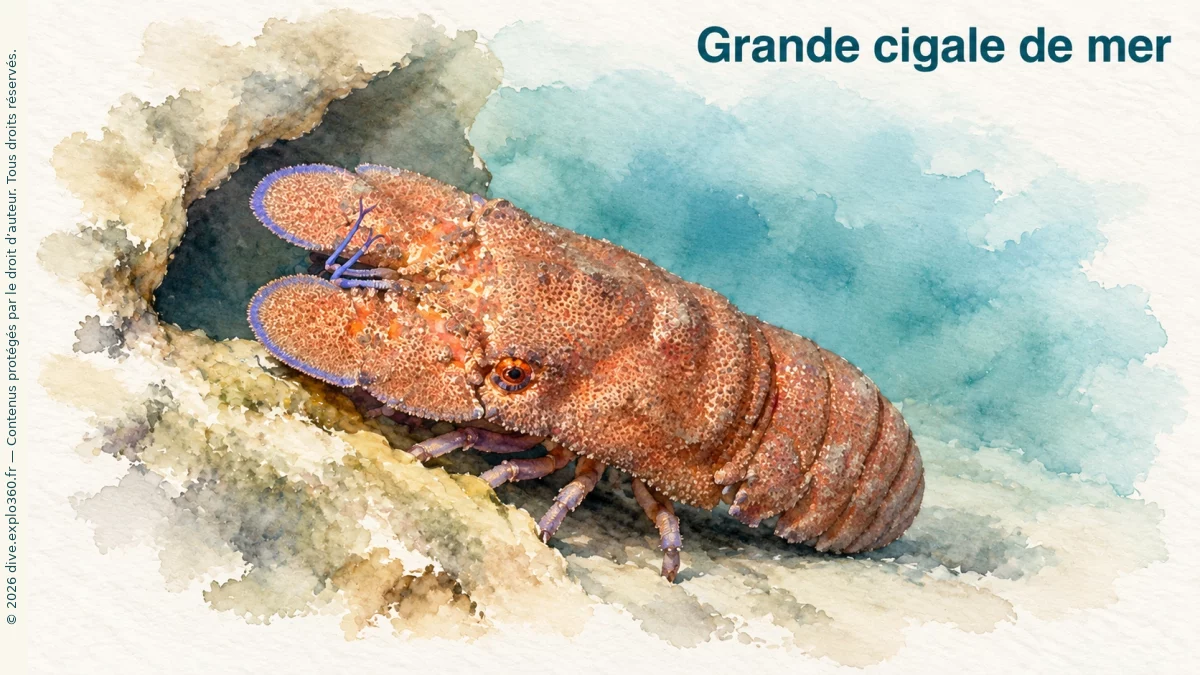
The broad, flattened body resembles a shortened spiny lobster. Its rough, granular shell is brown to reddish. Large flat antennae form two plates with violet margins in front of the head. Common length is around twenty-five to thirty centimetres, although some individuals grow considerably larger.
The abdomen is stout and jointed. The legs lack the large claws of a European lobster; females nevertheless have a small claw on the last pair. This is used in particular to tend the eggs carried beneath the body.
WHERE DOES IT LIVE?
It uses rocks, caves and fissures, from a few metres to over one hundred metres deep. An isolated slab among Posidonia seagrass can also provide refuge. It may cling under an overhang or to a cavity ceiling, almost blending into the rock.
Its range covers the Mediterranean and part of the eastern Atlantic. It is more likely to emerge at night. At some study sites, occupation of coastal shelters also changes seasonally, so comparisons should record dates and conditions.
WHAT DOES IT EAT?
It eats molluscs, including limpets and abalones, together with other invertebrates. It can also take advantage of dead animals. Its diet therefore does not depend entirely on prey it captures itself.
Lacking large claws does not prevent it from manipulating shellfish. Its legs can prise up a limpet and turn it over to expose the flesh. Leg movements and mouthparts work together during feeding.
GO FURTHER WITH AMIGANSEAU
Unlock the full profile
Deepen your knowledge with the exclusive chapters and interactive resources included in an AMIGANSEAU licence.
- HOW DOES IT REPRODUCE?
- OUR OBSERVATIONS
- ARTICLE
Also included in the full profile
- Advanced navigation between description, ecological context, observations and behaviour
- Interactive food chain to explore the species’ feeding relationships