 Habitat
 Depth
 Group
 Role
 Size
WHAT DOES IT LOOK LIKE?
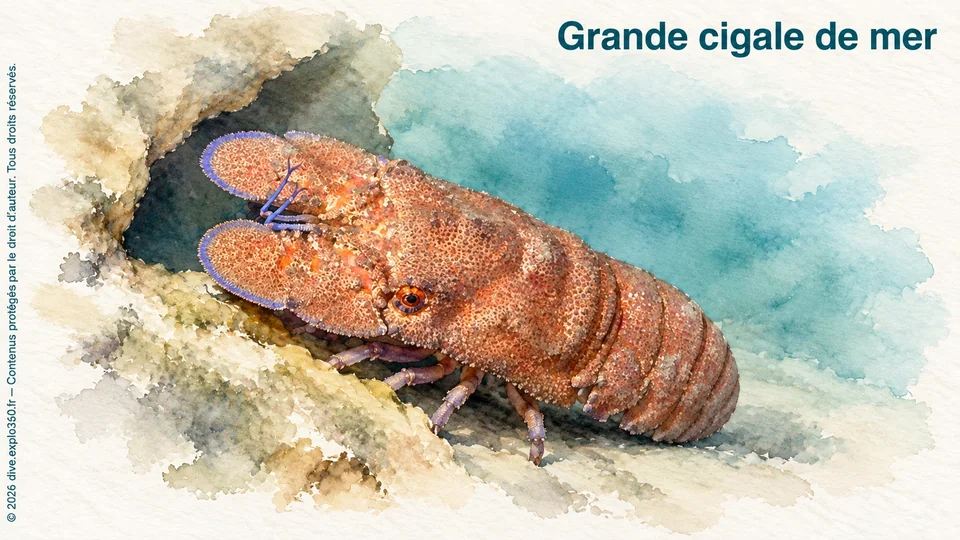
At the front of its head, two broad, flattened antennae form paddle-like structures with violet-tinged edges. Its wide, flattened body is covered by a brownish to reddish carapace with a rough, granular surface. The large abdomen is divided into clearly visible articulated segments. Unlike a clawed lobster, it has no large claws at the front of its body. Females, however, have a small claw at the tip of the last pair of walking legs.
WHERE DOES IT LIVE?
Rocky seabeds, with their crevices, caves and overhangs, provide plenty of shelter. You may also encounter it beneath an isolated slab among Posidonia seagrass. Sometimes it clings to the ceiling of a cavity, where its carapace can be difficult to distinguish from the surrounding rock.
Found from depths of just a few metres, it can live beyond 100 metres. Its range extends across the Mediterranean and part of the eastern Atlantic. Usually concealed during the day, it is more likely to leave its shelter at night.
WHAT DOES IT EAT?
Molluscs form an important part of its diet, including limpets, abalones and slipper limpets. It also eats crustaceans and may feed on animal remains.
To detach a limpet firmly attached to rock, it uses the tips of its legs as levers beneath the shell's edge. Once the mollusc has been lifted, it can turn it over to reach the soft tissues, then bring the food to its mouthparts. This handling sequence, documented in the species, shows how it can feed on prey firmly attached to a surface despite having no large claws.
GO FURTHER WITH AMIGANSEAU
Unlock the full profile
Deepen your knowledge with the exclusive chapters and interactive resources included in an AMIGANSEAU licence.
Subscribing to Dive.Explo360 means supporting a different way to discover marine life.
Our independent platform is entirely self-funded and relies solely on subscriptions. Every licence helps us continue our work, create new content, and share what we know about the marine world with as many people as possible.
Starting at €80 per year, your support makes all the difference.

 Understand the species