Habitat
 Depth
 Group
 Role
WHAT DOES IT LOOK LIKE?
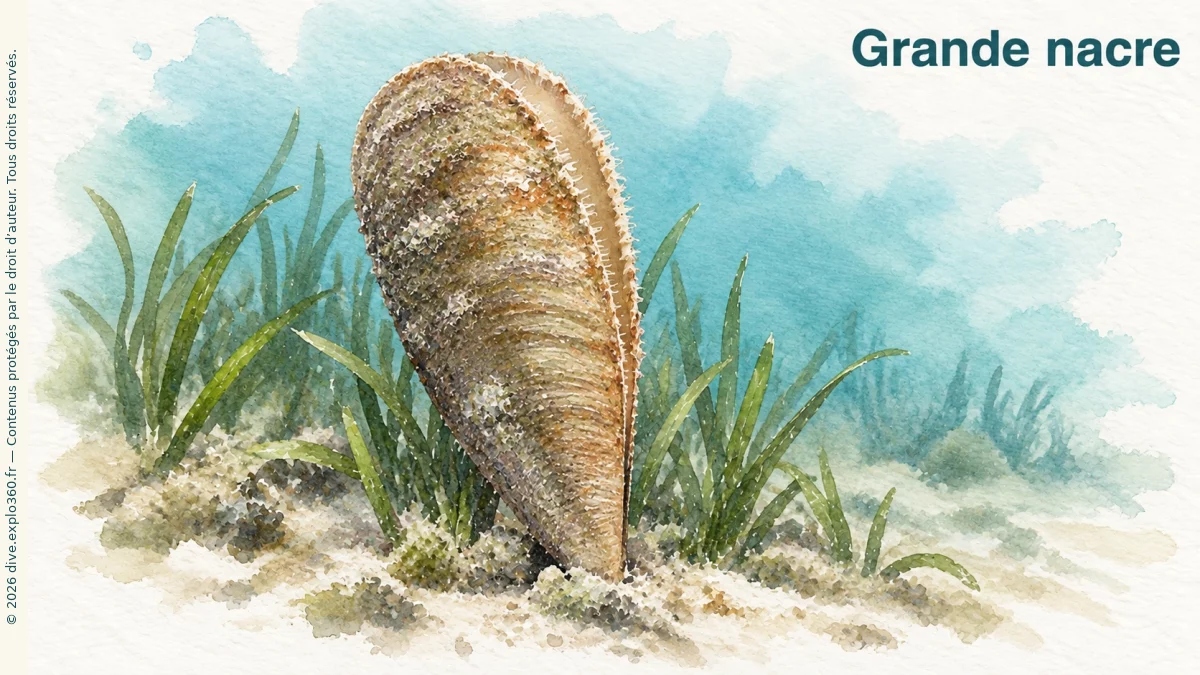
The shell of Pinna nobilis forms a long triangle with its point buried in the seabed. The broad rounded part stands upright. Some individuals exceed a metre and can live for several decades.
Young valves have small gutter-shaped projections that become less obvious in large individuals. The outside is brown and the interior pearly. The spiny fan mussel, Pinna rudis, can resemble young fan mussels, but its projections are larger and fewer.
WHERE DOES IT LIVE?
It occurs naturally in the Mediterranean on sand or sandy mud, often within Neptune-grass or eelgrass meadows. Its byssus, a bundle of strong threads, anchors it below the sediment.
The shell supports attached organisms such as algae and sea squirts. Small crustaceans, including certain shrimps, can also live between the valves.
WHAT DOES IT EAT?
It filters water to retain small particles. Planktonic organisms and organic debris form part of its diet. The gills help collect food while also allowing it to breathe.
The animal must maintain an opening for water exchange. Its position in the seabed and exposure to currents therefore influence its living conditions.
GO FURTHER WITH AMIGANSEAU
Unlock the full profile
Deepen your knowledge with the exclusive chapters and interactive resources included in an AMIGANSEAU licence.
- HOW DOES IT REPRODUCE?
- OUR OBSERVATIONS
- ARTICLE
Also included in the full profile
- Advanced navigation between description, ecological context, observations and behaviour
- Interactive food chain to explore the species’ feeding relationships