Habitat
 Depth
 Group
 Role
WHAT DOES IT LOOK LIKE?
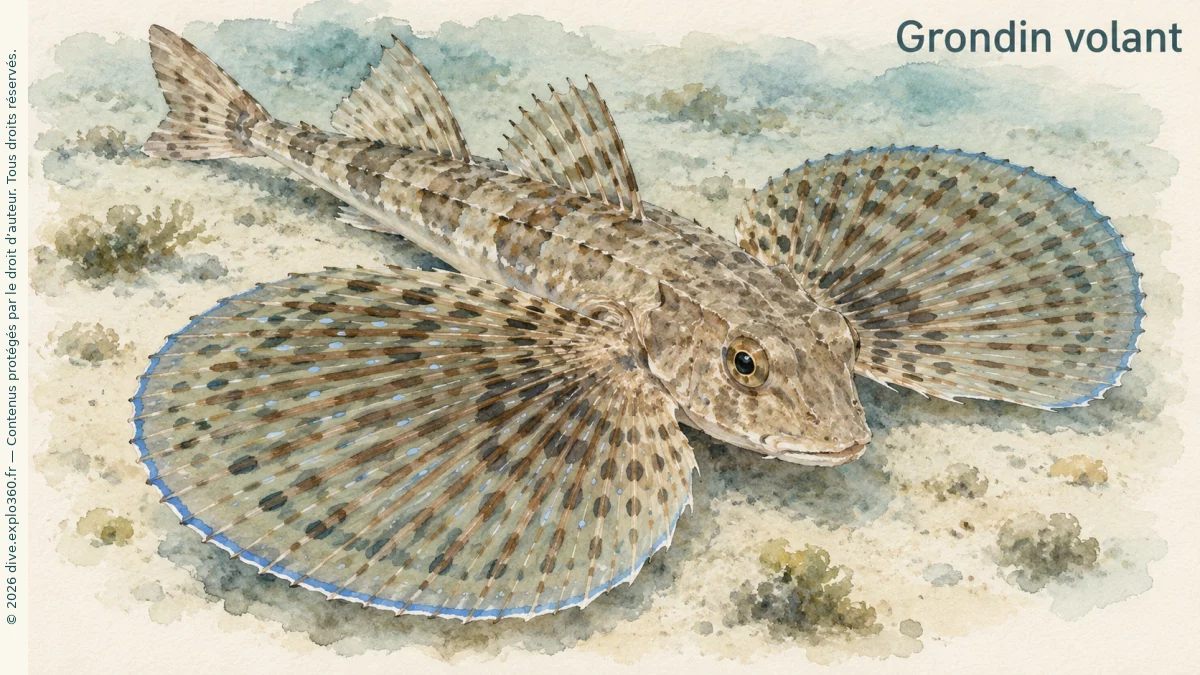
The flying gurnard has a massive head protected by bony plates and bearing spines. The elongated body narrows towards the rear. Large pectorals spread into mottled blue-edged fans, with an anterior section containing more independent rays involved in exploring the bottom. Dorsal elements are widely separated. DORIS gives an average length around 20 centimetres and a maximum of 50 centimetres. Colour and apparent width change substantially with posture.
WHERE DOES IT LIVE?
It inhabits sand and mud, sometimes in slightly brackish coastal settings. The usually described encounter interval is 15–70 metres, with shallower observations and a reported limit around 80–100 metres. Adults may be conspicuous near shore while juveniles need not use identical areas. The natural range covers the Mediterranean and regions on both Atlantic coasts, including the Caribbean.
WHAT DOES IT EAT?
Its prey includes benthic crustaceans, particularly crabs, bivalves, worms and occasionally small fish. The snout and free pectoral rays contribute to searching sediment. This close, tactile investigation connects the fish with fauna difficult to notice from the water column. DORIS also describes nocturnal movement into open water and feeding there, without reducing the importance of the seabed in encounters commonly followed by divers.
GO FURTHER WITH AMIGANSEAU
Unlock the full profile
Deepen your knowledge with the exclusive chapters and interactive resources included in an AMIGANSEAU licence.
- HOW DOES IT REPRODUCE?
- OUR OBSERVATIONS
- ARTICLE
Also included in the full profile
- Advanced navigation between description, ecological context, observations and behaviour
- Interactive food chain to explore the species’ feeding relationships