Habitat
 Depth
 Group
 Role
WHAT DOES IT LOOK LIKE?
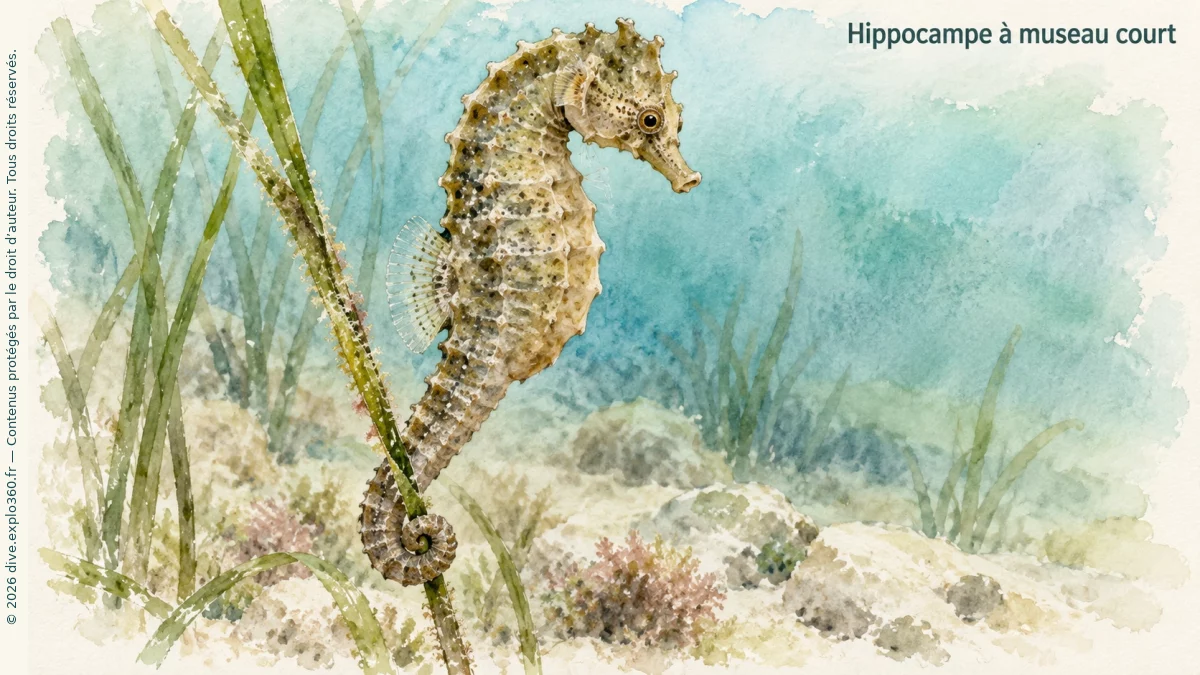
The short-snouted seahorse is a small fish with a curved neck, short tubular snout and a body supported by bony rings. Its prehensile tail curls around a support, while the small translucent dorsal fin contributes to swimming. Colours include dark shades, green and brown. Maximum length is around 12–15 centimetres. Head profile and snout proportions are more informative than an isolated colour or skin filament.
WHERE DOES IT LIVE?
It occupies lagoons and relatively sheltered coastal water over muddy sand or habitats combining relief and loose sediment. The described range extends from the surface to thirty metres. Algae, seagrass and other small objects may provide attachment. Gulf of Lion records are not restricted to lagoons. Describing it as a seahorse living exclusively in seagrass would therefore omit part of its ecology.
WHAT DOES IT EAT?
The tubular mouth sucks in small living prey. Planktonic and benthic crustaceans are among documented resources. The animal may lower its head near the sand and move slowly before rapid suction. Stillness and camouflage do not imply absence of predation. Small prey size also explains why feeding can be difficult to interpret with the unaided eye, even when the fish’s posture is clearly visible.
GO FURTHER WITH AMIGANSEAU
Unlock the full profile
Deepen your knowledge with the exclusive chapters and interactive resources included in an AMIGANSEAU licence.
- HOW DOES IT REPRODUCE?
- OUR OBSERVATIONS
- ARTICLE
Also included in the full profile
- Advanced navigation between description, ecological context, observations and behaviour
- Interactive food chain to explore the species’ feeding relationships