Habitat
 Depth
 Group
 Role
WHAT DOES IT LOOK LIKE?
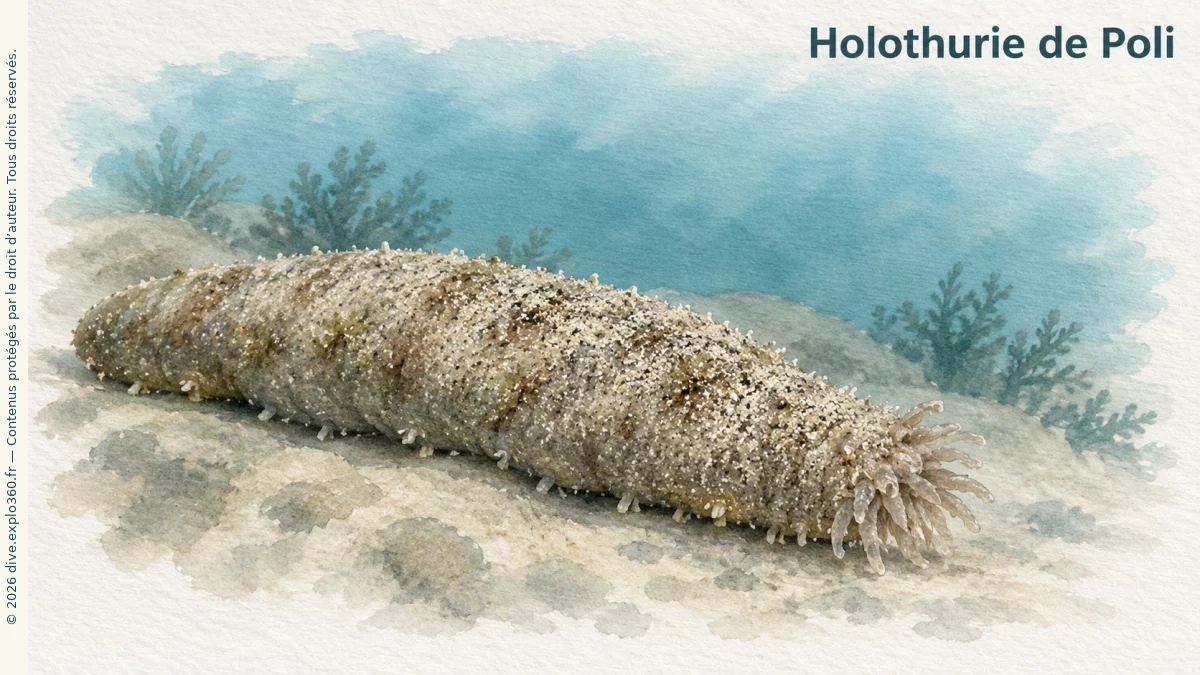
The poli’s sea cucumber has an elongated cylindrical body, grey to brown with dark mottling. Papillae, small skin projections, have pale tips; tube feet, extendable tubes contributing to adhesion and movement, are whitish.
The body may retain a film of sand and debris. Retractile mouth tentacles lie at one end and the waste outlet at the other. A contracted or covered individual does not show the species’ full variation.
WHERE DOES IT LIVE?
It occurs on mixed seabeds near rocks, in seagrass and between vegetated patches. It is found in shallow French Mediterranean waters.
Grain size describes part of the habitat. Available organic matter, water movement and oxygen conditions also help explain differences between sites.
WHAT DOES IT EAT?
Mouth tentacles bring particles inward. Ingested sediment contains organic remains, microbes and small organisms providing food. Processed deposits leave as clumps or small strings.
Particle selection and the assimilated portion differ from total swallowed volume.
GO FURTHER WITH AMIGANSEAU
Unlock the full profile
Deepen your knowledge with the exclusive chapters and interactive resources included in an AMIGANSEAU licence.
- HOW DOES IT REPRODUCE?
- OUR OBSERVATIONS
- ARTICLE
Also included in the full profile
- Advanced navigation between description, ecological context, observations and behaviour
- Interactive food chain to explore the species’ feeding relationships