Habitat
 Depth
 Group
 Role
WHAT DOES IT LOOK LIKE?
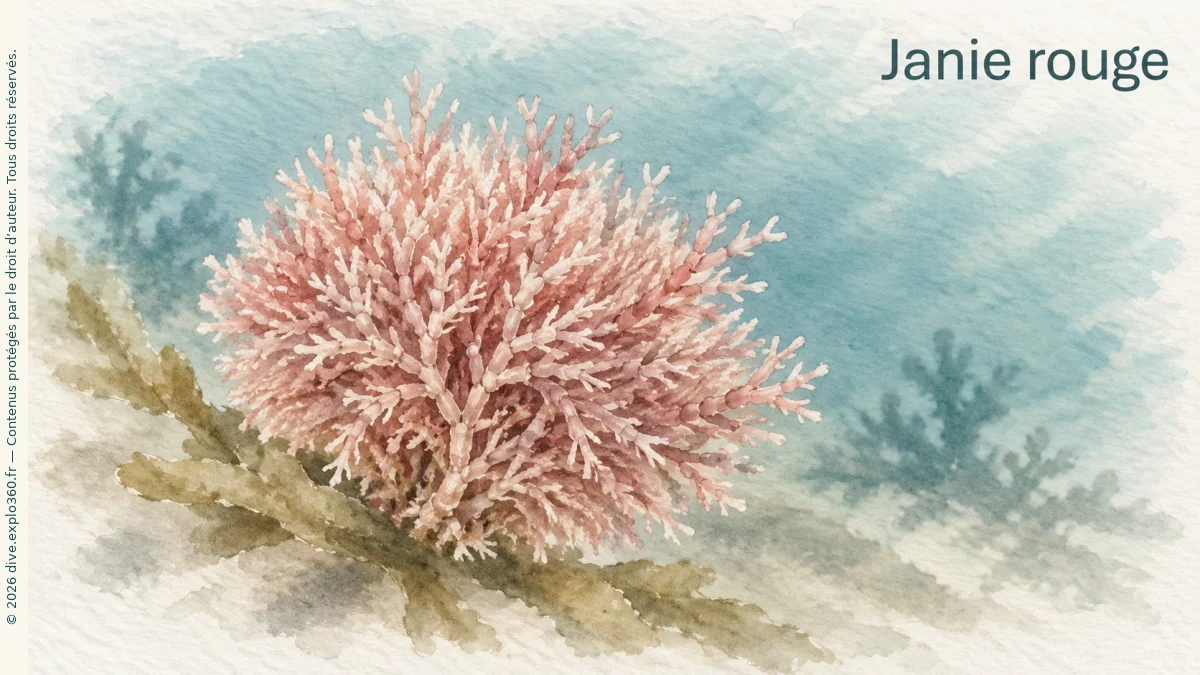
The red jania has very fine cylindrical branches, generally forking in two, grouped into pink to purplish tufts. The thallus, the algal body, consists of calcified segments separated by small joints.
Precise identification uses segment shape and conceptacles, cavities containing reproductive structures. Several Jania species look similar and cannot be separated confidently in diving photographs.
WHERE DOES IT LIVE?
It occurs in lit shallow Mediterranean water and may be epiphytic, meaning attached to other algae. This is documented along French coasts.
The association does not itself imply parasitism. The supporting alga provides a place to grow; Jania feeds through its own water exchanges and light use.
WHAT DOES IT EAT?
Photosynthesis produces organic matter using light energy and available carbon. Required mineral nutrients come from water.
Calcification, deposition of calcium carbonate in body regions, contributes rigidity. It neither replaces photosynthesis nor makes the alga equivalent to animal coral.
GO FURTHER WITH AMIGANSEAU
Unlock the full profile
Deepen your knowledge with the exclusive chapters and interactive resources included in an AMIGANSEAU licence.
- HOW DOES IT REPRODUCE?
- OUR OBSERVATIONS
- ARTICLE
Also included in the full profile
- Advanced navigation between description, ecological context, observations and behaviour
- Interactive food chain to explore the species’ feeding relationships