Habitat
 Depth
 Group
 Role
 Size
 Good to know
WHAT DOES IT LOOK LIKE?
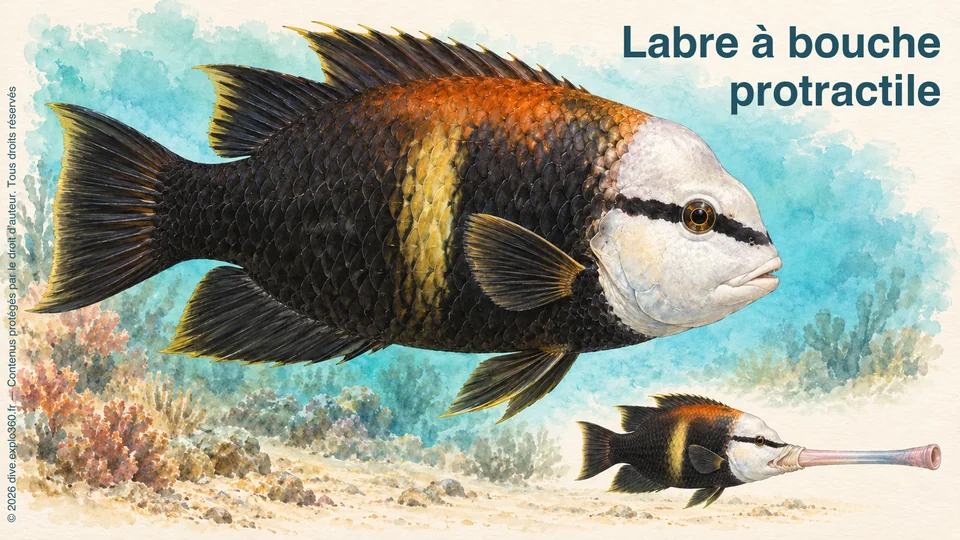
A large male has a white head crossed by a dark line near the eye, a rusty-orange upper back and a nearly black body. Females may be yellow, pale or brown, with dark-edged scales; juveniles bear pale bars. At rest, the elongated jaws fold beneath the head. They can extend far forward as a narrow tube. The largest individuals reach 54 cm.
WHERE DOES IT LIVE?
Look for this wrasse around coral-rich lagoons and outer reef slopes, from the Red Sea across the tropical Indo-Pacific. It moves among coral formations, often alone, from shallow water to depths of several tens of metres.
WHAT DOES IT EAT?
It lies in wait near the reef until a small fish or crustacean comes within reach, then suddenly thrusts its jaws forward and drawing prey into the tubular mouth. It may also follow a goatfish stirring the sand and take small animals exposed by its search.
GO FURTHER WITH AMIGANSEAU
Unlock the full profile
Deepen your knowledge with the exclusive chapters and interactive resources included in an AMIGANSEAU licence.
Subscribing to Dive.Explo360 means supporting a different way to discover marine life.
Our independent platform is entirely self-funded and relies solely on subscriptions. Every licence helps us continue our work, create new content, and share what we know about the marine world with as many people as possible.
Starting at €80 per year, your support makes all the difference.
 Understand the species