Habitat
 Depth
 Group
 Role
WHAT DOES IT LOOK LIKE?
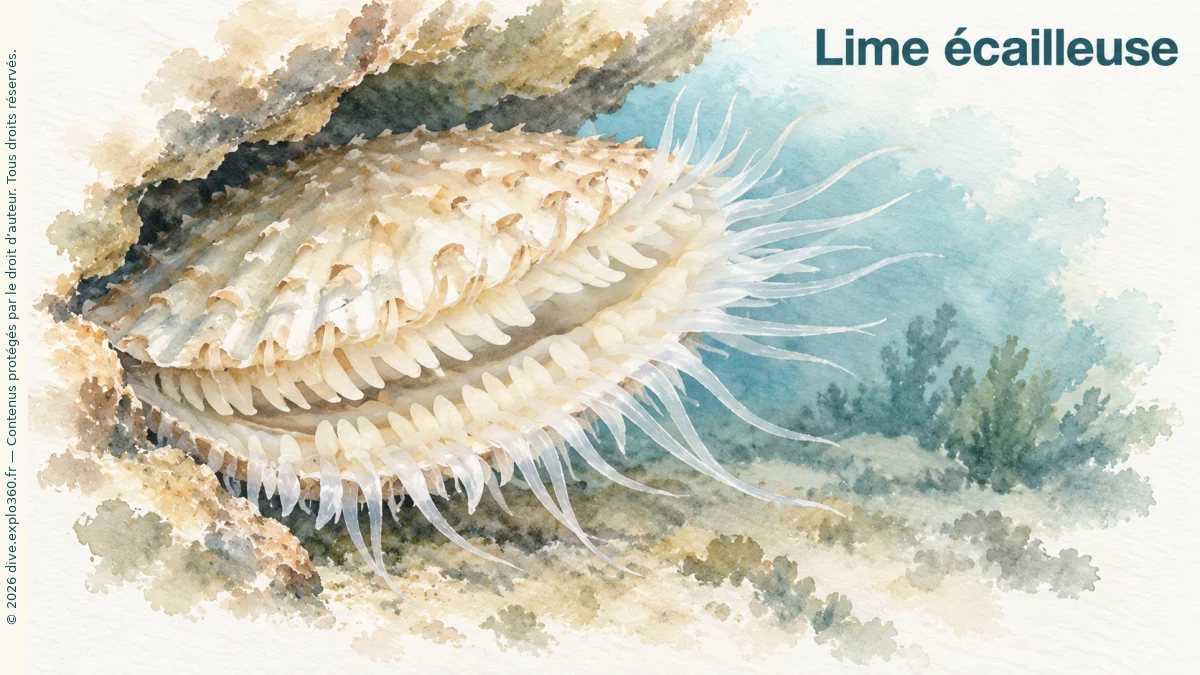
The shell of Lima lima is white, oval and elongated, usually three to seven centimetres long. Eighteen to twenty-four prominent ribs radiate across the valves and carry small scales.
Long white contractile tentacles fringe the mantle, the tissue around the body. They contrast with the orange-red tentacles of the smaller flame shell, often found in comparable shelters.
WHERE DOES IT LIVE?
It occupies cracks in rock, the undersides of stones and sometimes the matte beneath Neptune grass, the accumulated roots, stems and sediment at the meadow’s base. Encounters are possible from shallow water to around a hundred metres.
The byssus, a bundle of strong threads, generally holds the animal in its shelter. Tentacles may extend while the valves remain difficult to see.
WHAT DOES IT EAT?
It eats tiny particles present in the water. This is described as microphagous feeding: food consists of very small items rather than large prey.
Sticky tentacles help collect them. Water therefore brings resources to an animal that can remain protected between stones.
GO FURTHER WITH AMIGANSEAU
Unlock the full profile
Deepen your knowledge with the exclusive chapters and interactive resources included in an AMIGANSEAU licence.
- HOW DOES IT REPRODUCE?
- OUR OBSERVATIONS
- ARTICLE
Also included in the full profile
- Advanced navigation between description, ecological context, observations and behaviour
- Interactive food chain to explore the species’ feeding relationships