 Habitat
 Depth
 Group
 Role
 Size
WHAT DOES IT LOOK LIKE?
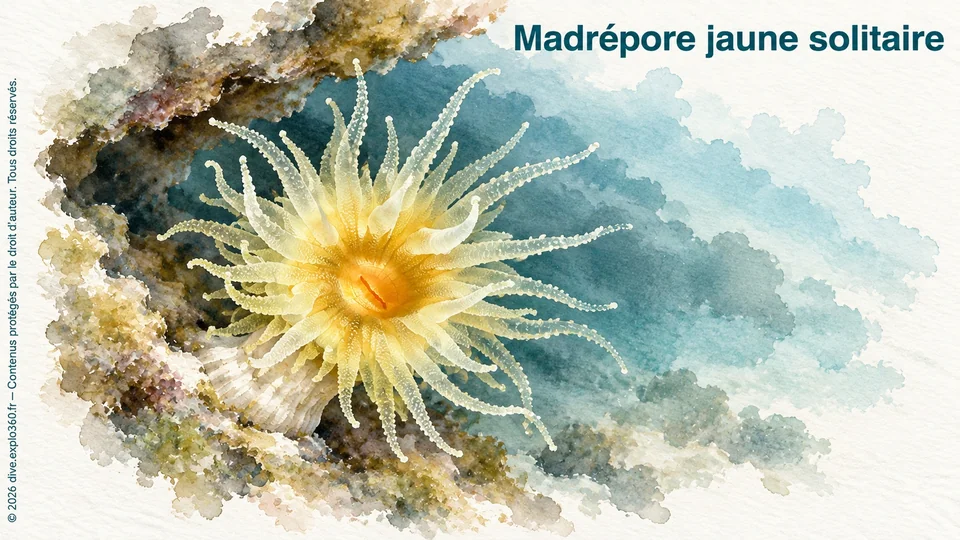
Bright yellow belongs to the polyp, the soft animal occupying the little limestone cup of the yellow solitary coral (Leptopsammia pruvoti). Open, it may reach 30 mm across, beyond a skeleton up to 17 mm in diameter. The cup base is narrowed; once the tentacles withdraw, the crown becomes almost invisible.
WHERE DOES IT LIVE?
It occupies shaded rocks beneath overhangs and along cave-entrance walls. Encounters are often at a few tens of metres, but dark shelter can hold it much shallower. Its range also includes Atlantic coasts and the southern British Isles.
Several animals can be crowded on one rock face. “Solitary” describes the usual organisation as independent polyps, not a required distance between neighbours. Distinguish it from a carpet of small interconnected yellow animals.
WHAT DOES IT EAT?
The yellow solitary coral’s polyp presents a tentacle crown that takes small waterborne prey. Crustaceans can be intercepted, immobilised by stinging cells and directed to the mouth. The coral remains attached while currents renew capture opportunities. It has no zooxanthellae, so photosynthetic products from algal partners are not a feeding route for this species. Expanded tentacles form an apparatus for taking small organisms.
GO FURTHER WITH AMIGANSEAU
Unlock the full profile
Deepen your knowledge with the exclusive chapters and interactive resources included in an AMIGANSEAU licence.
Subscribing to Dive.Explo360 means supporting a different way to discover marine life.
Our independent platform is entirely self-funded and relies solely on subscriptions. Every licence helps us continue our work, create new content, and share what we know about the marine world with as many people as possible.
Starting at €80 per year, your support makes all the difference.
 Understand the species