Habitat
 Depth
 Group
 Role
WHAT DOES IT LOOK LIKE?
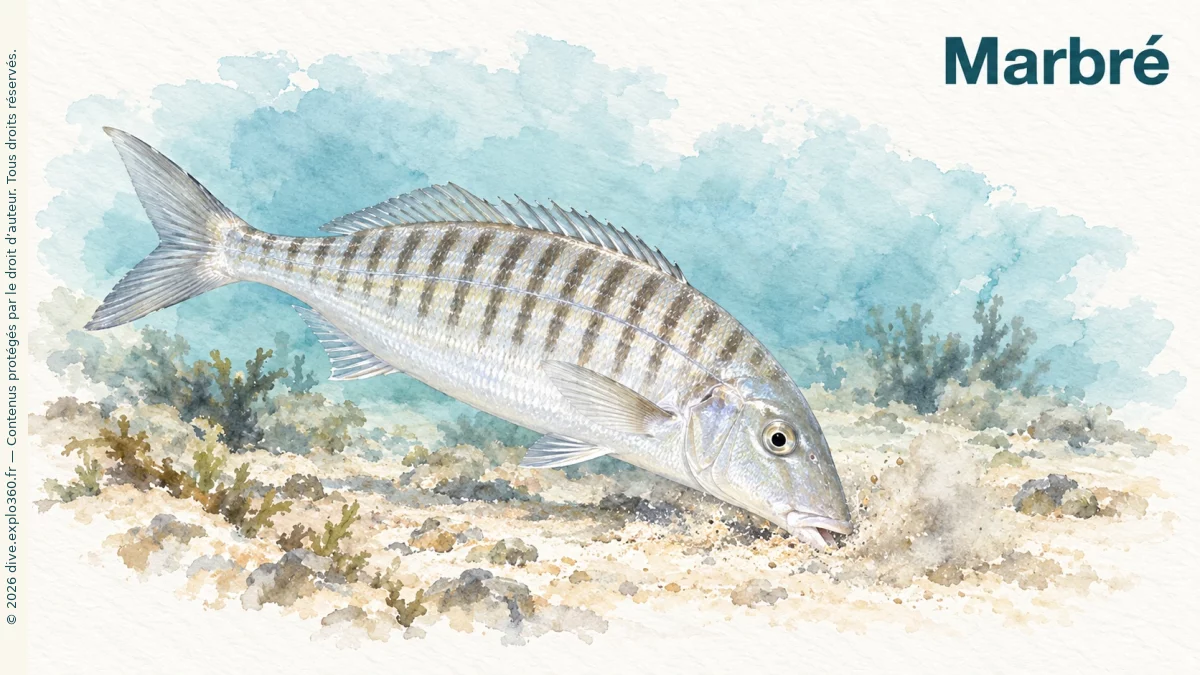
The silver body is elongated, with around fifteen dark vertical bands over the back and upper flanks. The snout is pointed and dark on top, and the tail distinctly forked. Common lengths range from roughly twenty to forty centimetres; some individuals exceed fifty.
One long dorsal fin borders the back. The head slopes gently towards a mouth that can extend forwards. The sharpsnout seabream can look similar, but its body is deeper and a dark ring surrounds the base of its tail.
WHERE DOES IT LIVE?
It mainly inhabits coastal sand, also visiting algae-covered rocks and seagrass edges. It can live from the surface to around eighty metres. Young fish particularly use shallow areas beside beaches.
Striped seabream often move in groups and may approach the shore during the warm season. They occur in the Mediterranean and other regions of the Atlantic, Red Sea and western Indian Ocean.
WHAT DOES IT EAT?
It searches the bottom for worms, crustaceans, molluscs and other small animals. Molars, broad teeth within its jaws, allow it to crush hard prey. It can feed by day and night.
The resources eaten vary between places. In a study from the northern Aegean, marine worms and bivalves, molluscs with two shell valves, were particularly well represented.
GO FURTHER WITH AMIGANSEAU
Unlock the full profile
Deepen your knowledge with the exclusive chapters and interactive resources included in an AMIGANSEAU licence.
- HOW DOES IT REPRODUCE?
- OUR OBSERVATIONS
- ARTICLE
Also included in the full profile
- Advanced navigation between description, ecological context, observations and behaviour
- Interactive food chain to explore the species’ feeding relationships