Habitat
 Depth
 Group
 Role
WHAT DOES IT LOOK LIKE?
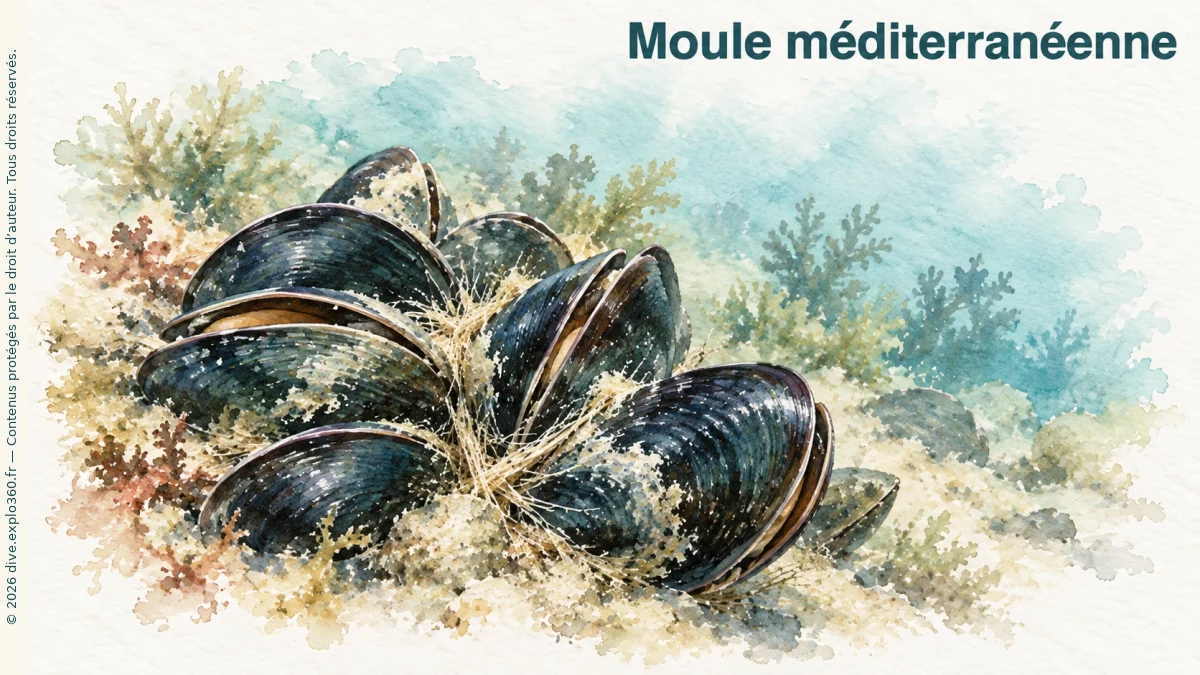
The Mediterranean mussel has a black to bluish or dark brown shell, elongated and distinctly broader at the rear. Its two valves can reach about twelve centimetres. The outline changes with growth and living conditions.
The byssus, a bundle of strong threads, emerges between the valves and attaches the mussel to its support. The mantle, the tissue producing the shell and surrounding the body, often has a purple edge. Shape alone is not always enough to distinguish it from other mussels.
WHERE DOES IT LIVE?
It lives in dense groups on shore rocks, often in wave-exposed water near the surface. It also uses ropes, submerged structures and other mussels’ shells.
Brief air exposure is possible because water is retained between the valves. The risk of drying nevertheless limits the space it can occupy outside the water.
WHAT DOES IT EAT?
It creates a current with microscopic cilia, tiny moving structures, and filters water over its gills. Particles are trapped in mucus, sorted and moved towards the mouth.
It eats phytoplankton, tiny suspended photosynthetic organisms, as well as organic debris. Unsuitable material can be rejected. The gills also provide the exchanges required for breathing.
GO FURTHER WITH AMIGANSEAU
Unlock the full profile
Deepen your knowledge with the exclusive chapters and interactive resources included in an AMIGANSEAU licence.
- HOW DOES IT REPRODUCE?
- OUR OBSERVATIONS
- ARTICLE
Also included in the full profile
- Advanced navigation between description, ecological context, observations and behaviour
- Interactive food chain to explore the species’ feeding relationships