Habitat
 Depth
 Group
 Role
WHAT DOES IT LOOK LIKE?
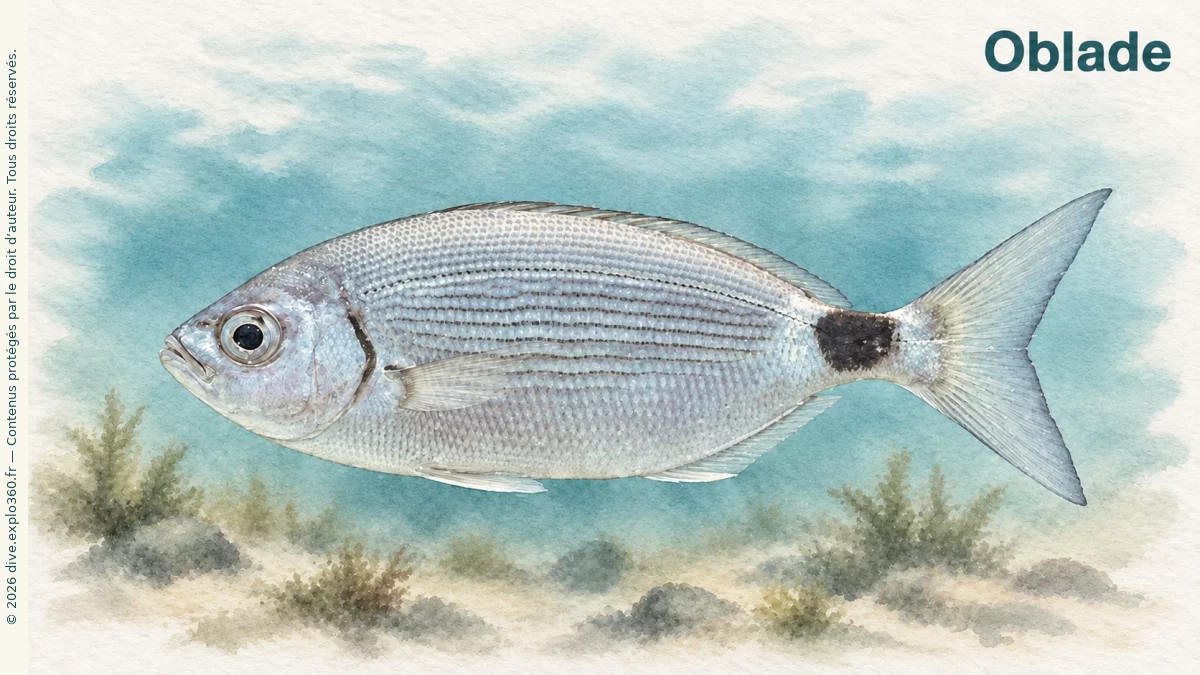
Saddled seabream have elongated, silvery-grey bodies with a bluish sheen and paler bellies. Fine dark lines run along their sides. Adults are usually 15 to 25 centimetres long.
The white-edged black patch before the tail is their clearest marking. It sits on the caudal peduncle, the narrow section linking the body to the tail. A large eye and small mouth tilted upwards complete the picture.
The dark marking near the tail can lead to confusion with white seabream. However, white seabream have deeper bodies, often marked with vertical bars, while saddled seabream are more elongated and have fine horizontal lines.
WHERE DOES IT LIVE?
Shoals frequent coastal waters above rocks and seagrass beds. Adults often swim between the surface and about twenty metres, making visits towards the bottom.
Young fish gather in very shallow rocky areas. In winter, adults may move farther offshore and into deeper water.
WHAT DOES IT EAT?
Their food is mainly small animals, although they also eat algae. In open water they catch copepods, tiny crustaceans that drift with the currents.
They find other small prey near the seabed. This part of the diet increases as they grow, so a young fish and a large adult use food resources in different proportions.
GO FURTHER WITH AMIGANSEAU
Unlock the full profile
Deepen your knowledge with the exclusive chapters and interactive resources included in an AMIGANSEAU licence.
- HOW DOES IT REPRODUCE?
- OUR OBSERVATIONS
- ARTICLE
Also included in the full profile
- Advanced navigation between description, ecological context, observations and behaviour
- Interactive food chain to explore the species’ feeding relationships