Habitat
 Depth
 Group
 Role
 Size
WHAT DOES IT LOOK LIKE?
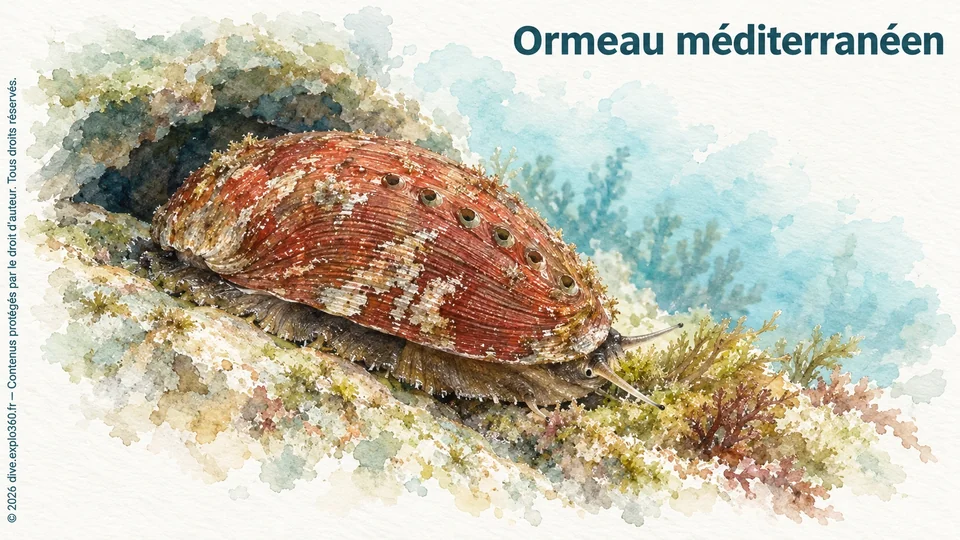
A line of perforations highlights the ear-shaped shell of the Mediterranean abalone (Haliotis tuberculata). Only the newest holes remain open. Attached organisms may hide the low, folded wall. Beneath it appears a broad foot, the fleshy lower part, accompanied by fine tentacles around the body edge.
WHERE DOES IT LIVE?
Stone undersides and crevices are characteristic daytime positions for the Mediterranean abalone. It also uses walls and some artificial surfaces, such as submerged posts. Hard surfaces and their recesses are therefore more useful places to look than exposed parts of the seabed alone.
WHAT DOES IT EAT?
The Mediterranean abalone’s food changes with size. Young animals use diatoms and small algal coverings. Larger ones gain access to red, brown or green macroalgae, with an adult preference for red algae reported. A toothed radular ribbon removes tissue against the food. Growth brings a shift from microalgae to large algae while the diet remains herbivorous.
GO FURTHER WITH AMIGANSEAU
Unlock the full profile
Deepen your knowledge with the exclusive chapters and interactive resources included in an AMIGANSEAU licence.
Subscribing to Dive.Explo360 means supporting a different way to discover marine life.
Our independent platform is entirely self-funded and relies solely on subscriptions. Every licence helps us continue our work, create new content, and share what we know about the marine world with as many people as possible.
Starting at €80 per year, your support makes all the difference.
 Understand the species