Habitat
 Depth
 Group
 Role
WHAT DOES IT LOOK LIKE?
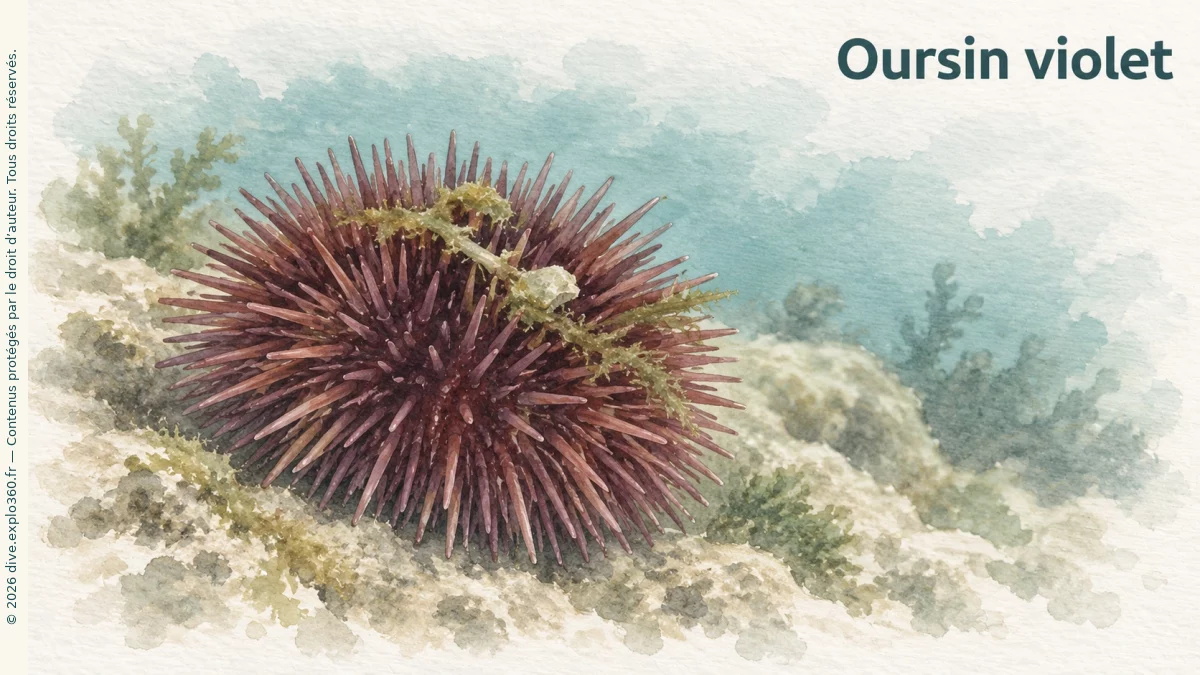
The purple sea urchin has a test, a rigid covering made of calcium carbonate plates, generally a few centimetres across. Spines are movable and colour ranges from purple to brown or olive green. Tube feet, small extendable tubes, reach between them and help with attachment and movement.
The mouth faces the seabed. Its five teeth are operated by Aristotle’s lantern, an arrangement of calcium carbonate pieces and muscles. Arbacia lixula, the black sea urchin, is a separate species, not the male of the purple sea urchin.
WHERE DOES IT LIVE?
It occurs on rocks and in Posidonia seagrass beds, mainly in shallow water. French Mediterranean observations also show individuals in hollows, where they anchor themselves and find shelter.
Distribution depends on seabed features. A site with many cavities exposes urchins differently from a bare slab, particularly to waves and predators.
WHAT DOES IT EAT?
It mainly eats algae, scraping or cutting them with its teeth. Other resources can supplement its diet, including small animals. Calling it a grazer describes its dominant activity without implying an exclusively plant-based diet.
Intense grazing can maintain areas with few large upright algae. Urchin density, access to food and predation are among the factors shaping this effect.
GO FURTHER WITH AMIGANSEAU
Unlock the full profile
Deepen your knowledge with the exclusive chapters and interactive resources included in an AMIGANSEAU licence.
- HOW DOES IT REPRODUCE?
- OUR OBSERVATIONS
- ARTICLE
Also included in the full profile
- Advanced navigation between description, ecological context, observations and behaviour
- Interactive food chain to explore the species’ feeding relationships