DIVE.EXPLO360.FRObserve, understand, share
Diver services

You can also access AMIGANSEAU diver services. Sign in to these services with your email address and pairing code.

trouve-MOIIdentify an encounterExplorariumKeep and share your dive memories
ShopAMIGANSEAU ACCESS ↗
Partners and information

Contact us

Verification code

Common pandora

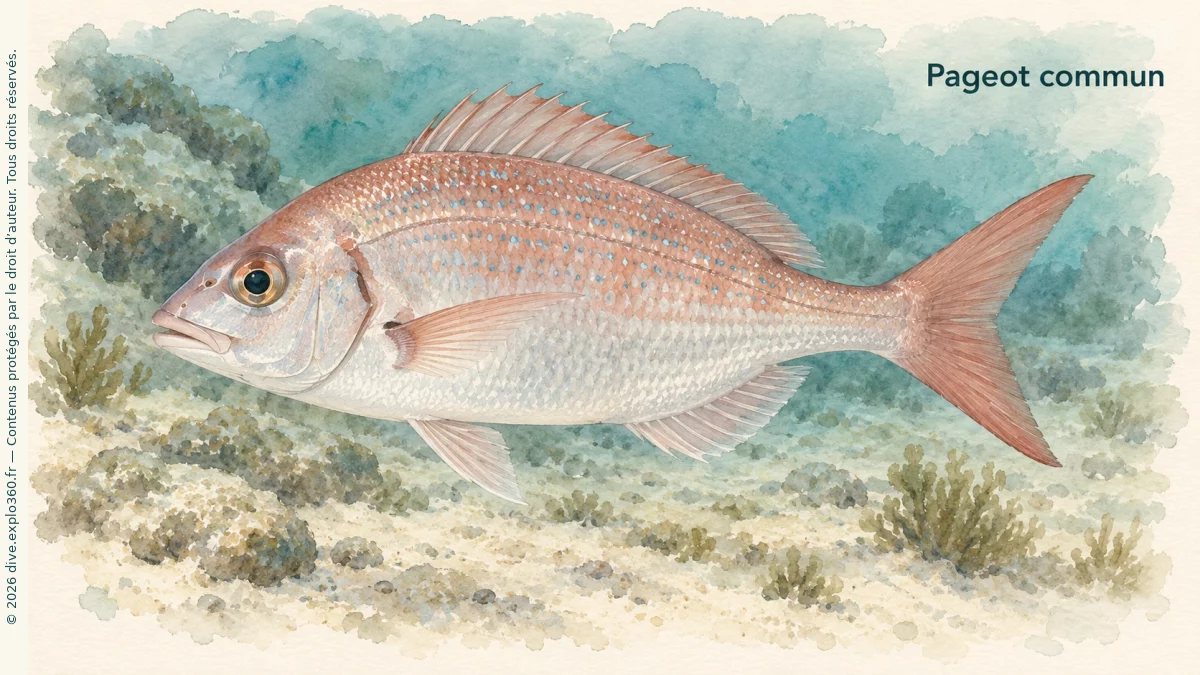
Distribution : Mediterranean, Black Sea and north-eastern Atlantic. Records include French Mediterranean shores and Marseille. Described at 5–200 m in the Mediterranean and down to 300 m in the Atlantic, often encountered at 20–100 m.

The common pandora can look familiar among the silvery fish close to the seabed. Identifying it nevertheless requires looking beyond a pink colour shared with other seabreams. Its movements between coastal sites and deeper water also help explain differences in the sizes encountered on dives.

Habitat of Common pandora Habitat
Sand, Rocky habitat, Gravel, Detrital bottom
Depth range of Common pandora Depth
5-300 m
Biological group of Common pandora Group
Ecological role of Common pandora Role
Predator

📏 Size

Often 15–30 cm; up to 60 cm

WHAT DOES IT LOOK LIKE?

The common pandora has an oval, compressed body, an almost straight forehead and a pointed snout. The eye is noticeably shorter than the snout. Its pinkish silver colour may include small blue dots on the upper body, a red mark on the upper edge of the gill cover and reddish colouring at the pectoral base. The forked tail lacks the white tips of the red porgy. Common lengths are 15–30 centimetres, although larger individuals occur.

WHERE DOES IT LIVE?

Habitats include rock, gravel, sand and mud, with an affinity for loose ground. It swims near the substrate without necessarily resting on it. It lives at depths of 5–200 metres in the Mediterranean and down to 300 metres in the Atlantic. Young fish generally occur closer to shore than adults, while deeper movement can take place during colder periods.

WHAT DOES IT EAT?

The diet is omnivorous with a substantial animal component. Worms, small crustaceans, molluscs and small fish are documented. Pointed front teeth and rows of posterior molars correspond to several ways of handling food. Benthic resources connect the fish with bottom communities, while movement allows it to inspect different surfaces. A fish tilting towards sediment may be searching for food, but that posture does not always reveal what is swallowed.

GO FURTHER WITH AMIGANSEAU

Unlock the full profile

Deepen your knowledge with the exclusive chapters and interactive resources included in an AMIGANSEAU licence.

Choose my licence
  • HOW DOES IT REPRODUCE?
  • OUR OBSERVATIONS
  • ARTICLE

Also included in the full profile

  • Advanced navigation between description, ecological context, observations and behaviour
  • Interactive food chain to explore the species’ feeding relationships
An active licence gives access to enriched profiles and AMIGANSEAU exploration tools.
Common pandora

🧠 Understand the species

What is this species’ ecological role?

AMIGANSEAU Explorer Premium

Access enriched species profiles with advanced content (audio, infographics and detailed articles).

Explore all species easily through a single interface.

Enjoy a smooth, fast learning experience suited to every level.

🔒 The full profile is available with a paid subscription only.

Discover licences

POURSUIVRE L’EXPLORATION

Explore further

ArticleTHE SECRETS OF SANDRead the article →JourneysJourney into maerl and sandDiscover → →ArticleWHAT IF IT ALL HAPPENED UNDERWATER?Read the article →