 Habitat
 Depth
 Group
 Role
 Size
 Precautions
WHAT DOES IT LOOK LIKE?
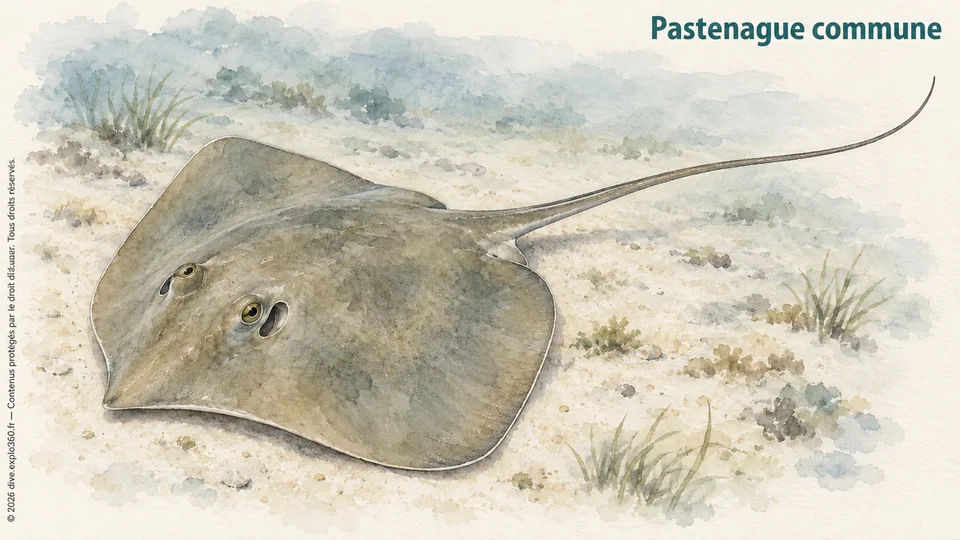
The smooth back, without large bumps, provides a first feature of the common stingray (Dasyatis pastinaca). Its diamond-shaped disc, the flattened body, has a pointed snout and flexible edges. Greyish to brownish above, it is pale underneath. A very long tail, armed with a serrated spine, extends the outline without a terminal fin.
WHERE DOES IT LIVE?
The range includes the Mediterranean and eastern Atlantic. Coastal sand, sandy mud and some sheltered estuaries provide habitat. It is often found between 5 and 60 m and can also live at greater depths. These summaries do not predict a sighting at every depth. Local substrate, shelter and conditions matter alongside a maximum depth figure.
WHAT DOES IT EAT?
Beneath the common stingray’s disc, the mouth is positioned to take animals against the seabed. Crustaceans, including crabs and shrimps, are important foods; small flatfish are also eaten. The ray can remain concealed in sand before taking nearby prey. Once held in place, the catch is processed by the jaws and teeth, including parts protected by armour.
GO FURTHER WITH AMIGANSEAU
Unlock the full profile
Deepen your knowledge with the exclusive chapters and interactive resources included in an AMIGANSEAU licence.
Subscribing to Dive.Explo360 means supporting a different way to discover marine life.
Our independent platform is entirely self-funded and relies solely on subscriptions. Every licence helps us continue our work, create new content, and share what we know about the marine world with as many people as possible.
Starting at €80 per year, your support makes all the difference.
 Understand the species