Habitat
 Depth
 Group
 Role
 Average size
 Good to know
WHAT DOES IT LOOK LIKE?
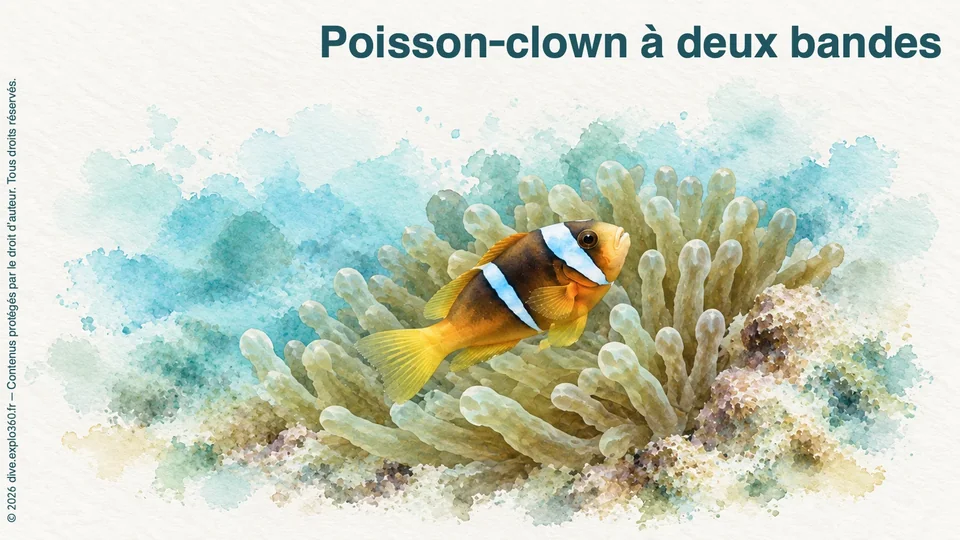
Two pale bars define the two-band anemonefish (Amphiprion bicinctus): one behind the eye and another across the middle of the flank. Both stand out broadly against the body’s brown and orange shades.
The tail is yellow. The strength of the colours differs between individuals, while the arrangement of the two bars remains the same.
WHERE DOES IT LIVE?
To locate the two-band anemonefish on a Red Sea reef, the host anemone is the key feature. The fish remains associated with this refuge and the water immediately around it. Its habitat can be described at two scales: the reef and the much smaller area occupied by the anemone.
WHAT DOES IT EAT?
Water passing around the anemone carries food for the two-band anemonefish. Its documented menu is based on zooplankton, particularly copepods and tunicate larvae. Many of these tunicates later become attached animals, but they are eaten during their free-living larval stage. Feeding targets very small prey, taken quickly into the mouth.
GO FURTHER WITH AMIGANSEAU
Unlock the full profile
Deepen your knowledge with the exclusive chapters and interactive resources included in an AMIGANSEAU licence.
- HOW DOES IT REPRODUCE?
- OUR OBSERVATIONS
- ARTICLE
Also included in the full profile
- Advanced navigation between description, ecological context, observations and behaviour
- Interactive food chain to explore the species’ feeding relationships
- Infographic and illustrated summary profile
 Understand the species